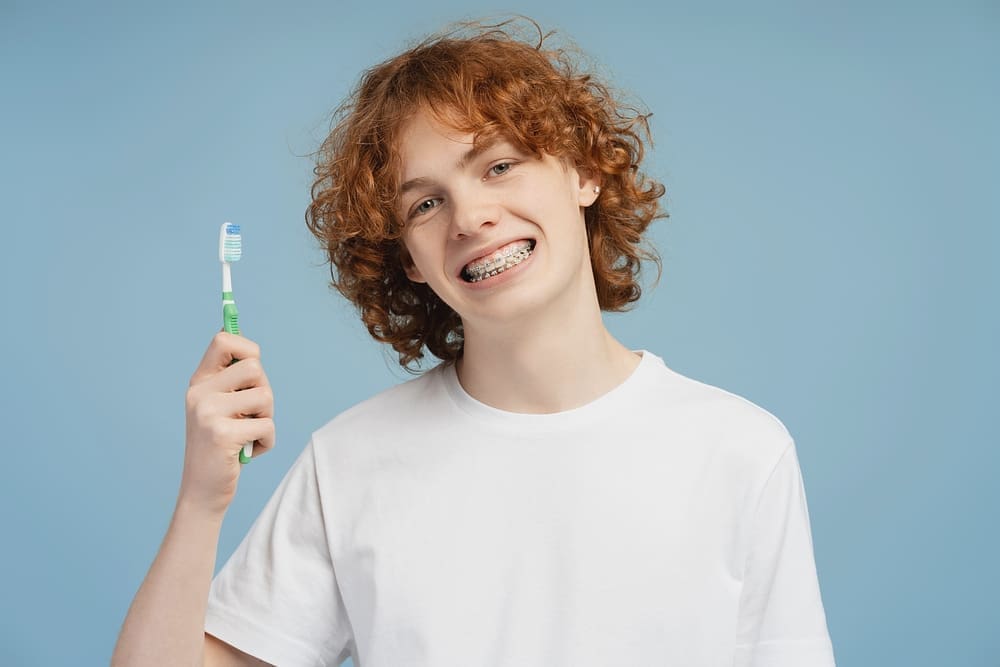
Short answer. The best toothbrush for braces is the one you use for two to three minutes around every bracket. In trials of patients in braces, electric and manual toothbrushes removed about the same amount of plaque, though some reviews find slightly healthier gums with electric brushes. The bigger difference comes from cleaning between the teeth once a day with an interdental brush, floss or a water flosser. Choose soft bristles, use fluoride toothpaste, and replace the brush or head every three months or sooner.
By Rodrigo F. Viecilli, DDS, PhD, board-certified orthodontist at Limestone Hills Orthodontics in Austin, TX, who has treated more than 5,000 patients.
Electric or manual toothbrush with braces?
For people without braces, the evidence favors electric brushes. A Cochrane review of 56 trials found that powered toothbrushes removed 11% more plaque over one to three months and 21% more after three months, with 6% and 11% less gum inflammation.
With braces, the advantage shrinks. A 2020 review of five trials in patients with fixed braces found no significant difference in plaque or gum inflammation after four and eight weeks. A 2017 review found a small short-term benefit for the gums with powered brushes, based on low-quality evidence, and no type of electric brush was clearly better than another. In a crossover trial, children and adults in braces removed about three quarters of their plaque with either kind of brush when they brushed for close to three minutes.
The American Dental Association puts it simply: either manual or powered brushes can be used effectively, and powered brushes may be easier for people with braces or limited dexterity. An electric brush is worth buying if its timer and steady motion make you brush longer and more carefully. If you brush well with a manual brush, you lose nothing.
| Brush | What the evidence shows | Good choice for |
|---|---|---|
| Manual, soft bristles, small head | Removed about as much plaque as electric brushes in braces trials when used well | Everyone; the cheapest option, and the one to carry for school or work |
| Electric, oscillating-rotating (small round head) | The most studied type; more plaque removed than manual brushes in people without braces | Patients who rush, children, and anyone who likes a built-in timer |
| Electric, sonic (side-to-side) | Also removed more plaque than manual brushes in single-brushing studies | Patients who prefer a head shaped like a manual brush |
| Orthodontic head with a V-shaped trim | Shorter middle bristles ride over the brackets while the outer rows clean above and below them; not tested head to head in the trials above | A good first head with new braces |
| Single-tuft brush | A small round tuft for bracket edges, the gum line and the backs of the last molars; not tested head to head in the trials above | Spots the main brush misses |
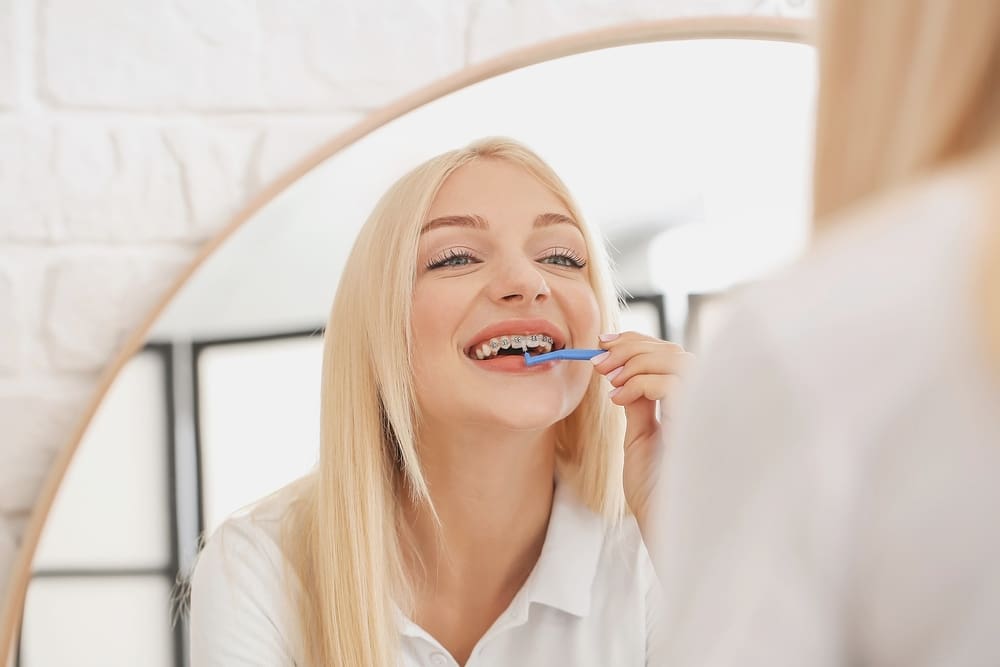
Cleaning between the teeth: interdental brushes, floss or a water flosser
A toothbrush cannot reach the space under the wire and between the teeth, which is where plaque sits longest. Every option below helps; the best one is the one you will use daily.
| Tool | What trials show | How to use it |
|---|---|---|
| Interdental brushes | In a trial of 110 patients in braces, interdental brushes reduced plaque whatever the head design. Patients preferred a short curved handle, which hurt less and reached behind the wire more easily | Slide under the wire and between the brackets, a few strokes per space |
| Water flosser with an orthodontic tip | In a four-week trial of 106 teenagers in braces, a daily water flosser plus a manual brush cut plaque and bleeding more than floss plus a brush or a brush alone. A review of 16 trials found water flossers reduce bleeding between the teeth about as well as floss, and people stick with them more | Trace the gum line and the brackets once a day, low pressure at first |
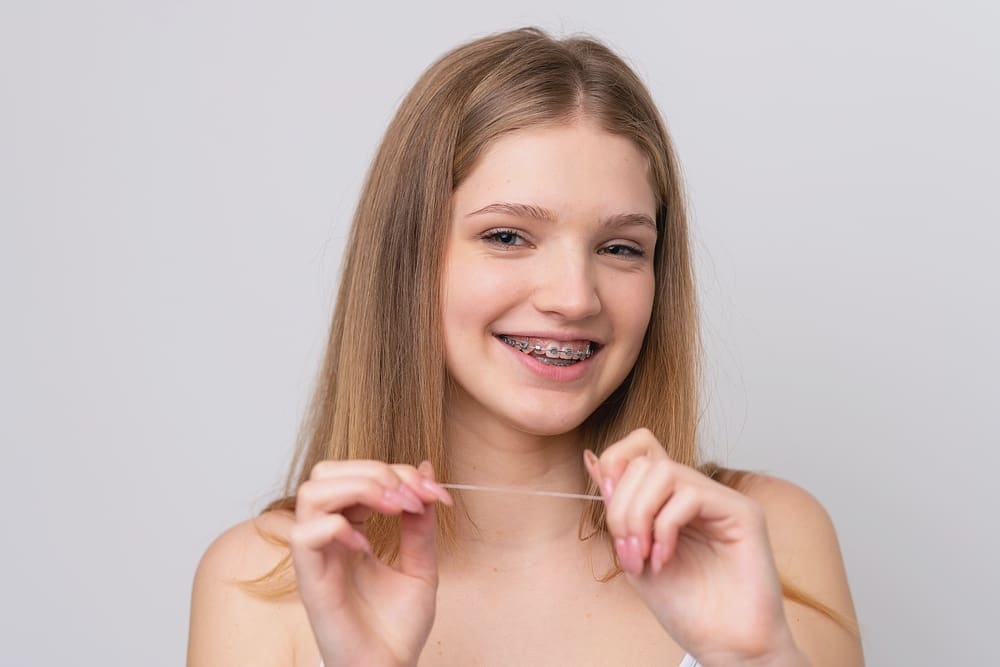
| Floss with a threader or orthodontic floss | Floss plus a brush beat a brush alone in the same teenage trial | Thread under the wire, then floss each side of the contact; see how to floss with braces |
The cost of skipping this step shows up when the braces come off. In pooled studies, about 46% of patients develop new white spots during treatment, mostly along the gum line and around brackets; see white spots after braces.
Toothpaste and rinses
Use a fluoride toothpaste twice a day. For patients at high risk of white spots, a prescription toothpaste with 5,000 ppm fluoride prevented about a third of new spots in a trial of 424 teenagers, although a Cochrane review rates that evidence as low certainty. A rinse does not replace brushing and cleaning between the teeth. Ask your orthodontist or dentist whether a prescription product makes sense for you.
A simple kit for braces
- A soft toothbrush or an electric brush with a small round or orthodontic head.
- Interdental brushes in two or three sizes.
- A water flosser or floss threaders for under the wire.
- Fluoride toothpaste.
- A travel toothbrush for school, work or after lunch out.
- Orthodontic wax for any bracket that rubs.
The daily routine, step by step, is in how to brush with braces and how to clean braces, and quick fixes for trapped food are in how to get food out of braces.
When to replace the brush or head
The American Dental Association recommends a new toothbrush every three to four months, or sooner when the bristles are visibly matted or frayed, because worn bristles clean less well. Brackets fray bristles faster than smooth teeth, so with braces expect to replace the brush or head closer to every three months, and look at it every few weeks.
Toothbrush and flosser questions, answered
Is an electric toothbrush better for braces?
Not by much. In trials of patients in braces, electric and manual brushes removed about the same amount of plaque, and some reviews found a small short-term benefit for the gums with electric brushes. An electric brush helps most if its timer and motion make you brush longer and more carefully.
Can an electric toothbrush damage braces?
Not when it is used gently. Guide the head slowly along the gum line and around each bracket and let the brush do the work. Pressing hard or knocking the head against brackets wears out the bristles faster. If a bracket comes loose, see what to do about a broken bracket.
Is a water flosser better than floss with braces?
It is at least as good for most people and much easier around wires. In a four-week trial of teenagers in braces, a water flosser removed more plaque than floss, and a review of 16 trials found water flossers reduce bleeding between the teeth about as well as flossing.
Do you need a special orthodontic toothbrush?
No. A soft brush with a small head works if you angle it above and below the brackets. An orthodontic head with a V-shaped trim and a single-tuft brush make the job easier, especially in the first weeks with braces.
How often should you replace your toothbrush with braces?
About every three months, and sooner when the bristles look splayed. The American Dental Association recommends every three to four months for everyone, and brackets wear bristles out faster than smooth teeth.
Limestone Hills Orthodontics is on RM 2222 in Northwest Austin. The first visit is free for new patients who have not been in orthodontic treatment in the last 12 months. Book a free orthodontic consultation or call (512) 720-6399.
Sources. Yaacob M, Worthington HV, Deacon SA, et al. Powered versus manual toothbrushing for oral health. Cochrane Database Syst Rev. 2014;(6):CD002281. doi:10.1002/14651858.CD002281.pub3. ElShehaby M, Mofti B, Montasser MA, Bearn D. Powered vs manual tooth brushing in patients with fixed orthodontic appliances: a systematic review and meta-analysis. Am J Orthod Dentofacial Orthop. 2020;158(5):639-649. doi:10.1016/j.ajodo.2020.04.018. Al Makhmari SA, Kaklamanos EG, Athanasiou AE. Short-term and long-term effectiveness of powered toothbrushes in promoting periodontal health during orthodontic treatment: a systematic review and meta-analysis. Am J Orthod Dentofacial Orthop. 2017;152(6):753-766.e7. doi:10.1016/j.ajodo.2017.09.003. Koretsi V, Klinke R, Herreiner P, et al. Duration of toothbrushing with fixed appliances: a randomized crossover clinical trial. Eur J Orthod. 2022;44(3):252-257. doi:10.1093/ejo/cjab075. Elkerbout TA, Slot DE, Rosema NAM, Van der Weijden GA. How effective is a powered toothbrush as compared to a manual toothbrush? A systematic review and meta-analysis of single brushing exercises. Int J Dent Hyg. 2020;18(1):17-26. doi:10.1111/idh.12401. Bock NC, von Bremen J, Kraft M, Ruf S. Plaque control effectiveness and handling of interdental brushes during multibracket treatment: a randomized clinical trial. Eur J Orthod. 2010;32(4):408-413. doi:10.1093/ejo/cjp088. Sharma NC, Lyle DM, Qaqish JG, et al. Effect of a dental water jet with orthodontic tip on plaque and bleeding in adolescent patients with fixed orthodontic appliances. Am J Orthod Dentofacial Orthop. 2008;133(4):565-571. doi:10.1016/j.ajodo.2007.12.008. Edlund P, Bertl K, Pandis N, Stavropoulos A. Efficacy of power-driven interdental cleaning tools: a systematic review and meta-analysis. Clin Exp Dent Res. 2023;9(1):3-16. doi:10.1002/cre2.691. Sonesson M, Twetman S, Bondemark L. Effectiveness of high-fluoride toothpaste on enamel demineralization during orthodontic treatment: a multicenter randomized controlled trial. Eur J Orthod. 2014;36(6):678-682. doi:10.1093/ejo/cjt096. American Dental Association. Toothbrushes, last updated August 2026.