
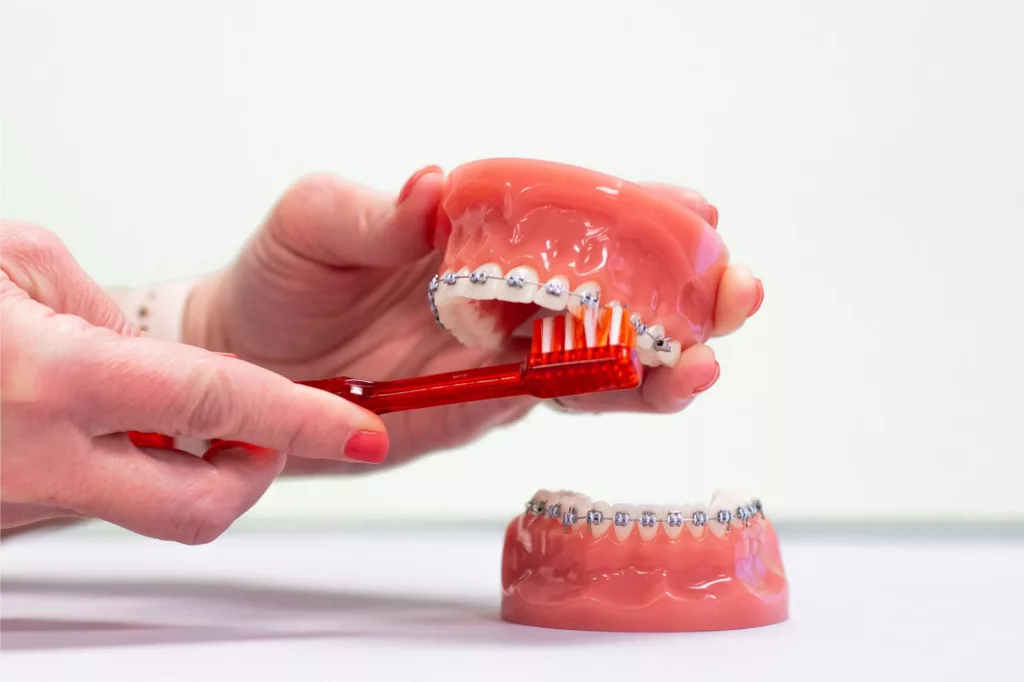
Short answer. Brushing with braces uses the modified Bass technique adapted for brackets: a soft-bristle toothbrush held at 45 degrees to the gumline, small circles, 10 seconds per pair of teeth, two minutes total. The technique covers three surfaces around every bracket (above toward the gumline, the bracket face directly, below toward the biting edge) and starts at the gumline above each bracket, because the bracket creates a shadow zone where plaque sits longest. An electric toothbrush with a sensitive setting and a 2-minute timer enforces both angle and time more reliably than most hand brushing. The full braces hygiene protocol (flossing, proxa-brush, water flosser, weekly deep clean) lives at How to Clean Braces; this guide is the brushing deep-dive.
Across roughly 5,000 cases treated at Limestone Hills Orthodontics, Dr. Viecilli sees a consistent biomechanical pattern: the modified Bass technique applied to braces patients is fundamentally different from the technique for teeth without brackets. The 45-degree angle starts at the gumline above each bracket, not at the bracket face directly, because plaque sits at the gumline contact point where the bracket creates a shadow zone. The bracket body and the archwire physically block saliva-rinse and toothbrush bristles from clearing the narrow strip of enamel between the bracket and the gum margin. That strip is where white-spot lesions develop almost universally if cleaning is inadequate.
Patients who learn the gumline-first sweep and the 3-surface-per-bracket rule in the first two weeks of treatment eliminate the white-spot lesion risk at braces removal almost entirely. At Limestone Hills, the technique walk-through happens twice in the first 30 days: once at the bonding appointment with a hand mirror, and again at the 1-week checkup before plaque starts hardening. The motor pattern locks in within about three weeks of correct repetition.
The 45-Degree Gumline Sweep and the 3-Surface-Per-Bracket Rule
The Bass technique is the standard toothbrushing method taught in dental hygiene programs: a soft-bristle brush held at 45 degrees to the gumline, with small circular motions that work the bristle tips into the gum-tooth junction. The braces modification changes which surface the brush starts on and what surfaces it covers per bracket.
The starting position is the gumline directly above each bracket, not the bracket face. With the brush head angled at 45 degrees toward the gum margin, the bristle tips contact the narrow strip of enamel between the bracket body and the gum tissue. Small circles work the bristles along that strip for about 3 seconds before the brush sweeps down across the bracket face toward the biting edge. Brushing straight at the bracket face leaves the gumline strip untouched; the correct motion is gumline-first, sweep-down second.
Every bracket has three surfaces the brush must reach. Skipping any one leaves a predictable plaque footprint that becomes either gum inflammation, decalcification, or white-spot lesions at the end of treatment.
- Surface 1: the gumline above the bracket. The shadow zone where the bracket blocks saliva-rinse and plaque accumulates fastest. Brush at 45 degrees angled toward the gum margin, small circles for 3 seconds per bracket.
- Surface 2: the bracket face and the bracket slot. The front of the bracket where the archwire passes. Plaque accumulates in the bracket-slot corners and along the wings. Light pressure, small circles for 2 seconds per bracket; the bristles fan into the slot.
- Surface 3: the gumline below the bracket. The strip of enamel between the bracket body and the biting edge. The same shadow-zone effect with the angle reversed: 45 degrees toward the biting edge, 3 seconds per bracket.
The order is non-negotiable. Starting at the bracket face before the gumline drags plaque onto the gumline strip and leaves it there. Total time runs about 6 seconds per bracket, 10 seconds per pair of teeth, and about 2 minutes for a full 20-bracket mouth, which matches the ADA brushing-time recommendation. Inside surfaces get the same 3-surface rule with the brush held vertically. Tongue-side surfaces are the most commonly skipped and the most commonly flagged at adjustment appointments.

Brush Selection: Electric vs Manual and Bristle Patterns
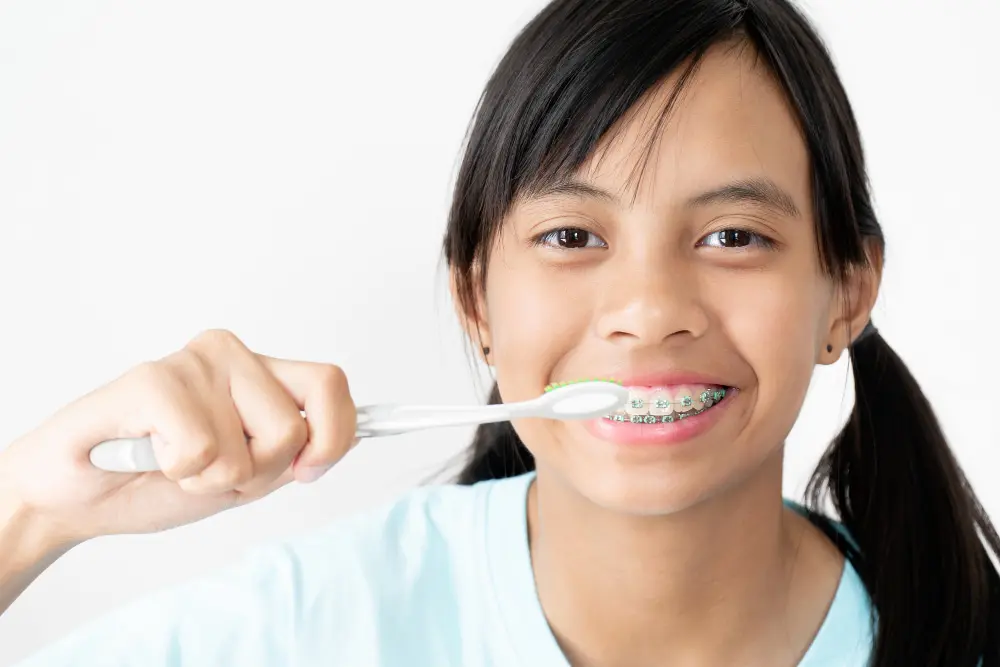
The practice recommends an electric toothbrush with a sensitive setting and a built-in 2-minute timer as the first option, with a soft-bristle manual brush plus a separate phone timer as the equally-effective backup. The choice depends on consistency, not cleaning quality.
The electric wins on three counts: the head motion reaches around bracket edges more evenly than most hand technique, the sensitive setting protects the bracket adhesive, and the timer enforces the full brushing time. Patients who switch see lower plaque scores at the next adjustment for the first 60 days; the gap closes as manual-brush patients improve their technique. Oscillating-rotating heads (Oral-B) and sonic heads (Philips Sonicare) both work.
Brush head replacement runs every 2 to 3 months, or sooner when the bristles splay outward. Braces patients wear out heads faster than patients without brackets; a 4-pack stored in the bathroom drawer prevents stretching a worn head for an extra month. The manual-brush option still works for patients who prefer it: adult-size soft bristles for teens and adults, child-size for kids under about age 11.
Bristle patterns vary across the orthodontic-care category, and not every pattern fits braces equally.
| Pattern | How it reaches brackets | Best for |
|---|---|---|
| Flat-trim soft | Even bristle height; reaches the 3 surfaces in separate passes with the modified Bass angle. | Patients comfortable with the gumline-first technique; most affordable option. |
| V-trim orthodontic | Taller bristles along the sides, shorter in the middle; the V channels the bracket and reaches both gumline strips in one pass. | Kids learning the technique; patients wanting a single-pass approach. |
| Sulcus-cleaning angled | Bristles cut at an angle; reaches the gumline strip aggressively even with imperfect technique. | Patients with a history of gum inflammation pre-treatment. |
| Electric oscillating or sonic | Round or oval head with high-frequency motion; clears the bracket face evenly when paced correctly. | Consistency-first patients; anyone with manual dexterity limits. |
Brand names matter less than bristle pattern and softness. Any soft or extra-soft head in any of the four patterns clears plaque effectively with correct technique. Hard and medium bristles do not belong in a braces hygiene kit.
Quadrant Pacing and the 2-Minute Timer
Two minutes feels long when brushing without a timer; most patients cut actual brushing time to between 45 and 75 seconds and never realize it. The quadrant pacing system divides the mouth into four 30-second sections and pairs with a timer to keep the time honest.
- Upper right quadrant, 30 seconds. Start at the most distal upper-right molar and work toward the midline. About 5 to 6 brackets in 30 seconds at 10 seconds per pair of teeth.
- Upper left quadrant, 30 seconds. Continue from the midline to the most distal upper-left molar.
- Lower left quadrant, 30 seconds. Drop to the lower arch starting at the most distal lower-left molar and work toward the midline.
- Lower right quadrant, 30 seconds. Finish from the midline to the most distal lower-right molar.
The pacer on most electric toothbrushes signals every 30 seconds with a brief pause; that signal is the cue to move to the next quadrant. A phone timer with a 30-second interval works the same way for manual-brush patients.
Cheek-side and tongue-side surfaces each need their own pass through the four quadrants, so a complete routine runs 4 minutes total: 2 minutes cheek-side, 2 minutes tongue-side. Most consumer guidance describes a single 2-minute time, which for braces patients usually covers cheek-side only and skips the inside. The Limestone Hills protocol calls for a 4-minute routine that covers both sides systematically. For kids, this usually requires parent supervision for the first 30 days; by month one, most kids run it independently.
Tongue Scraping, Inside Surfaces, and Elastic-Wear Patients
Three brushing-adjacent steps round out the routine and cover the surfaces braces patients most commonly miss. None take more than 30 seconds.
Tongue scraping. A tongue scraper or the back of the toothbrush head, drawn from the back of the tongue forward, clears the bacterial film that sits on the tongue surface. Tongue bacteria contribute to the bad breath some braces patients notice in the first month, even when brushing and flossing are thorough. Five to seven scrapes are enough; aggressive scraping irritates the tongue without adding cleaning benefit.
Tongue-side coverage in the same routine. The 3-surface pass covers cheek-side surfaces in the standard cycle. Tongue-side and palate-side coverage requires a second 2-minute pass with the brush head rotated for the narrower inside surface. Patients who skip the inside pass develop plaque accumulation on the lingual gumline that the hygienist notes at every adjustment.
Elastic-band wearers brush after each elastic-change cycle. Patients on intermaxillary elastics (Class II, Class III, vertical, anterior open bite) carry elastics most of the day and remove them only to eat and to brush. The elastic loop creates a small dam that traps food at the elastic hook on each bracket. A 30-second targeted brush at the elastic hook after each change clears the trap before plaque hardens. The full 4-minute routine still happens twice a day; the elastic-hook brush is an addition, not a replacement.
Common Brushing Mistakes Specific to Braces
Five mistakes account for almost all preventable brushing-related defects at braces removal. Each has a specific fix that most patients can apply within one brushing cycle.
- Brushing too hard around brackets. Heavy pressure splays the bristles outward so the tips contact only the bracket face and miss the gumline, and over months causes the gum recession some braces patients develop. The fix is light pressure, brush held like a pencil. An electric brush flashes a pressure-warning light when pressed too hard; manual-brush patients listen for bristles squeaking against the bracket, which is the audible signal for too much pressure.
- Skipping the gumline above the bracket. The shadow zone above each bracket is where white-spot lesions develop almost universally if cleaning is inadequate. Patients who brush straight at the bracket face miss this strip every time. The fix is the modified Bass starting position: gumline first, 45 degrees toward the gum margin, 3 seconds per bracket.
- Skipping the bracket face entirely. Patients who learn the gumline angle sometimes overcorrect and brush only above and below the bracket, missing the face. Plaque accumulates in the bracket slot, which contributes to gum inflammation. The fix is the 3-surface rule: gumline above, bracket face, gumline below, in that order.
- Brushing only 30 to 45 seconds per quadrant. Without a timer, most patients cut total brushing to under 60 seconds. The fix is a 2-minute timer on the phone, the bathroom clock, or the electric toothbrush, with the 30-second quadrant signal that keeps coverage even.
- Letting the brush head wear past 8 to 10 weeks. Splayed bristles contact less surface area and reach the gumline strips less effectively. Braces patients wear out heads faster than patients without brackets; replacement every 2 to 3 months is the standard, with replacement at the first sign of splaying being the better practice.
Patients who attend the practice’s first-week and first-month checkup with the hygienist catch any of these five mistakes before they cause real damage. A chairside walk-through with a hand mirror is the most effective teaching tool the practice has; most patients adjust technique within one cycle once they see the bristle position on a mirror.
Brushing with Braces in Austin’s Hard-Water Climate
Austin’s tap water is hard, and that affects how aggressively the brushing technique needs to clear the gumline strips. The City of Austin Q3 2022 water quality summary lists system-wide hardness at approximately 180 parts per million, roughly 30 percent above the national average. The calcium and magnesium minerals deposit on enamel around bracket bases the same way they leave deposits on faucets and glass shower doors; over months, the mineral layer creates a slightly rougher surface that holds plaque against the tooth.
The technique does not change for Austin patients, but the margin for skipping the gumline-first sweep is narrower. Mineral roughening accelerates the demineralization that causes white-spot lesions, which means the 3-surface rule and the 2-minute timer carry more weight in Austin than in a soft-water city. The same metro water reaches braces patients across Lakeway, Cedar Park, Round Rock, Bee Cave, Westlake, Steiner Ranch, Anderson Mill, and Northwest Hills, so the technique is identical across every neighborhood served from the Austin practice. Patients on private well water in the Hill Country between Bee Cave and Dripping Springs benefit from a fluoride mouthwash rinse twice a week and a fluoride varnish at the every-6-months hygiene visit.
Common Questions About Brushing with Braces
What is the best toothbrush for braces?
A soft-bristle or extra-soft-bristle toothbrush with a small to medium head fits braces best. Orthodontic-specific heads with a V-trim bristle pattern (taller bristles along the sides, shorter in the middle) cradle the bracket and reach the gumline above and below in the same pass; a flat-trim soft brush works equally well when paired with the modified Bass angle. Hard bristles damage the gum tissue and the bracket adhesive and should not be used during treatment. Adult-size heads suit teenagers and adults; child-size heads suit kids under about age 11. Replace the brush every 2 to 3 months, or sooner if the bristles splay outward at the edges, which happens faster on braces patients than on patients without brackets.
Should I use an electric toothbrush with braces?
An electric toothbrush with a sensitive setting and a 2-minute timer is the practice’s first recommendation. Oscillating-rotating heads and sonic heads both work; the sensitive setting protects the bracket adhesive while the high-frequency motion reaches around bracket edges more evenly than most hand brushing. The built-in timer enforces the 2-minute brushing time that the routine depends on. A manual brush works equally well in clinical outcomes when the patient uses the modified Bass technique correctly; the electric brush is a consistency aid more than a cleaning aid. Kids learning the routine, adults who want the time savings, and anyone with manual dexterity limitations benefit most from the switch.
How long should I brush my teeth with braces?
Two minutes minimum, divided into four 30-second quadrants: upper right, upper left, lower left, lower right. Within each quadrant the technique covers three surfaces per bracket, which works out to about 10 seconds per pair of teeth. A 2-minute timer on the phone, on the bathroom clock, or built into the electric toothbrush keeps the time honest; without a timer, most patients cut brushing to under 60 seconds and never realize it. The brushing happens twice a day, morning and evening, plus a quick rinse after every meal eaten away from home. Patients wearing elastics also brush briefly after each elastic-change cycle to clear any food that accumulated under the elastic loop.
Why do my gums hurt when brushing braces?
Sore gums in the first 1 to 2 weeks of treatment are normal; the gums are adjusting to the bracket edges and to the new technique. After week 2, sore gums during brushing usually mean one of three things: the bristles are too hard, the brushing pressure is too heavy, or plaque accumulation has caused mild gingivitis that responds to better cleaning rather than less. Switching to an extra-soft bristle, easing the pressure, and adding a fluoride mouthwash rinse fixes most cases. Bleeding gums during brushing in the first month are a signal to clean more thoroughly, not to back off; the bleeding resolves within 1 to 2 weeks once plaque clears. Persistent pain after week 4 is worth a clinical check.
Do I need a special toothpaste for braces?
Any ADA-accepted fluoride toothpaste works during braces treatment. Standard fluoride formulations cover the daily routine; a prescription-strength fluoride (1.1% sodium fluoride, brand names like PreviDent) is sometimes added at the orthodontist’s recommendation for patients with high cavity risk or visible white-spot risk. Whitening toothpaste is the one category to avoid; the abrasive particles concentrate around bracket edges and can cause uneven coloration that shows up when the brackets come off. Sensitivity formulations are fine. Children’s flavored fluoride toothpastes are fine. The toothpaste does less work than the technique; the brushing motion clears plaque, the fluoride strengthens enamel against any plaque that gets missed.
Sources. American Association of Orthodontists, “Brushing and Flossing with Braces” patient resource (aaoinfo.org). American Dental Association, “Oral Health Topics: Toothbrushes” and “Brushing Your Teeth” guidance referencing the modified Bass technique (ada.org). American Dental Hygienists’ Association, “Brushing” resource on the modified Bass technique and recommended brushing time (adha.org). Cochrane Database of Systematic Reviews on fluoride agents for caries prevention during fixed orthodontic treatment; PubMed reviews under “white spot lesions orthodontic” and “demineralization braces”. City of Austin Water Quality Summary, Q3 2022 (austintexas.gov/department/water-quality-reports). Clinical observations across approximately 5,000 cases at Limestone Hills Orthodontics, Austin, Texas. Reviewed by Dr. Rodrigo Viecilli, DDS, PhD in Orthodontic Biomechanics (Indiana University), Diplomate of the American Board of Orthodontics.