
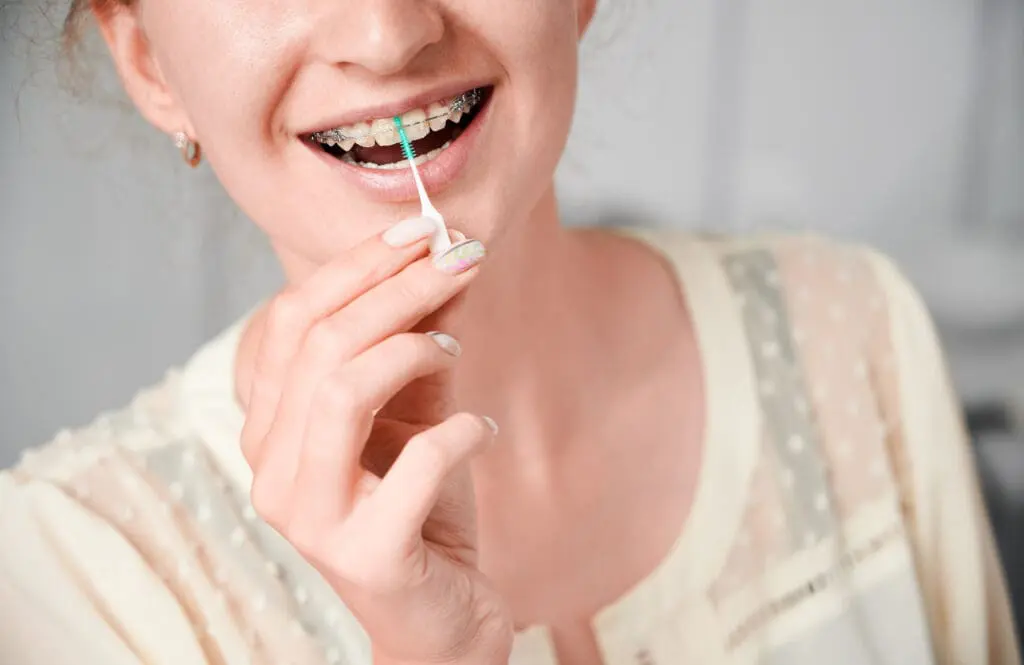
Short answer. What you need to know about how to clean braces is a four-minute routine done morning and evening, plus a quick rinse and proxa-brush pass after lunch. The daily protocol is rinse the mouth with water, brush with a soft toothbrush angled at 45 degrees against the gumline using the modified Bass technique adapted for brackets, run a proxa-brush under the archwire at every bracket, pull regular floss under the wire with a floss threader between every pair of teeth, and finish with a water flosser along the gumline. The weekly addition is a fluoride mouthwash rinse and a deeper proxa-brush pass under each bracket wing. Austin patients use the same protocol with one adjustment: the city’s hard water leaves mineral deposits around bracket bases over months, so the weekly fluoride rinse and the in-office hygiene visit every six months stay non-negotiable.
Across roughly 5,000 cases treated at Limestone Hills Orthodontics, Dr. Viecilli sees a consistent pattern: cleaning failures in the first two to three weeks of braces cause gum inflammation that adds two to three months to total treatment time. Inflamed gums slow tooth movement because the bone remodeling that lets teeth shift depends on healthy periodontal tissue around the tooth root; the orthodontist has to wait for the inflammation to resolve before advancing wire sequences, and that wait shows up as extra months on the back end. The patients who lock the cleaning routine into a daily habit by week two finish on the original timeline. The patients who treat cleaning as something to start later, after the brackets feel less new, almost always finish three months past their original estimate.
Austin’s hard water adds a second consideration. The city’s tap water runs at about 180 parts per million system hardness per the City of Austin Q3 2022 water quality summary, roughly 30 percent above the national average. The calcium and magnesium minerals deposit on enamel around bracket bases the same way they deposit on glass shower doors, and the mineral layer holds plaque against the tooth surface in a way that contributes to white-spot lesions if daily cleaning is inadequate.
The Daily Cleaning Routine (Four Minutes, Morning and Evening)
The full braces cleaning routine runs about four minutes twice a day, plus a midday rinse and proxa-brush pass. The order matters because each tool clears a different surface; running them out of order leaves food residue trapped under the wire or against the gumline.
The five-step daily routine, in order:
- Rinse the mouth with water for 10 seconds. A vigorous rinse dislodges loose food before any brushing starts. Loose food trapped against the bristles during brushing scratches the bracket surface and reduces brushing efficiency.
- Brush with a soft-bristle toothbrush, modified Bass technique adapted for brackets, two minutes total. Hold the brush at 45 degrees to the gumline, in small circles. Cover three surfaces around every bracket: above the bracket angled toward the gumline, below the bracket angled toward the biting edge, and directly on the bracket face. Spend about ten seconds per pair of teeth and work systematically from one side of the mouth to the other.
- Run a proxa-brush under the archwire at every bracket. Insert the proxa-brush head between the wire and the tooth from outside the mouth, push it through to the inside, and rotate three or four times before pulling it back out. One pass per bracket. The proxa-brush reaches the surface a regular toothbrush cannot.
- Floss with a threader and regular waxed floss between every pair of teeth. Thread the floss under the archwire, pull the threader through, then floss the contact point the way a person without braces would. Repeat for every pair of teeth. Superfloss with a built-in stiff end works the same way and is faster for most patients.
- Finish with a water flosser along the gumline. Medium pressure, tip held about a centimeter from the gumline, angled toward the gumline rather than directly at the bracket. Trace the gumline systematically, upper arch then lower, inside surfaces then outside surfaces.
The whole routine takes about four minutes once the order is locked in. The first week feels slow because every step is new; by the third week most patients run it on autopilot. Setting a four-minute timer on a phone or a bathroom clock keeps the time honest. Skipping the timer almost always means the brushing portion gets cut to under a minute.
The Tools That Belong in the Braces Hygiene Kit
The full kit covers five surfaces: the bracket face, the gumline above and below each bracket, the surface under the archwire, the contact point between teeth, and the inside-tooth surface. No single tool covers all five.
- Soft-bristle toothbrush, replaced every 8 to 10 weeks. Adult-size soft or extra-soft bristles for adults, child-size for kids. Replace earlier than 8 weeks if the bristles look frayed; braces patients wear out toothbrushes faster because the bristles work harder around bracket edges.
- Electric toothbrush with a sensitive setting (optional but useful). Oscillating heads and sonic heads both work. The sensitive setting prevents bracket damage while reaching around brackets more evenly than most hand brushing. Patients with manual dexterity issues, kids learning the routine, and adults who want the time savings benefit most.
- Proxa-brush or interdental brush, sized for the space under the wire. A small cone-shaped brush head on a thin wire handle. Replace every 4 to 6 weeks. Sized 1.0mm to 1.2mm for most braces patients; the orthodontist sizes the kit at the bonding appointment.
- Floss threader (or Superfloss with a built-in stiff end). A small disposable plastic loop that threads regular floss under the archwire. Threaders are sold in packs of 50 to 100; one pack lasts several months. Superfloss is slightly faster but costs more per use.
- Water flosser, countertop or cordless travel model. Pulsed water stream at medium pressure rinses food and surface plaque from under the wire and along the gumline. Countertop models hold more water and reach higher pressure; cordless models travel and store in a drawer. Both work.
- Standard fluoride toothpaste plus a fluoride mouthwash for the weekly rinse. Any ADA-accepted fluoride toothpaste works for the brushing step. Add a fluoride rinse (ACT, Listerine Total Care alcohol-free, or any standard fluoride mouthwash) once a week minimum, daily if the orthodontist recommends it. Skip whitening toothpaste during treatment because the abrasive particles concentrate around bracket edges and can cause uneven coloration when the brackets come off.
The starter kit fits in a small zippered pouch and runs about $40 to $60 at retail. Limestone Hills sends every new braces patient home with the threaders and proxa-brushes already sized to their case.
The Proxa-Brush Angle: Why 45 Degrees Matters
The proxa-brush is the tool patients most often hold wrong. The brush head is designed to enter the space between the archwire and the tooth at an angle, not perpendicular to the tooth. Held perpendicular, the bristles compress against the wire and only contact the front of the tooth; held at 45 degrees, the bristles fan out and clean the under-wire surface and the side of the bracket at the same time.
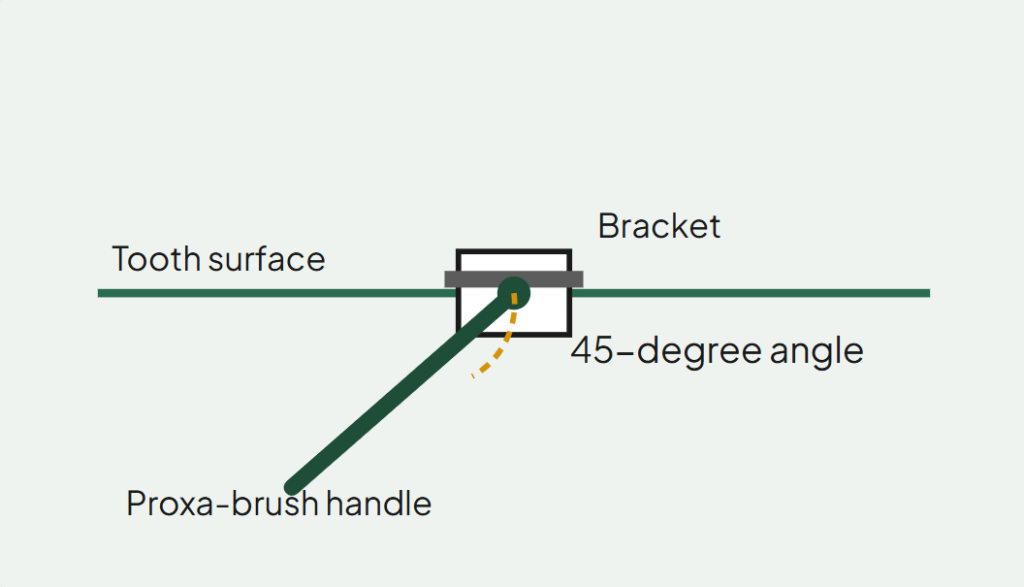
The technique is the same on the upper and lower arch, with the handle angle reversed: on the upper arch the proxa-brush enters from below the wire and angles up; on the lower arch it enters from above the wire and angles down. The bristles always fan toward the tooth side, never toward the wire.
Patients who learn the angle in the first week of treatment clean under the wire effectively for the rest of treatment. Patients who hold the proxa-brush perpendicular often miss the under-wire surface for months. The hygienist at Limestone Hills demonstrates the angle in person at the bonding appointment.
The On-the-Go Kit for School, Work, and Travel
The midday routine matters because lunch is the meal most likely to leave food trapped in brackets. Kids in Westlake or Cedar Park schools, working professionals in downtown Austin or on the Lakeway commute, and families traveling out of state all need a portable kit that handles a five-minute rinse-and-proxa pass anywhere there is a sink.
The portable kit fits in a school pencil case, a desk drawer, or a glove compartment:
- A small zippered pouch. Anything around 4 by 6 inches works. Pencil cases, small toiletry bags, and travel cosmetic pouches all do the job.
- A travel-size soft toothbrush with a cap. Adult or child size depending on the patient. The cap keeps the bristles clean inside the pouch.
- A small tube of fluoride toothpaste. The 0.85-ounce travel tubes sold at every drugstore last several weeks of midday use.
- Five to ten floss threaders. Loose in the pouch, replaced from the home supply weekly.
- One proxa-brush with a cap. The same size as the home kit. Replace from the home supply every 4 to 6 weeks.
- Orthodontic wax. A small flat pack of wax for any bracket that starts to irritate the cheek mid-day. Not strictly cleaning, but the same pouch.
- A small bottle of mouthwash (optional). A 1.5-ounce travel bottle of fluoride mouthwash, refilled from the home bottle.
The midday version of the routine takes about 90 seconds: rinse the mouth, brush briefly, proxa-brush every bracket, rinse again. Floss threaders and the full four-minute routine wait for evening. The point of the portable kit is not a complete clean; it is preventing food from sitting in the brackets for six to eight hours between lunch and the evening routine, which is when the gum inflammation pattern accumulates.
The Weekly Deep Clean (Different from the Daily Routine)
The daily routine handles the surface plaque and food residue that accumulate every day. The weekly deep clean handles the things daily brushing misses: mineral deposits around bracket bases from Austin’s hard water, plaque that has hardened toward the gumline where the toothbrush passes too quickly, and biofilm that survives in the deepest grooves of the bracket wings.
The weekly addition runs about 8 minutes once a week, on a day that anchors easily in the patient’s schedule. Sunday evening, Wednesday after dinner, or Saturday morning all work; the key is picking one day and sticking to it.
- Fluoride mouthwash, 60-second rinse. Swish a measured cap of fluoride mouthwash around every tooth surface for the full 60 seconds. The fluoride strengthens enamel against the demineralization that happens when plaque sits around bracket bases.
- Proxa-brush at every bracket, two passes per bracket. The weekly version is two passes per bracket instead of one, with the second pass at a slightly different angle to catch what the first pass missed.
- Floss threader at every pair of teeth, with one extra up-and-down at each contact. The weekly version flosses each contact point three times instead of one, working the floss into the gumline contact slightly deeper.
- Water flosser at high pressure along every gumline surface. The weekly pass uses the higher pressure setting that the daily routine avoids. The extra pressure rinses out the gumline crevice that the daily medium-pressure pass leaves behind.
- Tongue scrape and final rinse. The tongue scraping does not change between daily and weekly, but the weekly final rinse is a water-and-mouthwash mix swished for an additional 30 seconds.
Patients who add the weekly routine almost never see white-spot lesions when the braces come off. Patients who skip the weekly routine and rely on daily brushing alone sometimes finish treatment with visible enamel staining in the same shape as the bracket pads, which is the cosmetic outcome the cleaning protocol is designed to prevent.
Common Mistakes That Cause Real Damage
Most braces cleaning mistakes correct themselves within the first two weeks once the patient gets used to the routine. A handful of mistakes cause real damage, and those are the ones the protocol is designed to prevent.
- Skipping the gumline angle. Brushing straight at the tooth instead of angled at the gumline leaves a strip of plaque along the gum margin. That plaque causes gum inflammation, which slows tooth movement, which adds months to treatment. The 45-degree angle is the single most important technique detail in the daily routine.
- Using a hard-bristle toothbrush or scrubbing aggressively. Hard bristles damage the gum tissue and the bracket adhesive over time. Aggressive scrubbing accelerates the gum recession that some patients see during treatment. Soft bristles and light pressure clean better than hard bristles and heavy pressure.
- Skipping flossing because it is slow with braces. Floss threaders take 5 to 8 minutes the first week and 2 to 3 minutes by the third week. The contact point between teeth never gets cleaned by brushing alone; skipping flossing creates cavities in the contact points that are not visible until the braces come off.
- Treating the water flosser as a replacement for flossing. Water flossers complement floss threaders. They do not replace them. Water pressure rinses loose debris but does not disrupt the bacterial biofilm that forms at the gumline contact between teeth. Both tools matter.
- Eating with damaged brackets in place. A broken bracket or a poking wire is not a cleaning problem on its own, but cleaning becomes much harder around damage and patients who try to work around it usually push food deeper instead of clearing it. Call the office for any damage rather than working around it.
These mistakes compound. A patient who skips flossing and skips the gumline angle accumulates inflammation, white-spot risk, and cavity risk at once. The patient who locks the routine in by week two avoids all three.
Cleaning Braces in Austin’s Hard-Water Climate
Austin’s tap water is hard. The City of Austin Q3 2022 water quality summary lists system-wide hardness at approximately 180 parts per million, with calcium at about 40 mg/L and magnesium at about 20 mg/L. That puts Austin at roughly 30 percent above the national average hardness of 138 PPM. The minerals are safe to drink and meet every federal water-quality standard; they leave the same deposits on enamel around bracket bases that they leave on faucets and glass shower doors.
The protocol does not change for Austin patients, but the consequences of skipping it do. Mineral buildup around brackets gives plaque a slightly rougher surface to cling to, which slows the rinse-away action of saliva between meals and contributes to the demineralization spots that become white-spot lesions if cleaning is inadequate. The weekly fluoride mouthwash rinse helps, the in-office hygiene visit every six months helps, and the daily proxa-brush pass at every bracket is the load-bearing step.
The same metro water reaches braces patients across Lakeway, Cedar Park, Round Rock, Bee Cave, Westlake, Steiner Ranch, and the Northwest Hills neighborhoods, so the protocol is identical in every neighborhood. Patients on private well water in the Hill Country have variable hardness profiles; those families should treat the every-six-months hygiene visit as non-negotiable and ask the hygienist about a fluoride varnish application if the well water shows particularly high hardness.
Common Questions About Cleaning Braces
How do you brush teeth with braces properly?
Use a soft-bristle toothbrush angled at 45 degrees to the gumline, brush in small circles for two minutes total, and cover three surfaces around every bracket: above the bracket toward the gumline, below the bracket toward the biting edge, and directly on the bracket face. The modified Bass technique adapted for braces means starting at the gumline angle instead of straight at the tooth, then sweeping the bristles down across the bracket. Spend about ten seconds per pair of teeth, work systematically from one side of the mouth to the other, and finish with a tongue scrape. An electric toothbrush with a sensitive setting cuts the time in half and reaches around brackets more evenly than most patients can manage by hand.
What is the best floss for braces?
A floss threader with regular waxed floss is the gold standard, and a proxa-brush or interdental brush covers the spots a threader is slow to reach. The threader pulls regular floss under the archwire between every pair of teeth, then the floss works the gumline contact point the way it does on teeth without braces. Patients who find threading slow often switch to Superfloss, which has a stiff end built into the floss itself. A water flosser is a complement to manual flossing, not a replacement, because water pressure rinses food away without breaking the bacterial film at the gumline. The full braces hygiene kit is threader plus regular floss plus proxa-brush plus water flosser; each tool covers a different surface.
How often should you clean braces?
Twice a day with the full routine, plus a quick rinse and a proxa-brush pass after lunch or any meal eaten away from home. Morning and evening get the four-minute version: brush, proxa-brush every bracket, floss-thread between every pair of teeth, water-floss along the gumline, tongue scrape. Midday at school or work gets the portable version: water rinse, proxa-brush every bracket, replace anything visibly stuck. Weekly adds one fluoride mouthwash rinse plus a deeper proxa-brush pass under each bracket wing. The frequency matters more than the duration; a one-minute pass three times a day cleans better than a five-minute pass once.
Can you use a water flosser with braces?
Yes, and a water flosser is one of the most useful additions to a braces hygiene kit. The water flosser uses a pulsed water stream to rinse food and loose plaque from under the archwire, around brackets, and at the gumline. The right setting is medium pressure with the tip held about a centimeter from the gumline, angled toward the gumline rather than directly at the bracket. A water flosser does not replace a floss threader because the water pressure rinses surface debris without disrupting the bacterial biofilm at the gumline contact point; the two tools cover different surfaces and the kit is stronger with both. Countertop models and cordless travel models both work; the difference is convenience, not cleaning quality.
What happens if you do not clean your braces well?
Three real consequences. Gum inflammation in the first two to three weeks of treatment is the most common one; inflamed gums slow tooth movement because the bone around the tooth roots does not remodel efficiently while the soft tissue is irritated. White-spot lesions, which are early demineralization marks where plaque sat on the enamel under or around a bracket, are permanent once the braces come off. Cavities form faster around brackets than around uncovered teeth because plaque sits longer in the bracket grooves. The cleaning protocol is not a hygiene preference; it is a treatment-time protocol. Patients who clean well finish on schedule. Patients who do not often add two to three months to total treatment time.
Sources. American Association of Orthodontists, “Brushing and Flossing with Braces” patient resource (aaoinfo.org). American Dental Association, “Oral Health Topics: Orthodontics and Brushing and Flossing” guidance for patients in fixed orthodontic appliances (ada.org). City of Austin Water Quality Summary, Q3 2022 (austintexas.gov/department/water-quality-reports), reporting system-wide hardness of approximately 180 mg/L as CaCO3 with calcium at 40 mg/L and magnesium at 20 mg/L. Clinical observations on cleaning patterns, first-week gum inflammation, and the relationship between hygiene compliance and treatment-time extension cited from Dr. Rodrigo Viecilli’s practice records across approximately 5,000 cases treated at Limestone Hills Orthodontics, Austin, Texas. Reviewed by Dr. Rodrigo Viecilli, DDS, PhD in Orthodontic Biomechanics (Indiana University), Diplomate of the American Board of Orthodontics.