Short answer. No, not the way it is sold online. Resting or pressing your tongue on the roof of your mouth does not reshape the jaw or facial bones of an adult, and no clinical study shows that it does. Tongue posture still matters in two real ways. Guided tongue exercises, called myofunctional therapy, help orthodontic correction work and stay stable. And in a child who is still growing, correct tongue posture can help guide how the jaws develop.
By Rodrigo F. Viecilli, DDS, PhD, board-certified orthodontist at Limestone Hills Orthodontics in Austin, TX. His PhD is in orthodontic biomechanics, the study of how teeth and bone respond to force.
What is mewing?
Mewing means resting the whole tongue flat against the roof of the mouth, with the lips closed and breathing through the nose. Followers believe that holding this posture for months or years will widen the upper jaw, sharpen the jawline and change the shape of the face. Some versions add forceful pressing, called hard mewing, or chewing exercises.
The name comes from John Mew and his son Mike Mew, British orthodontists who promoted a method they called orthotropics. Videos of the tongue posture spread through online forums in the 2010s, and the word reached the mainstream around 2019. Mewing is now a prominent practice in looksmaxxing, the online culture of trying to maximize physical appearance, which pediatricians flagged in 2026 as an emerging concern for children.
What mewing means as slang
For many teenagers the word is now a joke more than a technique. A student who does not want to answer a question puts a finger to the lips, as if to say shush, then traces a finger along the jawline. The message is that they cannot talk because they are mewing. The gesture went viral in schools in spring 2024. Online it is often written as two emojis: a shushing face followed by a person pointing toward the jaw. If your child does this at the dinner table, it is a meme, not a medical plan.
Does mewing work?
For reshaping an adult face, no. In January 2024 the American Association of Orthodontists warned against the trend and said there is no scientific evidence that it reshapes the jawline. The British Orthodontic Society has said the same about changing the shape of the face by holding the teeth and tongue in a set position. Oral surgeons took up the subject in their own journal in 2019, under the title “Mewing: Social Media’s Alternative to Orthognathic Surgery?” Here is each claim against what is known.
| The claim | What the evidence shows |
|---|---|
| It reshapes the jaw and face of an adult | No clinical study shows this. Adult facial bones do not grow in response to tongue posture |
| It widens the palate | In adults the growth seam of the palate has matured. Widening the upper jaw then takes an expander anchored to the bone, or surgery |
| It sharpens the jawline | Lifting the tongue raises the floor of the mouth, so the area under the chin looks tighter while the posture is held. That is posture, and it ends when you relax |
| It straightens teeth or fixes a bite | No. Tongue pressure can move teeth, but not in a planned direction. Uneven pressure can open gaps or change the bite |
| It works if you start young | Partly true, and not as a home method. In a growing child, tongue posture is one of the things that shapes the jaws. Changing it is done under supervision, after a diagnosis |
| The before and after photos prove it | Photos differ in head angle, lighting, weight and tongue position. In teenagers they also record normal growth |
Why tongue pressure cannot reshape an adult jaw
Bone does respond to force. That is how braces work. But two different processes get mixed up.
Teeth move. A tooth moves through bone under light pressure that lasts for hours a day. The resting pressure of the tongue and lips is one of the main things that decides where teeth settle. That is why a tongue that rests low or pushes forward can open a bite, and why pressing hard for months can move teeth in a direction nobody planned.
Jaws grow. A jaw changes size and position at its growth sites: the seams, called sutures, of the upper jaw and the growth cartilage of the lower jaw. These sites are active in a growing child and mature during the teenage years. In a study of 3D scans of 140 people, the early, open stages of the seam in the palate were typically seen only up to about age 13.
So in an adult, tongue pressure can shift teeth, but it cannot enlarge or reposition the jaw underneath them. Widening an adult upper jaw takes an expander fixed to the bone with miniscrews, called MARPE, or surgery. Moving a jaw forward or back takes jaw surgery. If tongue posture could do either, nobody would need them.
What tongue posture exercises are really for
Tongue posture exercises and myofunctional therapy can look like mewing, because both put the tongue on the palate. The purpose is different. At Limestone Hills Orthodontics they are used so that orthodontic correction can work and hold. They are not used to change the bones of an adult’s face.
- Open bite and tongue thrust. If the tongue rests or swallows forward between the front teeth, braces or aligners can close the bite and the tongue can push it open again. Retraining the tongue removes the force that caused the problem. See open bite treatment.
- A mouth breathing habit. After the cause is treated, such as allergies or enlarged adenoids, the old habit can remain. Exercises retrain lip seal, tongue rest position and nasal breathing. See mouth breathing.
- Holding the result. Teeth settle where tongue and lip pressure balance. Correcting a bite and leaving the habit in place invites relapse.
At Limestone Hills, mild cases start with a short home exercise program that is taught in the office and checked at routine visits. Its first exercise, holding the tongue against the palate for a few seconds at a time, looks just like mewing. The difference is that it is prescribed for a diagnosed tongue habit, in a set dose, to retrain a muscle pattern. Harder cases are referred for formal myofunctional therapy with a trained therapist or a speech-language pathologist, usually a program of 12 to 24 weeks timed to fit the orthodontic plan. The exercises are on the tongue thrust page.
The evidence has limits, and patients should know them. The studies are small. The best known, of 76 patients, found an average open bite relapse of 0.5 mm when therapy was added to orthodontics, against 3.4 mm without it. It looked back at records, though, and its comparison group was made up of patients who had already relapsed. A 2025 randomized trial in 32 children found that adding a short course of therapy to a tongue crib closed the bite no better than the crib alone, although it did improve how the children swallowed. Reviews of the research call myofunctional treatment in children promising and rate the quality of the evidence as questionable. That is why it is used to support orthodontic treatment toward a defined goal, and not as a cure on its own.
In children who are still growing
A growing child is different, because the jaws are still forming and the tongue is part of what shapes them. With the tongue resting on the palate, the upper jaw has support from the inside as it grows. With the tongue resting low and the mouth open, the upper jaw tends to grow narrow with a high palate, and the risk of a crossbite and of breathing problems during sleep goes up.
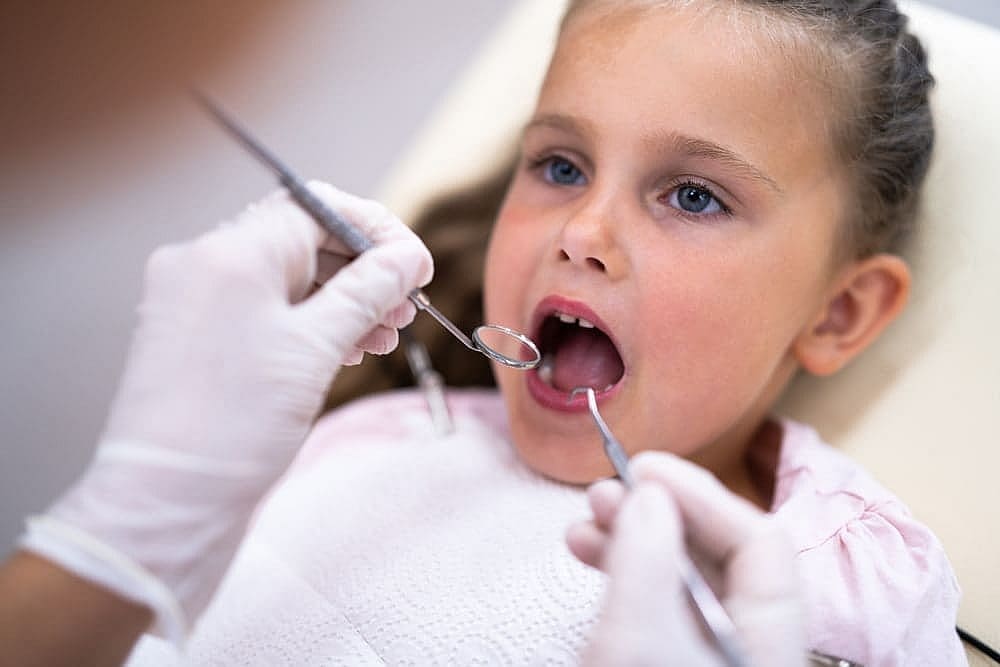
In a child who is still growing, tongue posture exercises can help change that growth pattern. They work best alongside treatment of the cause, such as allergies, enlarged tonsils or adenoids, or a thumb habit, and, when needed, a palatal expander or another growth-guiding appliance. In a trial of 22 children aged 7 to 10, therapy improved tongue strength and resting tongue posture. A 2026 pilot study followed eight children with an open bite through myofunctional therapy and measured improvement in the bite and in the volume of the palate a few months later. Studies this small show what is possible, not what is certain.
The window closes as growth ends. That is why the American Association of Orthodontists recommends a first orthodontic check by age 7, and why those years should not be spent on a home method.
Mewing vs myofunctional therapy
| Feature | Mewing | Myofunctional therapy |
|---|---|---|
| What it is | A self-taught tongue posture from social media | A structured exercise program for tongue rest position, swallowing, lip seal and nasal breathing |
| Who directs it | Videos and forums | The orthodontist, with a trained therapist or speech-language pathologist for formal therapy |
| The goal | Change the shape of the jaw and face | Remove a muscle habit so that orthodontic correction works and stays stable |
| Who it is for | Marketed to everyone, mostly teenagers and young men | Patients with a diagnosed problem: tongue thrust, open bite, low tongue posture or a mouth breathing habit |
| How long | Open-ended | A defined program, usually 12 to 24 weeks |
| The evidence | No clinical study showing a change in bone or face | Small studies, mostly in children, that support it as an add-on to orthodontic treatment |
| Who checks progress | Nobody | The therapist and the orthodontist, at set visits |
The two can look alike from the outside. The differences are the diagnosis, the goal and the supervision.
What happened to Mike Mew’s license?
Mike Mew, the British orthodontist who made mewing famous, is no longer licensed to practice dentistry in the United Kingdom. The regulator there, the General Dental Council, ordered his name erased from the Dentists’ Register, and in May 2026 the High Court dismissed his appeal.
| Date | What happened |
|---|---|
| 2010 | The General Dental Council reprimands his father John Mew, who developed orthotropics, over advertisements |
| 2017 | John Mew is erased from the register |
| November 6, 2024 | After 46 days of hearings, a Professional Conduct Committee orders Mike Mew erased from the register and suspends him at once |
| December 3, 2024 | He appeals to the High Court |
| May 15, 2026 | The High Court dismisses the appeal. The register now lists him as “Not Registered/Erased” |
The findings, as set out in the High Court judgment, concerned two young children and one video. He recommended orthotropic treatment for a six-year-old girl who had a normal bite and normal facial development. Her treatment included upper and lower expansion appliances and head and neck gear, and the committee found that it caused her harm in the form of a traumatic ulcer. For a second child, an impression for an expansion appliance was taken at age two. Orthotropic treatment was recommended when he was six, and appliances were fitted later that year. That treatment stopped within four months, after his parents raised concerns. The committee found that there was no clinical reason for the treatment in either case. It also found that claims in a 2017 YouTube video were inappropriate and misleading because they were made without adequate evidence, including the suggestion that a child’s intelligence could be increased.
It helps to be exact about what the case was. It was not about adults practicing a tongue posture at home. The regulator acted on two things: children given treatment that had no clinical reason and was liable to cause harm, and public claims made without adequate evidence. The lesson for patients is the difference between a tongue exercise that comes with a diagnosis and a limit, and a method promoted as able to do more than the evidence supports.
The risks of mewing
Resting the tongue lightly on the palate is normal and harmless. The risks come from pressing hard, from clenching and from waiting. The American Association of Orthodontists lists these:
- Teeth pushed out of line. Uneven pressure can tip teeth forward and open gaps.
- Bite problems, including an open bite.
- Jaw joint pain, from added stress on the joints.
- Speech changes.
- Longer, more complex treatment later to undo the changes.
The risk that gets the least attention is lost time. A teenager with a narrow upper jaw, a lower jaw that sits back or a breathing problem has a limited number of growing years in which those can be guided. Months spent mewing are months not spent on a diagnosis.
What works instead, by goal
| If the goal is | What can deliver it |
|---|---|
| A wider upper jaw in a child | A palatal expander, while the growth seam is still open |
| A wider upper jaw in an older teen or adult | A miniscrew-anchored expander (MARPE), planned on a 3D scan. Surgery when the seam is too mature |
| A lower jaw that sits back, in a growing child | Growth-guiding appliances during the growth years |
| A different jaw position in an adult | Orthodontics combined with jaw surgery |
| Straight teeth and a corrected bite | Braces or clear aligners |
| An open bite caused by a tongue habit | Orthodontics plus myofunctional therapy. See tongue thrust treatment |
| Easier breathing, less mouth breathing or snoring | A medical evaluation first, then airway-focused orthodontics if the jaws are part of the cause |
| A sharper jawline with a normal bite | Not something orthodontics treats when the bite and jaws are normal |
Where your tongue should rest
Correct tongue posture is real, and it is simple. The tip of the tongue rests just behind the upper front teeth without pushing on them. The body of the tongue lies lightly against the palate. The lips are together, the teeth are relaxed and not clenched, and breathing is through the nose. There is no pressing. If you cannot hold that position, or cannot breathe through your nose, that is a finding to have checked, not a habit to force. The full guide is at proper tongue posture.
Mewing questions, answered
Does mewing work after 25?
No. There is no evidence that mewing changes the jaw or face at any adult age, and by 25 the growth that can be guided is over. What can still change at 25 is tooth position, with braces or aligners, the width of the upper jaw in suitable patients, with a miniscrew-anchored expander, and jaw position, with surgery.
How long should you mew a day?
No number of hours makes mewing reshape adult bone. Normal tongue posture is a light resting position held without effort through the day, not a timed exercise. Pressing hard for hours adds risk to the teeth and the jaw joints and adds no benefit.
Can you mew with braces, Invisalign or a retainer?
Resting the tongue lightly on the palate is normal with any appliance. Do not press against the teeth, the braces, an aligner or a retainer, because extra force works against the movement your orthodontist planned. With a palatal expander in place the tongue cannot sit fully on the palate. That is expected and temporary.
Does mewing work for teenagers?
A teenager still has some growth left, so tongue posture matters more than it does in an adult. Self-taught mewing is still not treatment. If a teen has a narrow upper jaw, an open bite, a mouth breathing habit or a lower jaw that sits back, the remaining growth is better used on a diagnosed plan, which may include an expander, a growth-guiding appliance or supervised myofunctional therapy.
Can mewing fix an overbite or crooked teeth?
No. An overbite comes from the position of the teeth, the jaws or both, and crooked teeth need controlled forces in planned directions. Tongue pressure is neither controlled nor planned, and it can make spacing and bite problems worse. See overbite treatment for what does work.
Limestone Hills Orthodontics is on RM 2222 in Northwest Austin. The first visit is free for new patients who have not been in orthodontic treatment in the last 12 months, and it includes a 3D scan. Consultations for MARPE, MASPE, airway or TMJ concerns are $300, credited toward treatment. Book a free orthodontic consultation or call (512) 720-6399.
Sources. General Dental Council, Dentists’ Register, entry for Michael Gordon Mew, registration number 69138 (olr.gdc-uk.org). Dr Michael Mew v General Dental Council [2026] EWHC 1116 (Admin), judgment of May 15, 2026 (caselaw.nationalarchives.gov.uk). GDPUK, John Mew (1928 to 2025), August 17, 2025. Dentistry, GDC reprimands 81-year-old dentist over ‘whistleblowing’ advert, March 31, 2010, and ‘Mewing’ dentist struck off after ‘misleading’ treatment, November 12, 2024, which carries the British Orthodontic Society statement. American Association of Orthodontists, press release of January 22, 2024, and Does Mewing Actually Reshape Your Jaw? (aaoinfo.org). Merriam-Webster, Mewing, slang entry. Mekhail J, Howard C, Milanaik R. From mewing to peptides: looksmaxxing as an emerging pediatric concern. Pediatrics. 2026;158(3). doi:10.1542/peds.2026-077705. Lee UK, Graves LL, Friedlander AH. Mewing: social media’s alternative to orthognathic surgery? J Oral Maxillofac Surg. 2019;77(9):1743-1744. doi:10.1016/j.joms.2019.03.024. Proffit WR. Equilibrium theory revisited: factors influencing position of the teeth. Angle Orthod. 1978;48(3):175-186. Angelieri F, Cevidanes LHS, Franchi L, et al. Midpalatal suture maturation: classification method for individual assessment before rapid maxillary expansion. Am J Orthod Dentofacial Orthop. 2013;144(5):759-769. doi:10.1016/j.ajodo.2013.04.022. Smithpeter J, Covell D. Relapse of anterior open bites treated with orthodontic appliances with and without orofacial myofunctional therapy. Am J Orthod Dentofacial Orthop. 2010;137(5):605-614. doi:10.1016/j.ajodo.2008.07.016. Koletsi D, Makou M, Pandis N. Effect of orthodontic management and orofacial muscle training protocols on the correction of myofunctional and myoskeletal problems in developing dentition. Orthod Craniofac Res. 2018;21(4):202-215. doi:10.1111/ocr.12240. Homem MA, Vieira-Andrade RG, Falci SGM, et al. Effectiveness of orofacial myofunctional therapy in orthodontic patients: a systematic review. Dental Press J Orthod. 2014;19(4):94-99. doi:10.1590/2176-9451.19.4.094-099.oar. Leal TY, Garib D, Eto H, et al. Brief orofacial myofunctional therapy and tongue pressure as prediction factors for open bite correction: a randomized clinical trial. Clin Oral Investig. 2025;29(9):407. doi:10.1007/s00784-025-06483-2. Van Dyck C, Dekeyser A, Vantricht E, et al. The effect of orofacial myofunctional treatment in children with anterior open bite and tongue dysfunction: a pilot study. Eur J Orthod. 2016;38(3):227-234. doi:10.1093/ejo/cjv044. Van der Straeten C, Van Lierde K, Verbeke J, et al. Exploring orofacial myofunctional therapy and its core components in mixed-dentition anterior open bite: the ombit study. Clin Oral Investig. 2026;30(6). doi:10.1007/s00784-026-06917-5. Kim KA, Kim SJ, Yoon A. Craniofacial anatomical determinants of pediatric sleep-disordered breathing: a comprehensive review. J Prosthodont. 34(S1):26-34. doi:10.1111/jopr.13984. Clinical position of Dr. Viecilli, Limestone Hills Orthodontics, Austin, TX.