
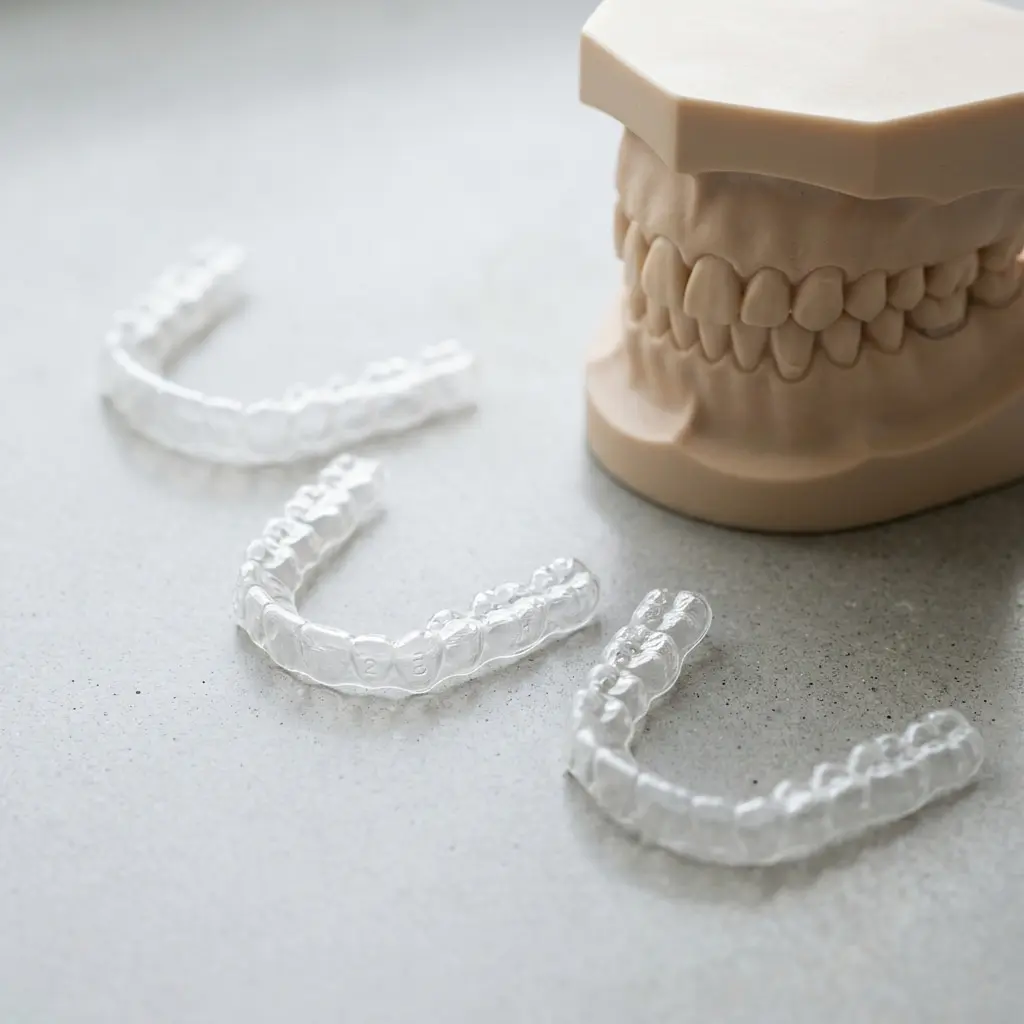
Clear aligners are the treatment category, a staged series of clear removable trays that move teeth. Invisalign is the best-known brand inside that category, not a separate thing. Other systems exist, including Angel Aligners. Which brand a patient uses matters far less than the orthodontist’s diagnosis, plan, and supervision of the case.
Dr. Rodrigo Viecilli is an ABO Diplomate with a PhD in orthodontic biomechanics and a co-inventor of the SmartArch wire system. Across 5,000+ treated cases at Limestone Hills in Austin, the pattern is consistent. Patients ask for Invisalign by name, then learn that Invisalign is one brand of clear aligner, not the category itself.
That distinction is the single most useful thing to understand before choosing. The category defines what the treatment is. The brand defines the engineering and the distribution model behind one version of it.
The result of any clear-aligner case is set by the diagnosis and the plan far more than by the logo on the tray. Dr. Viecilli weighs the brand last, after the clinical problem is defined.
Category Versus Brand, in Plain Terms
A clear aligner is a thin, transparent, removable tray that fits over the teeth. A course of treatment uses a numbered series of these trays, each one shaped slightly differently, so the teeth move a small amount per stage until they reach the planned position.
That description defines the category. It does not name a brand. Several manufacturers make clear-aligner systems, and they all share that basic mechanism while differing in materials, software, and how they are sold.
Invisalign is the most recognized brand within the category. It is made by Align Technology and has the longest operational record of any clear-aligner system. Because the name is everywhere, many people use Invisalign as a generic word for the whole treatment, the way a brand name sometimes stands in for a product type.
The confusion is harmless in casual conversation. It matters when choosing treatment, because a patient who thinks Invisalign is the only option never compares the alternatives. A patient who understands the category asks a better question: which clear-aligner system fits this case, and who is planning it.
What Invisalign Actually Is
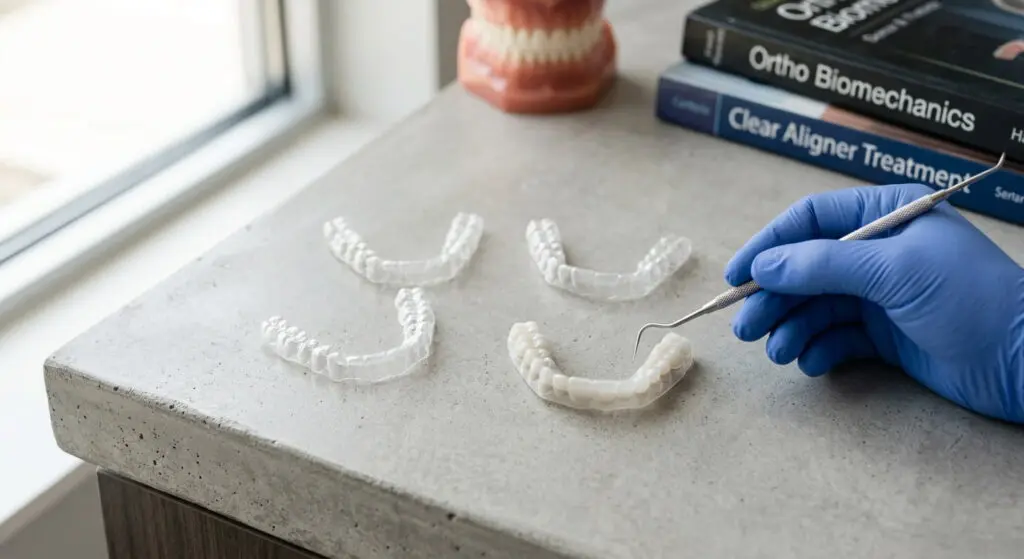
Invisalign is a clear-aligner brand owned by Align Technology. It pairs a single-material tray with tooth-colored composite attachments bonded to the teeth and a proprietary digital planning workflow. Successive product generations have refined the staging and the attachment design over a long span of clinical use.
Two facts about Invisalign are worth stating plainly because they are real strengths. It has the longest track record in the category, and it has the largest accumulated clear-aligner case database of any system. A long record means a mature, heavily refined product, and that has genuine clinical value.
Invisalign is also the most widely available system. It is offered through a large network that includes both orthodontists and general dentists. That breadth is why the brand is so recognized and why it is easy to find a provider almost anywhere.
None of that makes Invisalign automatically the right choice for a given patient, and none of it makes a competing system a weak product. It makes Invisalign a strong, well-documented brand within a category that contains other strong systems. The next section covers one of them.
Other Systems in the Category, Including Angel Aligners
Several manufacturers make clear-aligner systems. They differ mainly in material engineering, attachment design, planning software, and distribution model. For the patients treated at Limestone Hills the most relevant alternative is Angel Aligners, which the practice offers alongside Invisalign.
Angel Aligners is built on a different distribution philosophy. It is an orthodontist-only system. The manufacturer supplies it to orthodontic practices rather than to general dental offices, and it is not a direct-to-consumer mail-order product. The system stays in the hands of clinicians who completed a residency dedicated to tooth movement.
Limestone Hills offers both Angel Aligners and Invisalign, and Dr. Viecilli leans toward Angel as the preferred option for much of the practice case mix. That lean rests on four concrete attributes, not on any claim that Invisalign is inferior. Both are premium systems.
The first attribute is orthodontist-only distribution. Angel is available exclusively to orthodontists, which keeps the system inside specialist hands. The second is Angel Pro, an advanced tier that pairs two trays of different stiffness per treatment stage for more graded force on demanding movements, with particular value for posterior control.
The third is the angelButton. Angel builds the elastic attachment point into the tray itself from a transparent material, rather than bonding a separate composite button to the tooth as Invisalign does. Because the integrated button comes off every time the patient eats, it avoids the chewing forces a bonded button must withstand at every meal.
The fourth is cost. Angel’s leaner orthodontist-only channel carries less marketing and distribution overhead than a consumer-recognized brand sold through tens of thousands of practices. A leaner channel tends to produce lower lab fees, and Limestone Hills can often pass part of that difference to Austin patients.
Invisalign remains fully available at Limestone Hills for patients who specifically prefer that brand. Brand familiarity is a legitimate factor for someone who will wear trays for a year or more, and Invisalign’s long record supports that familiarity. The choice is shared, and the trade-off is explained in plain terms before treatment starts.
How Clear Aligners Work, Across Every Brand
The underlying mechanism is the same regardless of brand. A digital scan or impression captures the teeth. The orthodontist plans the final position and the sequence of movements that gets there. The lab manufactures a numbered series of trays, each one a small step along that plan.
The patient wears each tray for the prescribed period, usually most of the day and night, then advances to the next number. The trays apply light, continuous force in a controlled direction, and the teeth remodel into the new position over the staged sequence.
Most cases need elastics at some point to correct how the upper and lower teeth meet. This is where the attachment design matters. Invisalign typically uses bonded composite attachments as handles for the tray and the elastics. Angel builds that attachment into the tray. The biological process of moving a tooth is identical either way.
Because the mechanism is shared, the brand is not what makes a tooth move correctly. The planning is. A precise diagnosis and a well-sequenced plan move teeth predictably in any competent system. A vague plan struggles in all of them. That is the core point of this comparison.
What Actually Drives the Result
The brand on the tray is a minor variable next to four factors that decide whether a clear-aligner case finishes well: the diagnosis, the treatment plan, the supervision, and patient compliance.
Diagnosis comes first. An accurate read of the bite, the roots, the airway, and the jaw relationship defines the real problem. Dr. Viecilli’s PhD is in orthodontic biomechanics, and the practice uses 3D CBCT imaging so the plan is built on the actual anatomy rather than on a surface impression alone.
The plan is next. Tooth movement is a force-system problem. The sequence of movements, the staging, the attachment placement, and the elastics are engineering decisions. A strong plan in a mid-tier system outperforms a weak plan in a premium one, every time.
Supervision is third. Teeth do not always track the plan exactly. An orthodontist who checks progress, catches a tooth that is lagging, and adjusts before it compounds is the difference between a clean finish and a long detour. At Limestone Hills the same ABO Diplomate supervises every aligner case in either brand.
Compliance is fourth and it belongs to the patient. Clear aligners only work while they are in the mouth. A patient who removes the trays often, or skips wear time, slows or stalls the case no matter how good the brand or the plan is. This is the honest limit of the technology.
Features Worth Comparing Objectively
When comparing one clear-aligner brand to another, a few dimensions are worth real attention, and several common talking points are not. The table below frames the structural differences without ranking the systems.
| Dimension | Clear aligners as a category | How Invisalign and Angel differ within it |
|---|---|---|
| Core mechanism | Staged series of clear removable trays applying light continuous force | Identical in principle across both brands |
| Distribution | Varies by brand, from orthodontist-only to broad and direct-to-consumer | Angel is orthodontist-only; Invisalign uses a wide orthodontist and general-dentist network |
| Force control | Tray material and staging determine how force is applied | Angel Pro pairs a softer and a stiffer tray per stage; Invisalign uses a single-material tray with refined staging |
| Elastic attachment | Most cases need elastics; the attachment can be bonded or built in | Angel integrates a transparent button into the tray; Invisalign bonds a composite attachment to the tooth |
| Track record | Maturity differs widely by brand | Invisalign has the longest record and largest case database; Angel is a newer, orthodontist-focused system |
| What sets the result | Diagnosis, plan, supervision, and compliance, not the brand name | Same standard applies to both; at Limestone Hills, the same ABO Diplomate plans each case |
The dimensions that do not belong in a serious comparison are slogans about discretion or speed that every brand claims. Clear aligners are all relatively discreet. None move teeth faster than biology allows. Those are category traits, not brand advantages.
Where to Take This Comparison Next
This article compares features so the category-versus-brand distinction is clear. It is not the place that turns the comparison into a plan. The Limestone Hills clear aligners service page is. That page lists the systems the practice offers, including Angel Aligners and Invisalign, and how each is used.
The reason to start there rather than with a brand name is consistency. Whether a case ends in Angel or Invisalign, the same ABO Diplomate designs and supervises it, and the trade-off between systems is explained the same way every time. The brand follows the diagnosis, not the other way around.
A consultation produces the specific answer a blog cannot: the right system for one patient, the plan, and an exact number. The honest summary is that no clear-aligner brand overcomes a poor treatment plan or a patient who does not wear the trays. The orthodontist and the plan are the variables that matter most.

Clear Aligner Options in Austin and the Hill Country
Limestone Hills treats clear-aligner patients from across Austin and the surrounding Hill Country, including Lakeway, Cedar Park, Round Rock, Bee Cave, and Westlake. The systems on offer do not change by neighborhood, and the category-versus-brand logic is universal.
What stays constant is the orthodontist. Whether a patient in Steiner Ranch chooses Angel Aligners or a patient in Round Rock prefers Invisalign, an ABO Diplomate with a PhD in orthodontic biomechanics designs and supervises the case. To see the options side by side and book a consultation, the Limestone Hills clear aligners page is the place to start.
Common Questions About Clear Aligners and Invisalign
Is Invisalign the same as clear aligners?
Not exactly. Clear aligners are the treatment category, a series of clear removable trays that move teeth in stages. Invisalign is one brand within that category, the most recognized one, made by Align Technology. Other clear-aligner systems exist, including Angel Aligners. Saying clear aligners and Invisalign as if they mean the same thing is like calling every tissue a Kleenex.
If Invisalign is just one brand, why is it so well known?
Invisalign has the longest operational track record in the category and the largest accumulated case database, and Align Technology markets the brand to consumers directly. That recognition is real and has clinical value, because a long record means a mature system. It does not mean Invisalign is the only clear aligner or automatically the right one for a given patient.
What is the difference between Invisalign and Angel Aligners?
Both are premium clear-aligner systems that reach comparable goals. The structural differences are distribution and mechanics. Angel Aligners are supplied only to orthodontists, use a two-stiffness Angel Pro material per stage, and build the elastic attachment into the tray. Invisalign uses bonded composite attachments and is available through a far wider network. Limestone Hills offers both.
Does the aligner brand decide how good the result is?
No. The diagnosis, the treatment plan, and the orthodontist supervising the case drive the result far more than the brand on the tray. A premium brand cannot rescue a weak plan or a patient who skips wear time. Dr. Viecilli, an ABO Diplomate at Limestone Hills, treats the brand as one input among several, never the deciding factor.
Which clear-aligner systems does Limestone Hills offer in Austin?
Limestone Hills offers more than one system, including Angel Aligners and Invisalign. Dr. Viecilli leans toward Angel as the orthodontist-only option for much of the practice case mix, and provides Invisalign for patients who specifically prefer that brand. The clear aligners page lists the options, and a consultation produces a specific plan.
Sources. Manufacturer product information (Invisalign/Align Technology; Angel Aligner) and standard clear-aligner literature, stated qualitatively. Specifics that could not be independently verified are stated qualitatively rather than as exact figures. Clinical observations from Limestone Hills Orthodontics, Austin, TX.