
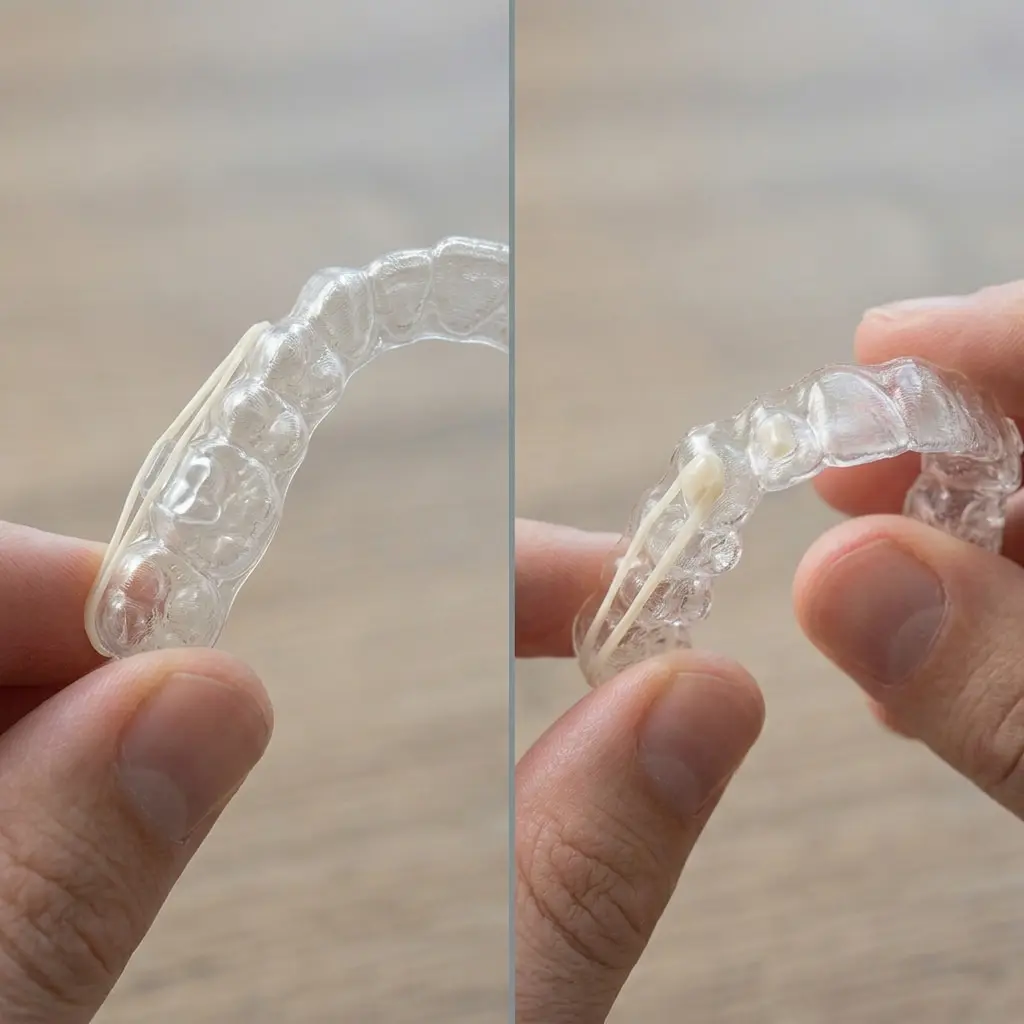
Invisalign vs Angel Aligners both straighten teeth with a sequence of clear trays and reach comparable clinical results for most Austin patients.
Limestone Hills offers both systems and leans toward Angel as the orthodontist-only option, while Invisalign stays available for patients who specifically want that brand. The differences that matter are distribution, force control, attachment design, and cost, not whether one system works and the other does not.
Angel Aligners and Invisalign reach the same clear-aligner goal. Across 5,000+ treated cases at Limestone Hills in Austin, what separates them in Dr. Rodrigo Viecilli’s clinical assessment is the orthodontist-only distribution, the Angel Pro dual-stiffness staging, and the transparent button built into the Angel tray.
Those three traits are why the practice leans toward Angel for its case mix. None of them frames Invisalign as a weak product. Invisalign carries the longest record and the largest case database in the category, and that record has real clinical value.
So the comparison at Limestone Hills is a question of fit, not a contest. A patient who wants Invisalign gets Invisalign, and Dr. Viecilli explains the trade-off plainly before treatment starts.
Same Goal, Two Engineering Paths
A clear aligner system has one job: move teeth predictably with a staged series of removable trays. Angel Aligners and Invisalign both do that job well. A patient in Westlake or Cedar Park weighing the two should start from that baseline rather than from marketing claims.
The systems diverge in how they are sold, how they apply force, and how they attach elastics. Dr. Viecilli evaluates those engineering choices the same way he evaluates wire systems or bracket prescriptions, by what gives an orthodontist the most predictable control over the case.
The sections below walk through each difference, then close with how Limestone Hills decides between the two for a given Austin patient. Both systems are premium products from established manufacturers, so the comparison is about engineering fit, never about one option being a budget substitute for the other.
Difference 1: Who Is Allowed to Provide the System
Angel Aligners are positioned as an orthodontist-only system. The manufacturer markets the technology to orthodontic practices rather than to general dental offices, and it is not a direct-to-consumer mail-order product. In practice the system runs through clinicians who completed a residency dedicated to tooth movement.
Invisalign uses a far wider network. It is available through both orthodontists and general dentists, and Align Technology reports a doctor network and treated-patient base far larger than any competitor in the category. That breadth is a strength for access and a reason Invisalign is the most recognized name in clear aligners.
For Limestone Hills the orthodontist-only model is a feature, not a limitation. It keeps Angel inside the hands of clinicians trained specifically in biomechanics. At this practice the point is partly academic, because Dr. Viecilli, an ABO Diplomate with a PhD in orthodontic biomechanics, personally plans and supervises every aligner case in either system. The distribution model matters more to the wider market than to a patient who is already in a specialist practice.
Difference 2: How Each System Controls Force
Invisalign delivers force through a single-material tray combined with SmartForce attachments and proprietary staging. It is a mature, heavily refined system, and experienced Invisalign providers treat a wide range of cases with it. Successive product generations have continued to add precision to that staging.
Angel’s advanced tier, Angel Pro, takes a different route. Each treatment stage uses two trays of different stiffness on a published “7 plus 3” protocol. A softer, self-adapting tray is worn for the first seven days of the stage, then a stiffer tray for the final three days.
The intent is a gentle initial push followed by firmer control to finish the movement, which Angel positions as helpful for complex tooth movements and for cases with larger jaw corrections.
Dr. Viecilli’s interest in the dual-stiffness approach is mechanical. Posterior control and larger anteroposterior corrections are where aligner cases most often lose predictability.
A protocol that lets the orthodontist apply a graded force across the stage gives more room to manage that, which is a clinical-judgment reason the practice leans Angel for complex cases. Simpler cases do well in either system.
The staging logic matters more than the marketing around it. With a single-material tray, the same plastic that starts a movement also has to finish it, so the clinician tunes force mainly through staging and attachments. A two-stiffness stage adds a second lever. The flexible tray seats and starts the tooth, then the stiffer tray expresses the planned position with more authority.
For an Austin patient with rotated premolars or a deep bite, that second lever can be the difference between a predictable finish and a mid-treatment refinement. None of this makes Invisalign a poor choice for complex work.
Skilled Invisalign providers correct difficult cases routinely, and the staging software is highly refined. The point is narrower: the Angel Pro mechanic gives the orthodontist one more way to grade force, and Dr. Viecilli weights that control heavily when the planned movements are demanding.
Difference 3: How Elastics Attach to the Teeth
Most aligner cases need elastics at some point to correct bite relationships. The two systems hook those elastics differently, and the difference shows up in patient comfort and in chair time.
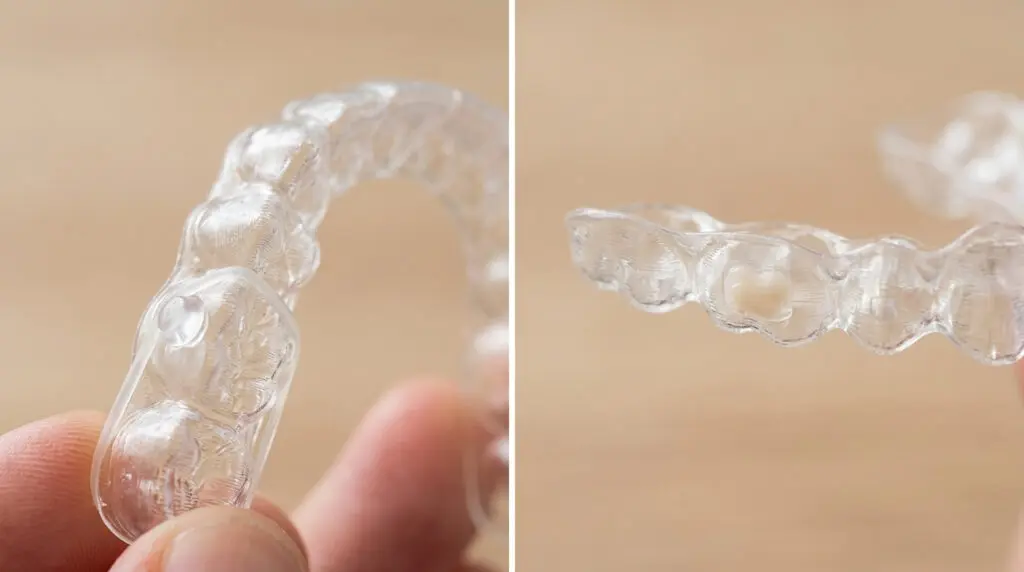
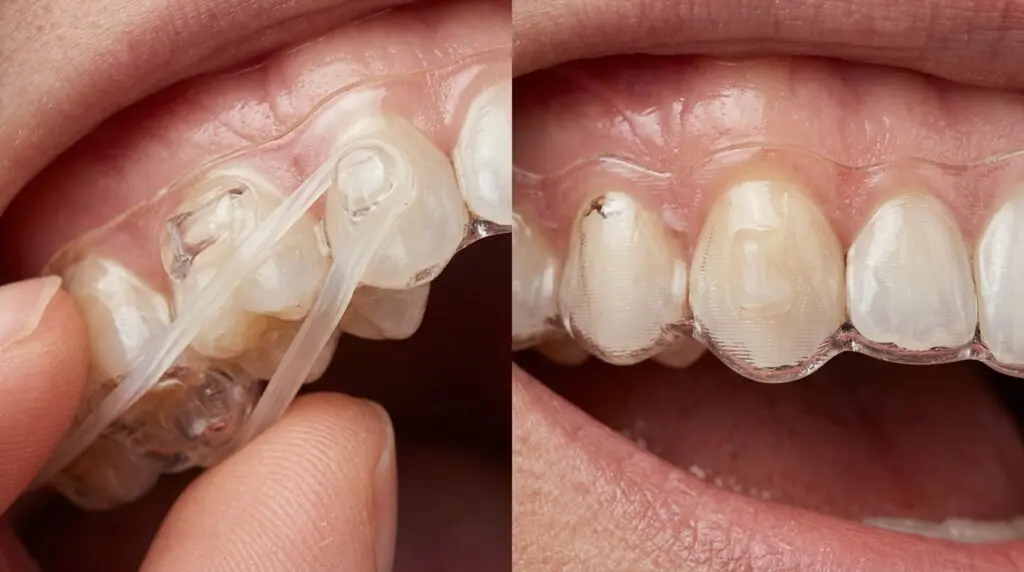
Invisalign typically uses tooth-colored composite attachments bonded directly to the enamel. They are discreet and effective, and they act as handles the tray pushes against. They do sit on the tooth, so they can pick up stain over a long treatment, and one occasionally needs repair or replacement if it chips during the case.
Angel builds the attachment point into the tray itself. The angelButton is manufactured directly into the aligner from a transparent, medical-grade material rather than bonded to the tooth, and it can be positioned at multiple points on the arch for multidirectional elastic force.
Because it is molded into the tray, it comes off every time the patient eats, so it avoids the chewing forces that a bonded button must withstand at every meal.
Dr. Viecilli’s clinical observation at Limestone Hills is fewer breakage and repair visits with the integrated design, which keeps Austin patients in fewer unscheduled chairside appointments. The mushroom-head shape of the integrated button is also designed to sit gently against the cheek and gum, which matters over a treatment that runs many months.
Difference 4: What Drives the Cost
Cost is not a quality signal here. Both systems are premium clear aligners. The difference is channel economics.
Invisalign is sold through tens of thousands of general and specialist practices and carries the marketing and channel overhead of a consumer-recognized brand. Angel’s orthodontist-only distribution is a leaner model with less of that overhead. A leaner channel tends to produce lower lab fees, and Limestone Hills can often pass part of that difference to Austin patients.
That said, the final figure for either system depends on case complexity and how many arches are treated. The honest answer to which system costs less for a given patient comes from a consultation, not a blog table. Limestone Hills quotes both systems plainly so an Austin family can compare real numbers side by side.
One caution is worth stating. A lower lab fee does not mean a lower-quality aligner, and a higher fee does not buy a better clinical result on its own.
The outcome is set by the diagnosis, the treatment plan, and the orthodontist supervising the case far more than by the brand on the tray. Dr. Viecilli frames cost as one input among several, never as the deciding factor, and never as a proxy for how well a case will finish.
Angel Aligners vs Invisalign at a Glance
| Dimension | Angel Aligners | Invisalign |
|---|---|---|
| Distribution | Orthodontist-only; available exclusively to orthodontists, not general dentists, not direct-to-consumer | Wide network of orthodontists and general dentists; most widely available system |
| Force control | Angel Pro pairs a softer and a stiffer tray per stage on a 7 plus 3 protocol; positioned for graded control on complex movements | Single-material tray with SmartForce attachments and proprietary staging; mature and heavily refined |
| Elastic attachment | angelButton manufactured into the tray; transparent, not bonded to the tooth; removed at every meal | Tooth-colored composite attachment bonded to enamel; discreet, can stain or chip over a long case |
| Cost driver | Leaner orthodontist-only channel; lower overhead often passed partly to the patient | Broad consumer-recognized brand with larger marketing and channel overhead |
| Case-type fit | Strong for complex movements and posterior control; simple cases also handled well | Broad range from simple to complex; longest clinical track record and largest case database |
| Who can provide | Orthodontist-only; at Limestone Hills, an ABO Diplomate | Orthodontists or general dentists; at Limestone Hills, the same ABO Diplomate |
The table summarizes structure. It does not rank the systems, because the right choice depends on the individual case and on what the patient values most.
How Limestone Hills Chooses Between the Two
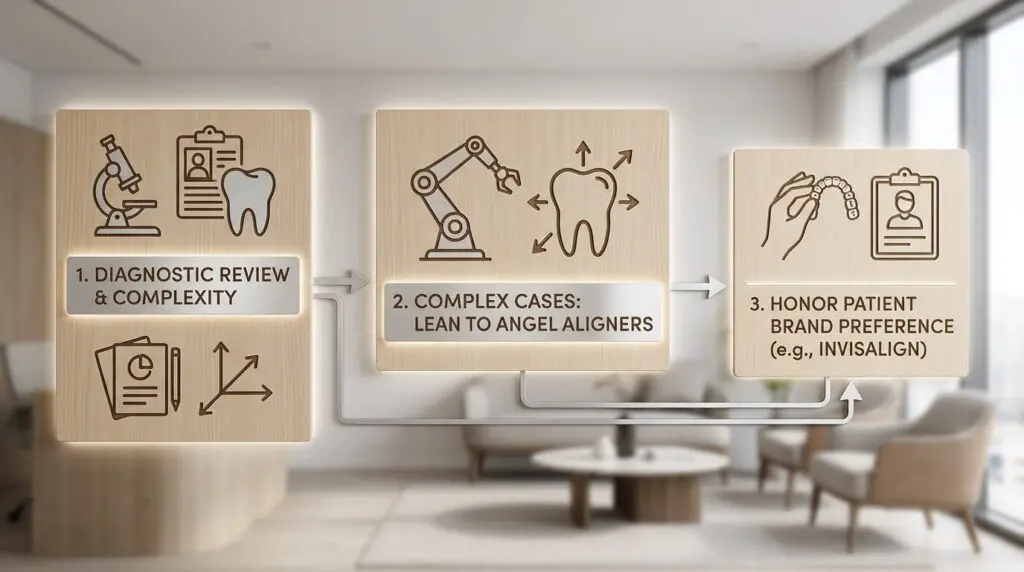
Dr. Viecilli does not assign a brand by reflex. He reviews the diagnostic records, the difficulty of the planned movements, and what the patient cares about. For many cases in the practice mix the orthodontist-only distribution, the Angel Pro force control, and the integrated buttons make Angel the cleaner clinical fit, and that is the practice’s default lean.
When a patient specifically wants Invisalign, that preference is honored. Brand familiarity is a legitimate factor for someone who will wear trays for a year or more, and Invisalign’s long record backs that familiarity. The decision is shared, and the trade-off is explained in plain terms before treatment starts.
The candid part is this. Invisalign has the longest operational record and the largest clear-aligner case database of any system, drawn from many millions of treated patients. A patient who values that specifically can choose it at Limestone Hills without pushback.
The practice presents the trade-off honestly rather than selling one brand to everyone, which is the same standard Dr. Viecilli applies to wires, brackets, and every other clinical decision.
Austin and the Hill Country
Limestone Hills treats clear-aligner patients from across Austin and the surrounding Hill Country, including Lakeway, Cedar Park, Bee Cave, Westlake, and Steiner Ranch. The systems on offer do not change by neighborhood.
The recommendation does change by case, because a teenager in Round Rock with mild crowding and an adult in Davenport Ranch with a complex bite correction are different clinical problems.
For Austin families comparing options nearby, the practical advantage of an orthodontist-led practice is consistency. Whether the plan ends in Angel or Invisalign, the same ABO Diplomate designs and supervises it, and the trade-off between the two is explained the same way every time.
A consultation is the step that turns this comparison into a specific plan and a specific number for the patient in front of the doctor.
Common Questions About Angel Aligners and Invisalign
What is the main difference between Angel Aligners and Invisalign?
Both move teeth with a staged series of clear trays and reach comparable clinical goals. The structural differences are distribution and mechanics. Angel Aligners are supplied through orthodontists, use a two-stiffness Angel Pro material per stage, and build the elastic attachment point into the tray itself. Invisalign uses tooth-colored composite attachments bonded to the teeth and is the most widely available and longest-running system. Dr. Viecilli’s clinical assessment at Limestone Hills leans toward Angel for the practice case mix, while Invisalign stays available for patients who prefer that brand.
Are Angel Aligners only available from orthodontists?
Angel Aligners are positioned as an orthodontist-only system rather than a product sold broadly to general dental offices or direct to consumers. Invisalign is available through a much larger network that includes both orthodontists and general dentists. At Limestone Hills the distinction is internal to the choice of system, because every aligner case in either brand is planned and supervised by Dr. Viecilli, an ABO Diplomate with a PhD in orthodontic biomechanics.
Does Angel cost less than Invisalign in Austin?
Angel’s leaner orthodontist-only distribution carries less marketing and channel overhead than a brand sold through tens of thousands of general and specialist practices, and Limestone Hills can often pass part of that difference to Austin patients. The final figure for either system depends on case complexity and how many arches are treated, so a consultation gives an exact number rather than a blog estimate.
Why does Limestone Hills recommend Angel over Invisalign for most cases?
It is a clinical-judgment position, not a statement against Invisalign. Dr. Viecilli values three Angel features: the orthodontist-only distribution model keeps the system inside specialist hands, the Angel Pro protocol pairs a flexible and a stiffer aligner per stage for more graded force on demanding movements, and the integrated angelButton lets elastics attach without separate bonded buttons. For patients who specifically want Invisalign, Limestone Hills provides it and explains the trade-off honestly.
Can a patient at Limestone Hills still choose Invisalign?
Yes. Invisalign has the longest operational record and the largest clear-aligner case database in the industry, drawn from many millions of treated patients, and a patient who values that specifically can choose it at Limestone Hills without pushback. Dr. Viecilli presents the Angel and Invisalign trade-off in plain terms during the consultation rather than steering every patient to one brand.
Sources. Angel Aligner, official manufacturer product information for Angel Aligner Pro, including the dual-material “7 plus 3” per-stage protocol with a softer self-adapting tray followed by a stiffer tray for complex movements.
Angel Aligner, official manufacturer product information for the angelButton, integrated transparent medical-grade attachment manufactured into the aligner rather than bonded to the tooth, supporting multidirectional elastic force.
Orthodontic Practice US, clinical feature on the angelButton and complex-case mechanics. Align Technology and Invisalign, official product information on SmartForce composite attachments and published company figures on doctor network size and a treated-patient database in the many millions.
Manufacturer specifics that could not be independently verified are stated qualitatively rather than as exact figures. Clinical observations from Limestone Hills Orthodontics, Austin, TX.