
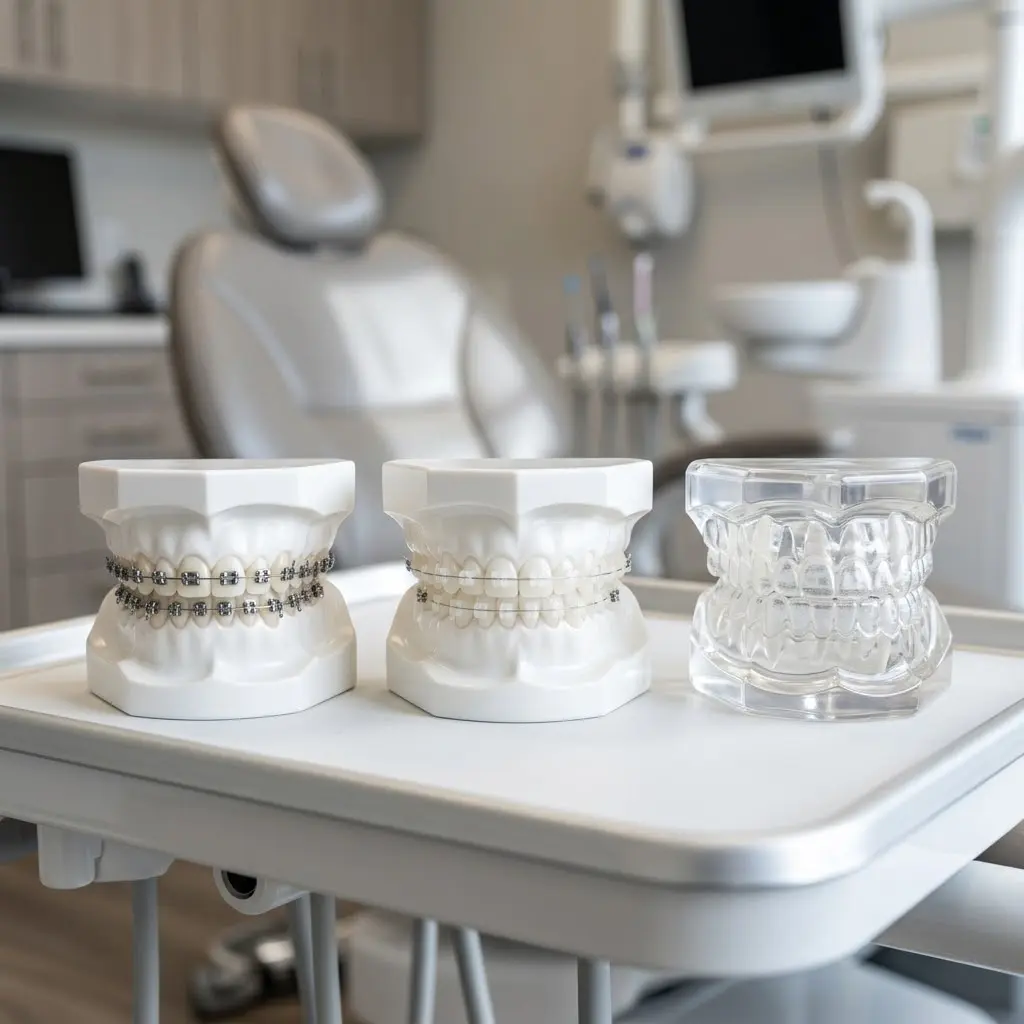
At most US orthodontic practices, metal braces start lower than Invisalign by $400 to $1,200. At Limestone Hills, metal braces start at $4,000 and Invisalign starts at $4,700, with clear ceramic braces in between. The clinical outcome is equivalent for most cases; the choice depends on esthetic preference, lifestyle compatibility, and case complexity rather than price.
Side-by-Side Comparison: Cost, Time, Lifestyle, Clinical Scope
The four mainstream orthodontic treatments differ on four dimensions a patient cares about: how much it costs, how long it takes, how it fits into daily life, and how wide the clinical scope is. The table below shows current pricing at Limestone Hills alongside the practical trade-offs.
| Dimension | Metal Braces | Clear Ceramic Braces | Invisalign | Angel Aligners |
|---|---|---|---|---|
| Starting cost | From $4,000 $149.99/mo in-house financing | From $4,600 premium for esthetics | From $4,700 premium-tier brand | From $4,000 orthodontist-only system |
| Typical treatment time | 12 to 24 months. SmartArch wire option can reduce by up to 40% in eligible cases. | 12 to 24 months. Self-ligating ceramic systems track close to metal-braces durations. | 9 to 24 months. Lite/Express plans for minor cases run 6 to 12 months. | 9 to 24 months. Angel Pro 2-stiffness system extends clinical reach into more complex cases than other aligner brands. |
| Lifestyle fit | Fixed appliance, visible. Patients return for adjustments every 6 to 10 weeks; no compliance requirement beyond food restrictions and oral hygiene. | Fixed appliance, semi-discreet (tooth-colored or transparent brackets). Same compliance profile as metal. | Removable trays, near-invisible. Requires 20 to 22 hours per day of wear. Easier oral hygiene but compliance-dependent. | Removable trays, transparent angelButtons integrated for elastic wear. Same 20-to-22-hour compliance profile. |
| Clinical scope | Widest range: minor cosmetic alignment to comprehensive bite correction, complex tooth movements, surgical-orthodontic coordination. | Same clinical range as metal. Some restrictions on bracket position when bonding to opaque ceramic substrate; otherwise equivalent. | Strong on mild-to-moderate alignment + minor bite correction. Posterior force control and elastic-wear cases require careful planning; some severe cases route to fixed appliances. | Extended clinical scope vs. other aligner brands. Angel Pro 2-stiffness handles posterior force control better; clinicians treat more complex cases without dropping to braces. |
Pricing at Limestone Hills is all-inclusive (consultation, 3D scan, every adjustment visit, broken-bracket repairs for active patients, first set of retainers). The pricing shown is the starting fee for a standard-complexity case; comprehensive multi-arch surgical or skeletal cases are quoted at the consultation.
Why Invisalign Tends to Cost More Than Metal Braces
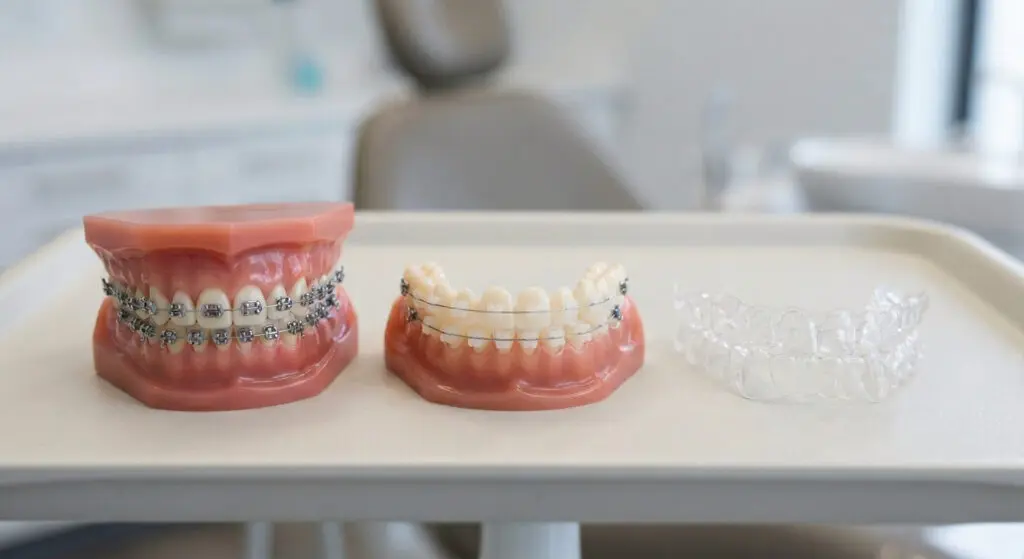
Across most US practices, Invisalign treatment is priced at a premium over metal braces. The price difference comes from three sources, not a higher profit margin.
1. Per-stage lab fees
Each Invisalign treatment plan generates a custom set of aligner trays manufactured by Align Technology. The practice pays a per-stage lab fee whether the case takes 14 trays or 60. Metal braces are a single bracket-and-wire kit shipped once; subsequent visits adjust the same appliance without new lab costs. Across a typical 18-month case, lab fees alone account for $400 to $1,200 of the price difference.
2. Refinement aligners
Most adult Invisalign cases require one or two refinement rounds at the end of treatment. Limestone Hills includes unlimited refinements within a 5-year window in the published Invisalign price, but the underlying lab cost is real and absorbed into the base fee. Braces cases occasionally need a brief detailing phase, but it does not carry a separate manufacturing cycle.
3. Clinical time per case
Invisalign-trained orthodontists invest 20 to 40 minutes per case planning the ClinCheck and modifying tooth-by-tooth movement targets before approving the plan. Braces cases involve clinical thinking at every wire change but the per-visit time is shorter and more standardized. The cumulative chair-time difference is small but real.
The Hybrid Option: Aligners First, Braces to Finish
Some adult cases land in a gray zone where neither aligners alone nor braces alone is the ideal fit. Limestone Hills routinely treats these cases with a hybrid sequence: most of the treatment runs in clear aligners (so the patient stays in the esthetic modality), and the final 2 to 4 months use brackets for the precision movements that aligners struggle with.
The hybrid sequence works best when the bulk of the case is alignment and the finishing work is mechanical detailing of bite contacts or rotation of a single tooth. Patients get the lifestyle benefit of aligners for the long phase and the mechanical control of fixed appliances for the short phase. The reverse sequence (braces first, aligners to finish) also works clinically; the choice depends on which phase needs the most precision.
Pricing for a hybrid case at Limestone Hills is structured as the higher of the two treatments rather than the sum. Hybrid patients pay the Invisalign price; the short braces-finish phase is included in that fee. Patients planning to ask about hybrid sequencing should bring it up at the free consultation so the doctor can evaluate whether the case is a good candidate.
How to Decide: Cost-Optimal vs. Esthetic-Optimal vs. Compliance-Optimal
The right treatment for any individual case is rarely about price alone. Three patient profiles map cleanly to three preferred treatments at Limestone Hills.
Cost-optimal: Metal Braces
If the lowest treatment fee is the priority, metal braces win in almost every case. Starting from $4,000 at Limestone Hills, monthly payments from $149.99 make even a comprehensive case affordable without compromising clinical results. Patients who do not mind the visibility of brackets and wires get the same outcome as more expensive treatments at the lowest price point.
Esthetic-optimal: Invisalign or Angel Aligners
Patients who need near-invisible treatment (working professionals, public-facing roles, wedding-prep patients) typically choose clear aligners. Adult cases with mild-to-moderate alignment plus minor bite correction track well in aligners. Severe rotation, large extraction-space closures, and skeletal correction may route to fixed appliances or a hybrid sequence even when the patient prefers aligners.
Compliance-optimal: Metal or Clear Ceramic Braces
Aligners depend on the patient wearing them 20 to 22 hours per day. Patients who travel often, have unpredictable schedules, or know they will struggle with the compliance requirement do better with fixed appliances. Clear ceramic braces split the difference: fixed appliance (no compliance issue) with semi-discreet esthetics.
Treatment Choice for Austin and Hill Country Families
Limestone Hills Orthodontics treats families from across the Austin metro and Hill Country. Patients drive to the practice from Lakeway, Cedar Park, Round Rock, Bee Cave, Westlake, Steiner Ranch, and the Northwest Hills neighborhoods. Within Austin proper, the practice draws regular flow from Tarrytown, Davenport Ranch, River Place, Four Points, Jester Estates, Anderson Mill, and Cat Mountain. Treatment fees and financing terms apply uniformly regardless of the patient’s home neighborhood, so the braces-vs-Invisalign decision can focus entirely on clinical fit and lifestyle rather than zip-code economics.
For Texas-based families weighing the two treatments, the state-level insurance environment matters less than most patients expect. Most Texas dental insurance plans with an orthodontic rider cover braces and Invisalign at the same percentage and lifetime maximum, so neither treatment offers a structural insurance advantage over the other. The clinical fit of the case is the deciding factor in nearly every situation Limestone Hills evaluates.
How Patients Pay for Either Treatment
The financing structure at Limestone Hills is identical for braces and Invisalign. Both treatments qualify for in-house monthly financing from $149.99/month with no down payment and 0% interest. Insurance benefits apply equally to both treatment types (typically 50% coverage up to a $1,500 to $3,500 lifetime maximum). HSA and FSA pre-tax dollars can pay any portion of treatment for either.
The choice between braces and Invisalign should be driven by clinical fit, esthetic preference, and lifestyle compatibility, not by which one is “the affordable option.” At all-inclusive pricing with the same financing structure, the meaningful price difference shows up only at the lifetime-maximum insurance level (where Invisalign exceeds the benefit cap more often than braces).
Common Questions About Invisalign vs Braces Cost
Is Invisalign cheaper than braces?
At most US orthodontic practices, Invisalign costs slightly more than metal braces. At Limestone Hills in Austin, metal braces start at $4,000 and Invisalign starts at $4,700. The gap reflects per-stage lab fees and refinement-aligner inventory, not a higher profit margin. Both treatments are quoted all-inclusive and qualify for the same in-house financing from $149.99/month.
Do braces and Invisalign produce the same clinical result?
For most cases, yes. Mild-to-moderate alignment, minor bite correction, and many class II / class III cases finish equivalently with either treatment when planned by an experienced orthodontist. Severe rotations, large extraction-space closures, surgical-orthodontic cases, and certain skeletal corrections favor fixed appliances for predictability. The free consultation at the practice includes a clinical exam and 3D imaging to identify which option fits a specific case.
Does dental insurance treat braces and Invisalign differently?
Most PPO dental plans with an orthodontic rider cover both treatments at the same percentage (typically 50% up to a $1,500 to $3,500 lifetime maximum per patient). The lifetime cap applies to the patient once; switching treatments mid-stream does not refresh the benefit. HMO and DHMO plans sometimes cover braces but not Invisalign, or cover them at different in-network rates. The front-desk team verifies exact benefits before treatment begins.
Can you switch from Invisalign to braces (or the other way) mid-treatment?
Yes, though it is uncommon when the initial plan is built by an experienced orthodontist. Switching mid-treatment happens most often when a patient discovers they cannot maintain the 20-to-22-hour daily wear schedule that aligners require. Switching from aligners to braces in that case adds a planning round but preserves the clinical progress already achieved. The reverse direction (braces to aligners) is less common and is usually a finishing-phase decision rather than a full treatment change.
Which is faster, braces or Invisalign?
Within the same case complexity, treatment time is comparable. Aligners can be slightly faster for mild alignment cases (6 to 12 months) because the tray-change schedule moves teeth on a predictable cadence. Comprehensive cases run 12 to 24 months in either treatment. Cases with SmartArch wire technology can finish braces treatment up to 40% faster in eligible cases. The doctor confirms the projected timeline at the consultation after reviewing the 3D scan.
Sources. Cost ranges referenced in this article reflect commonly-published national averages from the American Dental Association 2024 fee survey, the CareCredit/Synchrony ASQ360 2023 orthodontic cost study, and American Association of Orthodontists regional cost data. Practice-specific pricing at Limestone Hills is published transparently on the site and confirmed at the free consultation after a clinical exam and 3D imaging.