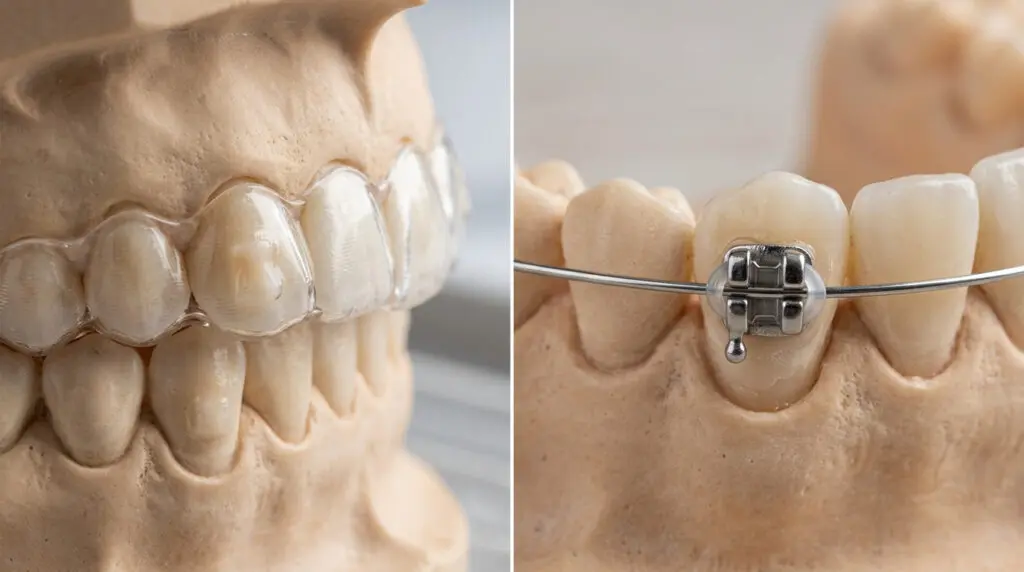
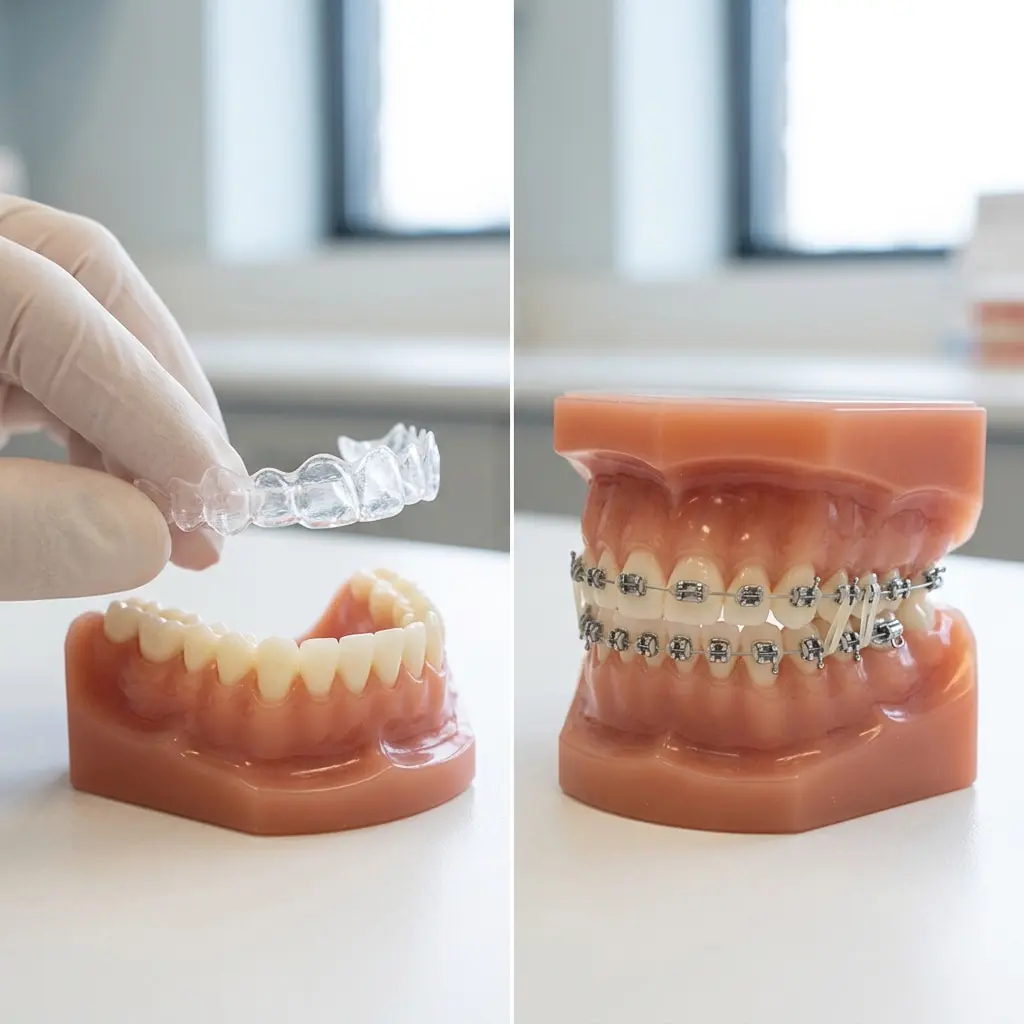
Neither clear aligners nor braces is universally better. The right choice depends on the malocclusion, the patient’s compliance, lifestyle, and cost. Aligners excel at mild to moderate cases and esthetics. Braces give an orthodontist the most direct control for complex movements. At Limestone Hills the recommendation is driven by the bite, not by preference alone.
Clear aligners and braces are two tools for the same job: moving teeth into a healthy, stable position. Across 5,000+ treated cases at Limestone Hills in Austin, Dr. Rodrigo Viecilli treats the choice as a clinical decision, not a marketing one.
Dr. Viecilli is an ABO Diplomate with a PhD in orthodontic biomechanics and a co-inventor of the SmartArch™ wire. That force-control background is why this comparison is organized by condition rather than by feature list.
The honest version is simple. Some bites can be treated well either way, and the patient’s preference matters. Other bites strongly favor one tool, and there the diagnosis is decided.
How Each System Works
Braces are fixed appliances. Brackets are bonded to each tooth, an archwire runs through the brackets, and the wire applies continuous, controlled force that the orthodontist tunes at each visit. Because the appliance is attached to the teeth, the force is on the case every hour of every day.
Clear aligners are removable trays. The patient wears a sequence of custom, nearly invisible trays, switching to the next set on a planned schedule. Each tray is engineered to move specific teeth a small amount, and small composite attachments are often bonded to the teeth to give the tray a better grip for harder movements.
Both systems move teeth through the same biology. Controlled force triggers bone remodeling, the tooth moves, and the bone stabilizes around the new position. The clinical difference is how directly the orthodontist can shape that force, and how dependent the result is on the patient wearing the appliance as prescribed.
At Limestone Hills, Dr. Viecilli plans both the same way: diagnose the bite from records and a 3D scan, define the target position, then choose the appliance that delivers the planned movements most predictably for that specific case.
Cost
Cost is one input, not the deciding factor. For an equivalent comprehensive case, clear aligners and braces fall in a similar overall range, and the difference between them is often smaller than patients expect. Simpler alignment costs less than complex correction in either system.
Metal braces are frequently the most economical option for a complex case, because the appliance itself is inexpensive relative to the engineering. Ceramic braces and clear aligners can cost more for esthetics or for the lab work behind a custom tray series. The honest answer for a given patient comes from a consultation and a specific plan, not a blog table.
One caution is worth stating plainly. A higher fee does not buy a better result on its own, and a lower fee does not signal a weaker appliance. The outcome is set by the diagnosis, the treatment plan, and the orthodontist supervising the case far more than by the appliance on the teeth.
Limestone Hills quotes both options in plain numbers so an Austin family can compare like for like, with financing options explained in the same conversation.
Treatment Time
Treatment time is set by the difficulty of the planned movements, not by the appliance label. Most comprehensive treatment runs roughly twelve to twenty-four months in either system. Minor alignment can finish faster in either. The most complex corrections take longer in either.
Braces work continuously because they are fixed, which helps keep complex cases on schedule. Aligners only work while they are in the mouth, so the timeline depends heavily on the patient wearing each tray the prescribed twenty to twenty-two hours a day. A patient who removes trays often will extend the case regardless of how good the plan is.
For an equivalent case treated to the same standard, the appliance changes control and esthetics more than it changes total months. Dr. Viecilli sets a realistic time estimate from the diagnostic records rather than from a general average, because two patients with the same chief complaint can have very different underlying bites.
Comfort and Lifestyle
Both systems cause mild, temporary soreness when teeth start moving and after each adjustment or tray change. That is the feeling of teeth moving, not a sign that something is wrong, and it settles within a few days.
Aligners are smooth and removable. Patients eat without food restrictions because the trays come out for meals, and brushing and flossing are normal because the trays come off to clean. The trade-off is discipline. The trays only work when worn, and a patient who is not consistent will not get the planned result.
Braces are fixed, so there is nothing to remember and nothing to lose. The trade-off is hardware. Brackets and wires can irritate the cheek until the tissue adapts, sticky and hard foods are restricted to protect the appliance, and cleaning takes more care around the brackets. For a patient who will not reliably wear trays, that fixed reliability is an advantage, not a drawback.
Esthetics often drive the conversation. Clear aligners are nearly invisible, which matters to many adults and image-conscious teens. Ceramic braces are tooth-colored and less noticeable than metal. Metal braces are the most visible but allow colored elastics that many younger patients enjoy choosing.
Effectiveness by Condition
This is where an orthodontist’s framework matters most, and where most generic comparisons stop short. The same tooth movement is not equally easy in both systems. The sections below summarize how Dr. Viecilli weighs the common malocclusions, in force-control terms.
Crowding. Mild to moderate crowding responds well to clear aligners, especially with planned attachments and, when appropriate, light interproximal reduction. Severe crowding that needs significant tipping, bodily movement, or extractions usually favors fixed braces, because the wire gives more direct three-dimensional control of where each root ends up.
Spacing. Closing gaps is one of the most predictable aligner movements, and many spacing cases are excellent aligner candidates. Large spaces, or spaces combined with a bite problem, can still be more controlled with braces, because closing space without unwanted tipping is easier to manage on a continuous archwire.
Overbite, underbite, and crossbite. Mild to moderate bite corrections can often be treated with aligners, frequently with elastics. Larger skeletal discrepancies, a deep overbite that needs real vertical control, or an underbite with a skeletal component are different.
Those cases are where fixed appliances, growth modification in younger patients, or surgical coordination in adults often become necessary. The bite, not the brand, sets that path.
Rotations. Mild rotations correct predictably with aligners and attachments. Severely rotated teeth, especially round teeth like premolars and canines, are one of the classic places aligners lose predictability, because the tray has little surface to push against. These cases often finish more reliably with braces, or with braces used for a finishing phase.
Extrusion and intrusion. Moving a tooth down into the bite, or up into the bone, is biomechanically demanding. These vertical movements are among the hardest for aligners to express, and they are a common reason a case is planned in braces or sent for a fixed-appliance finishing stage.
Dr. Viecilli weights this heavily. A tooth that sits too low or too high and is not fully corrected leaves a bite that will not stay stable.
The Clear Aligner Options at Limestone Hills
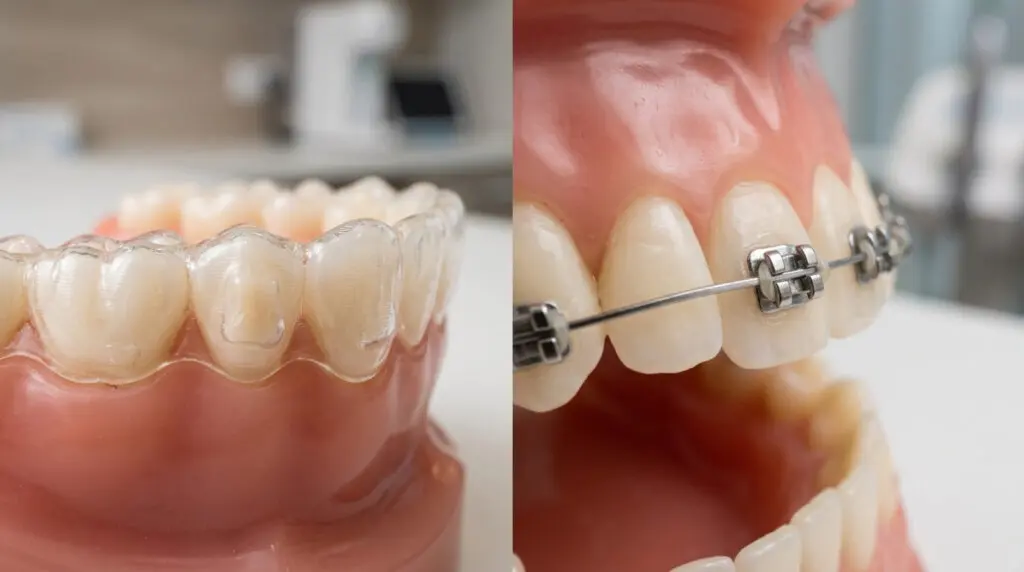
Clear aligners are a category, not a single product. Limestone Hills offers both Angel Aligners and Invisalign, and both are premium systems planned and supervised by an ABO Diplomate. Neither is a budget substitute for the other.
Limestone Hills leans toward Angel Aligners as the preferred system, for clinical reasons. Angel is an orthodontist-only system, distributed to orthodontists rather than to general dental offices or direct to consumers, which keeps it inside specialist hands.
Its advanced tier, Angel Pro, pairs a softer and a stiffer tray per stage. That gives more graded force on demanding movements and better posterior control on complex cases.
Angel also builds the elastic attachment point, the angelButton, directly into the tray as a transparent feature rather than bonding a separate button to the tooth. Dr. Viecilli’s clinical observation at Limestone Hills is fewer breakage and repair visits with that integrated design, because the button comes off with the tray at every meal and avoids chewing forces.
The leaner orthodontist-only distribution also tends to carry lower overhead, part of which the practice can often pass to the patient.
Invisalign remains fully available for patients who specifically prefer that brand. Invisalign has the longest operational record and the largest clear-aligner case database in the category, and that record has real clinical value.
A patient who wants Invisalign gets Invisalign at Limestone Hills. Dr. Viecilli explains the trade-off between the two systems plainly rather than steering every patient to one.
A Decision Framework
The choice is easier when it follows a clear order. Dr. Viecilli applies the same sequence to every case at Limestone Hills, and a patient can use a simplified version of it to set expectations before a consultation.
- Start with the diagnosis, not the appliance. Records and a 3D scan define the malocclusion, the severity, and whether the problem is dental or skeletal. Everything downstream depends on this step.
- Identify the hardest movement in the plan. Severe rotation, large vertical change, significant root repositioning, or a skeletal correction. The hardest movement, not the average one, decides how much direct control the case needs.
- If the hardest movement is biomechanically demanding, lean fixed. Severe rotations, real intrusion or extrusion, large bite corrections, and complex skeletal cases generally favor braces or a braces finishing phase, because the wire gives the most direct three-dimensional control.
- If the case is mild to moderate and the patient will comply, aligners are an excellent fit. Mild to moderate crowding or spacing and many manageable bite issues are reliably treated with aligners, with the esthetic and lifestyle advantages that come with removable trays.
- Weigh compliance honestly. Aligners only work while worn. A patient who will not consistently wear trays the prescribed twenty to twenty-two hours a day is often better served by fixed braces, regardless of esthetic preference.
- Where the case can go either way, let preference and lifestyle decide. Many cases can be treated well in either system. There, esthetics, daily routine, and cost are legitimate deciding factors, and the choice is genuinely shared.
The framework is not a formula that removes judgment. It is the order Dr. Viecilli reasons through so that the recommendation is driven by what the bite needs first, and by patient preference where preference can safely lead.
A Candid Note on the Limits
Two honest concessions belong in any comparison that claims to be useful. First, clear aligners depend entirely on patient compliance. The technology can be excellent and the plan correct, but a tray that sits in a drawer moves no teeth. For a patient who knows they will not be consistent, fixed braces are often the more honest recommendation.
Second, severe skeletal cases, large vertical movements, and the most demanding rotations frequently still need fixed appliances, growth modification in younger patients, or surgical coordination in adults. Marketing that implies any case can be solved with trays is not accurate. The best appliance is the one the bite requires, which is sometimes braces even when the patient would prefer aligners.
Stating those limits is part of the standard Dr. Viecilli applies to every clinical decision at Limestone Hills, the same way he evaluates wires and brackets. A recommendation a patient can trust is one that names the trade-offs out loud.
Austin and the Hill Country
Limestone Hills treats both clear-aligner and braces patients from across Austin and the surrounding Hill Country, including Lakeway, Cedar Park, Bee Cave, and Round Rock. The appliances on offer do not change by neighborhood.
The recommendation does change by case, because a teenager in Westlake with mild crowding and an adult in Steiner Ranch with a deep bite and rotated premolars are different clinical problems. The constant is the supervising orthodontist.
Whether the plan ends in aligners or braces, the same ABO Diplomate diagnoses it, designs it, and explains the trade-off the same way every time. A consultation is the step that turns this comparison into a specific plan and a specific number for the patient in front of the doctor.
Common Questions About Aligners vs Braces
Is it better to get aligners or braces?
Neither is universally better. For mild to moderate crowding or spacing in a compliant patient, clear aligners work well and are nearly invisible. For severe crowding, large bite corrections, significant rotations, or teeth that must be moved up or down in the bone, fixed braces give an orthodontist more direct control. At Limestone Hills, Dr. Viecilli recommends based on the diagnosis rather than the patient’s first preference.
How do I know if I need braces or aligners?
It starts with a diagnosis, not a guess. Crowded teeth, gaps, a bite where the upper and lower teeth do not meet correctly, or difficulty cleaning around crowded teeth all signal an orthodontic problem. Whether aligners or braces treat it best depends on the type and severity of the malocclusion, which an orthodontist assesses from records and a 3D scan during a consultation.
Which works faster, braces or aligners?
Treatment time is set by the case, not the appliance. Most comprehensive treatment runs roughly twelve to twenty-four months in either system. Simple alignment can finish faster with either. Complex movements can take longer in either. The appliance choice changes control and esthetics more than it changes total time for an equivalent case.
Are clear aligners as effective as braces?
For the cases they suit, yes. Aligners reliably correct mild to moderate crowding, spacing, and many bite issues when worn the prescribed twenty to twenty-two hours a day. Fixed braces retain an advantage for severe rotations, large vertical movements, and the most complex skeletal corrections. The deciding factor is the malocclusion and the patient’s compliance, which is why diagnosis comes first.
Can a patient at Limestone Hills choose either one?
Yes. Limestone Hills offers clear aligners, including Angel Aligners and Invisalign, and fixed braces in metal and ceramic. Dr. Viecilli presents the trade-off in plain terms during the consultation. When a case can be treated well either way, patient preference carries real weight. When the bite strongly favors one approach, he says so directly rather than fitting the case to a preference.
Sources. Manufacturer product information (Invisalign/Align Technology; Angel Aligner) and standard orthodontic treatment-modality literature, stated qualitatively. Specifics that could not be independently verified are stated qualitatively rather than as exact figures. Clinical observations from Limestone Hills Orthodontics, Austin, TX.