
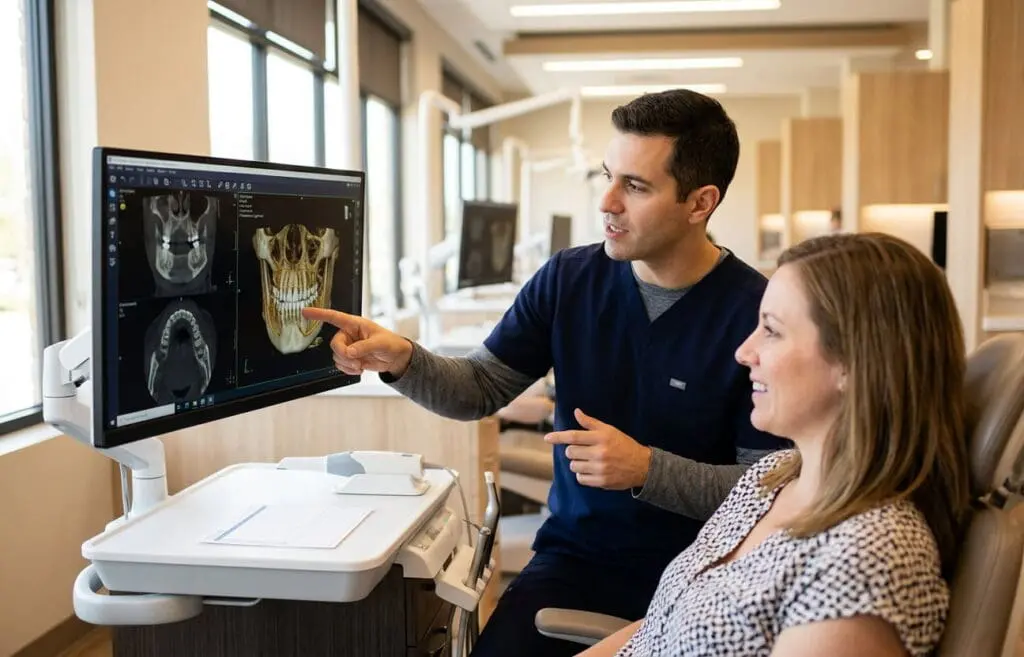
The real difference is the model, not the brand. Invisalign delivered by an orthodontist comes with an in-person exam, 3D imaging, and ongoing supervision.
The direct-to-consumer model used by SmileDirectClub, which ceased operations in 2023, and Byte, which suspended US sales in 2024, ships aligners without in-person diagnosis or supervision. That missing diagnostic and supervisory layer, plus the continuity risk if a provider exits the market, is the core concern.
Across 5,000+ treated cases at Limestone Hills in Austin, Dr. Rodrigo Viecilli’s clinical assessment is consistent: the protective part of orthodontic care is the diagnosis and the supervision, not the tray itself. An ABO Diplomate with a PhD in orthodontic biomechanics and 27+ publications, he frames the comparison around what an unsupervised model structurally cannot do.
It cannot detect active periodontal disease before force is applied. It cannot image root length, root angulation, and bone level. It has no clinician watching the biology while the teeth move, and no one accountable to manage a complication if one develops mid-case.
None of that is a statement against any company. It is a statement about a class of model. A supervised aligner case and an unsupervised one are different clinical pathways, and the difference is the part patients cannot see in a marketing photo.
The Real Comparison Is the Model, Not the Brand
Patients in Austin search “Invisalign vs SmileDirectClub vs Byte” expecting a head-to-head on three products. The more useful frame is different. Invisalign is one brand inside a category, the orthodontist-directed or in-office model. SmileDirectClub and Byte are brands inside a different category, the direct-to-consumer mail-order model.
The clinical question is not which brand of plastic is best. It is which model places a diagnosing and supervising clinician between the patient and weeks of continuous force. That is the variable that changes outcomes and recourse, and it is the variable this article is about.
This is the same framing Dr. Viecilli applies in the companion guide on the risks of mail-order orthodontics. The concern is the absence of a clinician, not remote convenience itself, and the distinction matters before any product is named.
What the Orthodontist-Directed Model Is
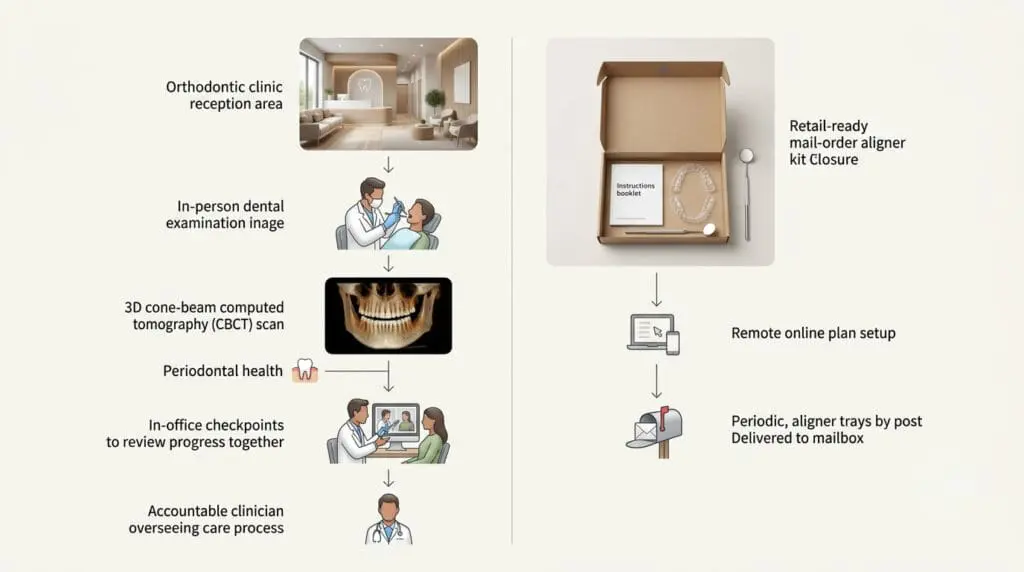
In the in-office model, a clear aligner case begins with a clinician examining the mouth in person. At Limestone Hills that means a clinical exam, a 3D cone-beam CT scan, an intraoral scan, and a periodontal screening before any plan is approved. Invisalign trays are then planned and supervised by the orthodontist, not shipped from a remote review.
The plastic tray in this model can look similar to a mail-order tray. What surrounds it is not similar. A licensed orthodontist diagnoses the case, controls the staging, verifies tracking at checkpoints, and decides when refinement is needed. The same clinician is accountable for the outcome from the first record to the final retainer.
That accountability is a treating-doctor relationship with professional liability behind it. It is structurally different from a product purchase, and it is the reason an orthodontist-directed Invisalign case and a mail-order case are not interchangeable even when the trays resemble each other.
What the Direct-to-Consumer Model Is
In the direct-to-consumer model, a patient typically takes a putty impression at home or submits photographs. A remote reviewer approves a plan, and aligners arrive by mail. There is no in-person clinical examination by a licensed orthodontist or dentist before treatment begins, and no in-office supervision while the teeth move.
SmileDirectClub and Byte are the two most recognized brands that operated on this model. The appeal is real and worth stating plainly. The price is lower and the process skips office visits. For a patient set on convenience and cost, that is a genuine draw.
What the lower price removes is not the plastic. It removes the clinician who diagnoses, images, screens for gum disease, and watches the case while the teeth move.
The American Association of Orthodontists and the American Dental Association have both issued formal positions that orthodontic movement performed without a prior in-person clinical exam can lead to irreversible harm. That risk attaches to the model, not to a single company.
What Supervision Adds That a Kit Cannot
Tooth movement is a biological process, not a cosmetic edit. When a tooth is pushed, bone resorbs on one side and rebuilds on the other, and the root sits inside that remodeling bone. None of this is visible in a photograph of the front teeth, which is the only data a typical mail-order workflow captures.
An in-person orthodontic workup screens for active gum disease, untreated decay, bone loss, root position, impacted teeth, jaw-joint dysfunction, and skeletal relationships. Moving teeth through undiagnosed periodontal disease can accelerate bone loss. Applying force without knowing root and bone position raises the risk of root resorption, a shortening of the root tip.
Dr. Viecilli’s clinical view is that the diagnostic step is the part that protects the patient. A patient who looks healthy in a selfie can have a condition that only a clinical exam and imaging detect, and force applied across that condition can do damage that does not reverse.
Supervision adds a second protective layer after diagnosis. A clinician verifying tracking at checkpoints catches a tooth moving off the planned path early, while it is still a small correction. In an unsupervised case no one is watching, so a small deviation compounds before anyone notices, if anyone notices at all.
Treatment-Complexity Limits of the Unsupervised Model
Even setting safety aside, the unsupervised model has a narrow clinical range. A direct-to-consumer plan is built from crown shapes inferred remotely, so it is best suited to very mild, purely cosmetic crowding or spacing on otherwise healthy teeth and gums. Outside that narrow band, the case needs diagnosis the model does not perform.
Bite correction, rotations, posterior control, deep bites, open bites, and any movement that depends on root position are where unsupervised cases most often lose predictability. These are exactly the movements where an orthodontist images the roots and bone, grades the force, and adjusts the plan as the teeth respond.
The decision of whether a discreet aligner is even the right tool for a given bite is itself a diagnostic judgment. That judgment is the subject of the companion guide on whether an orthodontist is needed for Invisalign, and it is a judgment a remote photo review is not positioned to make.
The Public-Record Continuity Risk
There is a second risk in the unsupervised model that has nothing to do with clinical safety and everything to do with structure. Because a direct-to-consumer arrangement is a transaction with a company rather than a relationship with a local treating clinician, the patient’s continuity of care depends on that company remaining in the market.
The recent record illustrates the exposure. It is documented public record that SmileDirectClub ceased its global operations and filed for Chapter 7 bankruptcy in late 2023. Separately, Byte suspended its US aligner sales in 2024 amid a regulatory review of its products. Both facts are stated here neutrally and only as public-record status.
The point is not a judgment about either company. It is a patient-protection observation. When a provider in an unsupervised model exits the market mid-treatment, a patient can be left without a treating clinician obligated to finish the case, and a manufacturer warranty is not a substitute for that obligation.
An orthodontist-directed case at a local Austin practice does not carry the same continuity exposure. The treating relationship and the obligation to finish the case sit with a named, licensed, insured clinician in the community, not with a remote company whose market status can change.
Refund, Warranty, and Recourse
Recourse is its own consideration because of how the unsupervised model is structured. A direct-to-consumer purchase is generally governed by a product warranty and a refund policy rather than a treating-clinician duty. If harm develops, there is often no in-network orthodontist obligated to diagnose the problem, halt the movement, and finish the case correctly.
The corrective path is usually to start over. That means a new orthodontic diagnostic workup, a new plan built around the current state of the teeth and bone rather than the original starting point, and a new treatment fee. Damage that already occurred, such as root shortening or attachment loss, may not be fully reversible, which limits what a corrective plan can achieve.
Limestone Hills accepts second-opinion consultations for Austin-area patients who want a clinical review of where an unsupervised case stands. Dr. Viecilli evaluates what was planned, what the imaging now shows, and what finishing the alignment under supervision would require, so the next decision is made with full information.
Where Invisalign and Angel Aligners Fit
Within the orthodontist-directed category, Limestone Hills offers two systems. Angel Aligners is the practice’s preferred orthodontist-only system, and Invisalign is available for patients who specifically prefer that brand. The detailed engineering comparison between those two is covered in Invisalign vs Angel Aligners.
For the purpose of this article the relevant point is narrower. Both Angel and Invisalign at this practice are orthodontist-directed and supervised by an ABO Diplomate. Both sit on the in-office side of the model line. Choosing between them is a clinical-fit and brand-preference decision, not a supervised-versus-unsupervised one.
That is the distinction worth keeping straight. The contrast in “Invisalign vs SmileDirectClub vs Byte” is not Invisalign winning a brand contest. It is the supervised model, which includes both Invisalign and Angel here, being a structurally different pathway from the unsupervised one.
In-Office vs Direct-to-Consumer at a Glance
| Dimension | Orthodontist-directed (in-office, e.g. Invisalign or Angel at Limestone Hills) | Direct-to-consumer (mail-order model) |
|---|---|---|
| In-person exam | Required before any plan is approved | Not part of the model; home impression or photos instead |
| Diagnostic imaging | 3D CBCT and intraoral scan; roots and bone assessed | Not part of the model; crowns inferred remotely |
| Periodontal screening | Performed before force is applied | Not part of the model |
| In-treatment supervision | Clinician verifies tracking and refinements at checkpoints | Patient self-reports remotely; no in-office checkpoints |
| Complexity range | Mild through complex, including bite and posterior control | Best suited to very mild cosmetic crowding or spacing only |
| Accountability | Named, licensed, insured treating clinician obligated to finish the case | Generally a product warranty and refund policy, not a treating duty |
| Continuity of care | Local practice relationship continues through the case | Depends on the company remaining in the market; SmileDirectClub ceased operations in 2023, Byte suspended US sales in 2024 |
The table compares clinical models, not companies. It does not rank brands, because the load-bearing distinction is whether a diagnosing and supervising orthodontist stands between the patient and continuous force.
The Candid Part
An honest comparison states the other side. Direct-to-consumer aligners are cheaper and more convenient than in-office care, and for a narrow set of very mild, purely cosmetic cases on healthy teeth and gums they can move teeth acceptably. For that small group the model is not a trick, and saying otherwise would not be candid.
The concern is not the plastic and not the convenience. It is the absence of diagnosis and supervision when something is wrong, the narrow complexity range, and the continuity risk if the provider exits the market. Those are structural features of the model, and they do not change because a given patient’s case happened to be simple.
Dr. Viecilli’s position is the same one he applies to every clinical decision. The protective layer is the diagnosis and the supervision. A patient who wants a discreet, low-visibility result can have one fully supervised, which removes the trade-off rather than accepting it.
Austin and the Hill Country
Limestone Hills delivers supervised aligner care across Austin and the surrounding Hill Country, including Lakeway, Cedar Park, Round Rock, Bee Cave, Westlake, and Steiner Ranch. The supervised-versus-unsupervised distinction does not change by neighborhood, and neither does the diagnostic standard applied before any plan is set.
Every patient receives an in-person clinical exam, a 3D CBCT scan, and a periodontal screening before any tooth is moved, and the same ABO Diplomate supervises the case to completion. Whether the plan ends in supervised Invisalign or Angel Aligners is a clinical and preference decision made at the consultation, detailed on the Invisalign page and the clear-aligners overview.
Common Questions About In-Office vs Direct-to-Consumer Aligners
What is the difference between Invisalign and direct-to-consumer aligners like SmileDirectClub or Byte?
The difference is the model, not the brand. Invisalign at an orthodontic practice is delivered after an in-person clinical exam and 3D imaging, with a clinician supervising the case at checkpoints. The direct-to-consumer model used by SmileDirectClub, which ceased operations in 2023, and Byte, which suspended US sales in 2024, ships aligners from a home impression or photos without an in-person exam or ongoing supervision. The clinical and continuity risk sits in that missing diagnostic and supervisory layer.
Is SmileDirectClub still in business?
No. It is documented public record that SmileDirectClub ceased its global operations and filed for Chapter 7 bankruptcy in late 2023. This post references that closure factually and only to illustrate a structural point: in an unsupervised direct-to-consumer model, a patient mid-treatment can be left without a treating clinician if the provider exits the market. An orthodontist-directed case at a local practice does not carry that same continuity exposure.
What about Byte aligners?
Byte suspended its US aligner sales in 2024 amid a regulatory review of its products. This post states only that verifiable public-record status and does not assert any unverified specifics. The relevant point for a patient is the same continuity-of-care concern: an unsupervised purchase model can leave a patient without an accountable treating clinician if the company changes its market status during a case.
Are direct-to-consumer aligners ever a reasonable choice?
For a narrow set of very mild cases, direct-to-consumer aligners are cheaper and convenient and can move teeth acceptably. The honest concern is not the plastic tray. It is the absence of a diagnosing clinician, no imaging of roots and bone, no periodontal screening, no in-treatment supervision, and limited recourse if something goes wrong. Dr. Viecilli’s view is that the diagnostic and supervisory layer is the part that protects the patient.
Does Limestone Hills only offer Invisalign?
No. Limestone Hills offers both Angel Aligners, the practice’s preferred orthodontist-only system, and Invisalign for patients who specifically prefer that brand. Both are orthodontist-directed and supervised by Dr. Viecilli, an ABO Diplomate. The category being contrasted in this article is supervised in-office care versus the unsupervised mail-order model, not one brand against another.
Sources. Public-record business filings, SmileDirectClub Chapter 7 bankruptcy and cessation of global operations, 2023, stated factually and neutrally. Publicly reported regulatory developments, Byte suspension of US aligner sales amid a regulatory review, 2024, stated only as verifiable public-record status.
American Association of Orthodontists and American Dental Association published positions that orthodontic treatment performed without a prior in-person clinical examination by a licensed orthodontist or dentist can lead to irreversible harm, cited for the clinical-model risk pattern, not as a claim about any single company.
Manufacturer product information for Invisalign and Align Technology and for Angel Aligner. Clinical reasoning on supervised diagnosis is stated qualitatively. Any specifics that could not be independently verified, including unverified lawsuit counts or settlement figures, are omitted rather than asserted. Clinical observations from Limestone Hills Orthodontics, Austin, TX.