
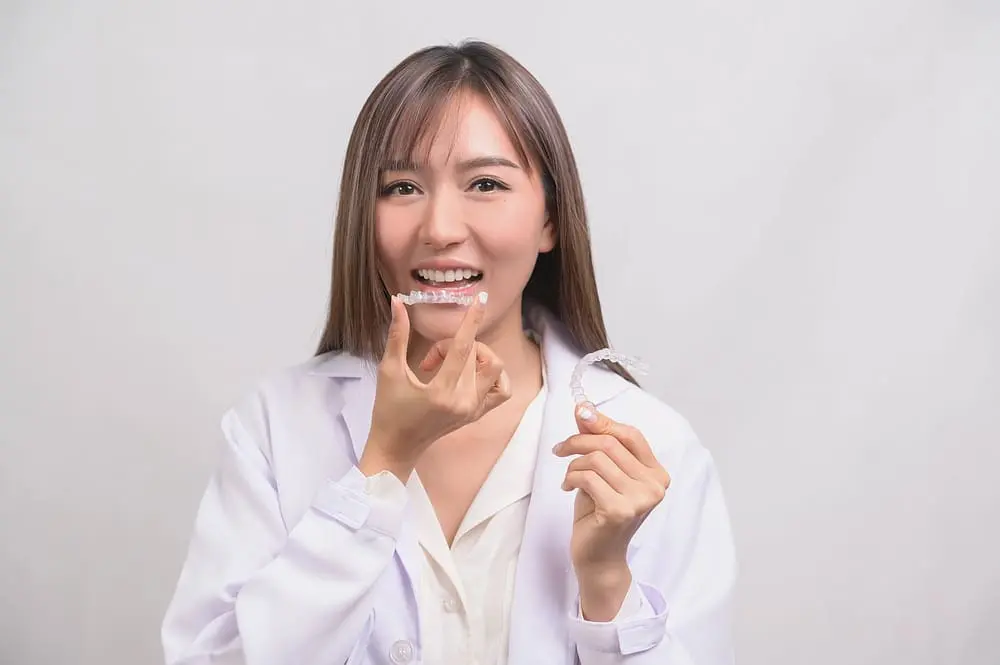
Short answer. No law requires an orthodontist for Invisalign, and many Austin general dentists offer it. The clinical answer is different. Invisalign is a tool; the clinician who diagnoses the case and directs the tooth movement determines the result.
An orthodontist completes a CODA-accredited residency in tooth movement and bite correction and reads a 3D scan that a tray alone cannot account for. For simple alignment a trained general dentist can do well. For anything complex, the diagnosis and the biomechanics are what the orthodontist adds, not the plastic.
Dr. Rodrigo Viecilli‘s clinical position at Limestone Hills Orthodontics: the Invisalign ClinCheck plan is only as accurate as the diagnosis behind it. The aligner does not decide which teeth should move, how far, in what order, or whether plastic alone can achieve a given movement. A clinician makes those decisions.
Every Invisalign case at the practice begins with a 3D CBCT scan that reveals root position, bone level, and skeletal relationships, then a chairside diagnosis, then a treatment plan, then the trays. Dr. Viecilli is a Diplomate of the American Board of Orthodontics, holds a CODA-accredited Specialty Certificate in Orthodontics, and earned a PhD in orthodontic biomechanics from Indiana University. That training is specifically about how force moves teeth through bone safely, which is the judgment a tray cannot supply.
The honest qualifier: many simple Invisalign cases can be completed competently by a well-trained general dentist who performs a proper workup. The real predictor of a case going wrong is complexity plus the absence of a diagnosis, not the provider’s title by itself.
Invisalign Is a Tool, Not a Treatment Plan
Patients often picture Invisalign as a product that straightens teeth on its own. It is more accurate to picture it as an instrument that executes a plan a clinician designs. The clear trays apply force. They do not decide which teeth move, how far, in what order, or whether a movement is achievable with plastic alone.
That decision-making is orthodontic diagnosis and treatment planning. It starts with imaging that shows what is below the gumline: root angulation, bone thickness, and the skeletal relationship between the jaws.
A tooth can look straight in the mirror while its root sits in a position that will not tolerate the movement a generic plan proposes. Only a diagnosis built on 3D data catches that before treatment begins.
The Invisalign ClinCheck software stages tooth movements and produces an animation. The animation is a proposal, not a guarantee. Teeth follow the plan only when the planned forces are biologically reasonable and mechanically deliverable. Judging that is clinical work the software cannot do, and the patient cannot evaluate from the animation.
This is the core reason the provider matters. The aligner is broadly the same instrument in every office. The diagnosis and the plan are not. A strong plan produces a predictable case. A plan built on a thin diagnosis produces the stalled cases, the surprise refinements, and the bite that closes wrong.
The Four Things an Orthodontist Adds to an Invisalign Case
An orthodontist’s contribution to Invisalign is not the trays. It is four clinical functions the trays cannot perform.
Diagnosis. An orthodontist reads a 3D scan and a clinical exam to determine the actual problem. Crowding can be a tooth-size issue, an arch-width issue, or a skeletal issue, and the correct Invisalign approach differs for each.
Misdiagnosing the cause produces a plan that moves teeth into positions that will not hold. Diagnosis is the orthodontist’s full-time specialty after a residency dedicated to it.
Biomechanically sound planning. The American Association of Orthodontists describes orthodontists as experts in the diagnosis of orthodontic problems, the forms of treatment, the timing of treatment, treatment planning, and supervision of treatment.
Planning means deciding where attachments go, when elastics are needed for a bite correction, whether a movement needs a different appliance, and how to sequence movements so the periodontal ligament and bone respond well. A PhD in orthodontic biomechanics, in Dr. Viecilli’s case, is training in exactly that force-and-biology relationship.
In-person monitoring. Teeth do not always follow the plan. An attachment debonds, a tooth lags, a tray stops seating. Caught early at a chairside checkpoint, these are small corrections. Caught late, they compound into a finish that does not match the plan. A photo-only workflow cannot replicate this.
Rescue of a stalled case. When a case goes off track, an orthodontist can re-image, re-diagnose, re-plan, add mechanics, or switch to braces for a phase. This requires the depth to know why the case stalled, not just that it did.
Orthodontist vs General Dentist vs Direct-to-Consumer for Invisalign
Three categories of provider can put a patient into clear aligners. They differ in training and in the clinical layer attached to the trays. The comparison below is about that clinical layer, stated neutrally; it is a question of diagnostic depth and supervision, not of anyone’s intent.
| Factor | Orthodontist | General dentist | Direct-to-consumer kit |
|---|---|---|---|
| Specialty training in tooth movement | CODA-accredited two to three year residency focused entirely on orthodontics. | Dental degree plus, typically, a manufacturer product course. | No clinician relationship for the patient. |
| Diagnostic imaging at the start | 3D CBCT and intraoral scan, in-person clinical exam. | Varies by office; some image, some do not. | At-home photos or putty impression, no in-person exam. |
| Who builds the treatment plan | The orthodontist reviews and modifies the ClinCheck plan chairside. | The dentist, often relying more heavily on the default software staging. | Remote panel review; no chairside clinician for the patient. |
| Attachments and elastics | Engineered onto specific teeth per the diagnosis, elastics for bite correction. | Used to varying degrees depending on training and case selection. | Generally not used; limited mechanical control. |
| Progress monitoring | In-person checkpoints every 6 to 12 weeks with direct exam. | In-person, frequency varies by practice. | Photo-based remote check-ins. |
| Best-fit case range | Mild to severe, including bite correction, rotations, and planned extractions. | Mild crowding and spacing; appropriate complex referrals. | Mild crowding and spacing, marketed as cosmetic. |
| If the case stalls | Re-diagnose, re-plan, add mechanics, or change appliance. | May refer to an orthodontist for complex correction. | Limited recourse; documented industry instability. |
The American Association of Orthodontists position is that only dentists who complete an accredited orthodontic residency may call themselves orthodontists, and that general dentists do not have the same level of education and experience in orthodontic treatment. That is a statement about training depth, not a judgment of any individual dentist’s care.
The Supervision Gap, Stated Plainly
The clearest way to understand why the provider matters is to look at what happens when supervision is removed entirely. The direct-to-consumer aligner model did exactly that, and the documented record is instructive without needing to assign motive to anyone.
The American Association of Orthodontists has stated repeatedly that clear aligner therapy is a medical treatment, not a cosmetic product, and that treatment without an in-person clinical examination can cause irreversible harm including tooth loss, gum recession, bite changes, and root resorption.
The AAO considers an initial in-person exam, including imaging to rule out problems such as gum disease, a necessary part of safe aligner treatment.
Industry events illustrate the point. SmileDirectClub, the largest direct-to-consumer aligner company, filed for Chapter 11 bankruptcy in September 2023 and ceased operations, leaving patients mid-treatment without a clinician.
Byte, owned by Dentsply Sirona, suspended its at-home product worldwide in October 2024 after FDA discussions about patient screening and stated it would not reinstate it. These outcomes trace to the absent in-person diagnostic and monitoring layer that a dentist or orthodontist provides in an office.
The supervision gap is a spectrum, not a switch. A mail-order kit removes nearly all of it. A general dentist provides a clinical layer that, for simple cases with a real workup, is sufficient. An orthodontist adds the deepest diagnostic and biomechanical layer, which matters most as complexity rises.
When Choosing an Orthodontist Matters Most for Invisalign
For a candid framework: the provider’s title matters least when the case is genuinely simple and a proper diagnosis confirms it. Mild crowding, minor spacing, a single rotated tooth in an otherwise sound bite, these can be handled competently by a trained general dentist who images the case and plans it carefully.
The title matters most in the cases where complexity is present, and the trap is that complexity is often invisible until a 3D scan reveals it. The following situations push beyond what default tray staging handles well:
- Bite correction. Deep bites, open bites, and jaw-relationship discrepancies (Class II or Class III) need elastics, attachment strategy, and sometimes auxiliary appliances planned by a clinician who treats these full time.
- Significant crowding. Distinguishing a tooth-size problem from an arch-width or skeletal problem changes the entire plan. The wrong call moves teeth into positions that relapse.
- Planned extractions or space closure. Closing extraction spaces with aligners is one of the harder tasks in the discipline and is unforgiving of a weak plan.
- Rotations and root movements. Rotating round teeth or moving roots, rather than tipping crowns, requires precise attachment engineering and biomechanical sequencing.
- A previously stalled case. A case that did not finish elsewhere needs re-diagnosis, not another generic plan layered on top of the first.
The practical recommendation that follows from this is not about provider type at all. It is this: get a real diagnosis before committing to any Invisalign plan, from any provider.
A 3D scan and a clinical exam reveal whether a case is actually simple or only looks simple. That diagnostic step is the single best predictor of a smooth case, and it is the step the orthodontist’s training is built around.
Credentials to Look For in an Invisalign Provider
Patients comparing providers in Austin can use three concrete signals, each independently verifiable.
A CODA-accredited Specialty Certificate in Orthodontics. The Commission on Dental Accreditation is the agency recognized by the U.S. Department of Education for accrediting dental specialty programs.
A certificate from a CODA-accredited orthodontic residency is the credential the American Dental Association requires to recognize a dentist as an orthodontist and the basis for AAO membership. A weekend course is product training, not specialty training.
Diplomate of the American Board of Orthodontics. ABO certification is a voluntary credential earned by passing written and clinical examinations administered by the orthodontist’s peers. It is held by roughly one in three orthodontists in the United States and requires presenting finished, documented cases for peer evaluation.
A consultation that includes a diagnosis. The most important signal is the process itself. A provider who builds a plan without an in-person exam and 3D imaging is building it on a guess. Ask whether the consultation includes both, and whether the clinician who will direct the case explains the plan chairside.
Dr. Viecilli at Limestone Hills Orthodontics holds the first two: a Diplomate of the American Board of Orthodontics and a CODA-accredited Specialty Certificate in Orthodontics, alongside a PhD in orthodontic biomechanics from Indiana University, 27 or more peer-reviewed publications, and co-inventorship of the SmartArch superelastic archwire.
The practice’s consultation is built around the third signal: every case is imaged and diagnosed before a plan exists.
Austin and the Hill Country: Getting a Diagnosis Before You Choose
Limestone Hills Orthodontics treats adult and teen Invisalign patients from across the Austin metro and the Hill Country. Patients arrive regularly from Lakeway, Cedar Park, Round Rock, Bee Cave, Westlake, and Steiner Ranch. Within Austin proper, patients come from Tarrytown, Davenport Ranch, River Place, Northwest Hills, Four Points, Jester Estates, and Anderson Mill.
The Austin market includes many providers offering Invisalign, both orthodontists and general dentists. The decision is not about brand availability, because the trays are broadly the same. It is about the diagnostic depth and the supervision attached to them.
Worth asking any Austin provider: does the consultation include 3D imaging, does the clinician who will direct the case review the plan in person, and are refinement and monitoring part of the quoted treatment.
For Austin-area patients already mid-treatment in a stalled Invisalign case, or in a discontinued mail-order case, Limestone Hills accepts second-opinion consultations. An orthodontist’s review of where a case stands and what finishing it under supervision would require is itself a diagnosis, the step the original plan may have skipped.
Common Questions About Orthodontists and Invisalign
Do I legally need an orthodontist to get Invisalign?
No. Invisalign is sold by Align Technology to licensed dentists and orthodontists, and many general dentists offer it. There is no legal requirement that an orthodontist provide it. The question is clinical, not legal. An orthodontist completes a Commission on Dental Accreditation (CODA) accredited residency of two to three years focused entirely on tooth movement, bite correction, and the biology and mechanics of moving teeth safely. A general dentist’s training centers on restorative and preventive care. For a simple alignment case with a sound diagnostic workup, a well-trained general dentist can deliver a competent result. The risk rises with case complexity and with the absence of a proper diagnosis, not with the provider’s title alone.
What does an orthodontist add to Invisalign that the aligners do not?
Four things. First, a diagnosis: an orthodontist reads root position, bone level, and skeletal relationships from a 3D scan and decides what should move, in what order, and how far. Second, a biomechanically sound treatment plan: the Invisalign ClinCheck software stages tooth movement, but a clinician must judge whether each planned movement is achievable with plastic alone or needs attachments, elastics, or a different appliance. Third, monitoring: in-person checkpoints catch a tooth that stops tracking within one tray of when it happens. Fourth, rescue: when a case stalls, an orthodontist can re-diagnose, re-plan, add mechanics, or change course. The trays are identical plastic; the clinical judgment directing them is not.
Can a general dentist do Invisalign well?
For simple cases, yes. The American Association of Orthodontists is clear that clear aligner therapy is a medical treatment requiring an in-person examination and professional supervision, and a general dentist who performs that workup can competently handle mild crowding or spacing. The honest predictor of trouble is not the provider’s title by itself. It is case complexity combined with the absence of a diagnostic workup. A complex bite problem treated without a 3D diagnosis is the high-risk scenario, whether the provider is a dentist or an orthodontist. The reason to choose an orthodontist for anything beyond simple alignment is that diagnosis and biomechanics are the orthodontist’s full-time specialty, and complexity is often invisible until imaging reveals it.
Why is an orthodontist better for complex Invisalign cases?
Complex movements, deep bites, open bites, significant crowding, jaw discrepancies, extraction-space closure, and rotations push beyond what plastic trays accomplish on their own. These cases need attachments engineered onto specific teeth, elastics for bite correction, sometimes auxiliary appliances, and a staging sequence that respects how bone and the periodontal ligament respond to force over time. An orthodontist’s CODA-accredited residency and, in Dr. Viecilli’s case, a PhD in orthodontic biomechanics, are training specifically in that force-and-biology relationship. The Invisalign plan is only as good as the diagnosis and mechanical reasoning behind it, and complex cases are where that reasoning matters most.
What credentials should I look for in an Invisalign provider?
Three signals. First, a Commission on Dental Accreditation (CODA) accredited Specialty Certificate in Orthodontics, which is the credential the American Dental Association requires to recognize a dentist as an orthodontist and the basis for American Association of Orthodontists membership. Second, Diplomate status with the American Board of Orthodontics, a voluntary peer-examined certification held by roughly one in three orthodontists in the United States that requires passing written and clinical examinations. Third, a consultation process that includes an in-person clinical exam and 3D imaging before any treatment plan, because a plan built without a diagnosis is a plan built on a guess. Dr. Viecilli holds all three: an ABO Diplomate, a CODA-accredited residency certificate, and a PhD in orthodontic biomechanics.
Sources. American Association of Orthodontists, “About the AAO,” membership and specialty-training requirements, and consumer guidance on clear aligner therapy and direct-to-consumer orthodontics (aaoinfo.org).
American Board of Orthodontics, board-certification process and Diplomate definition (americanboardortho.com). Commission on Dental Accreditation, accreditation of advanced dental specialty programs in orthodontics and dentofacial orthopedics (recognized by the U.S. Department of Education). American Dental Association, policy discouraging direct-to-consumer dental laboratory services without an in-person clinician role (adopted 2018, reaffirmed 2023).
Dentsply Sirona, public disclosures regarding the October 2024 suspension and January 2025 repositioning of the Byte at-home aligner product (investor.dentsplysirona.com). Clinical observations and consultation protocol from Limestone Hills Orthodontics, Austin, TX.