
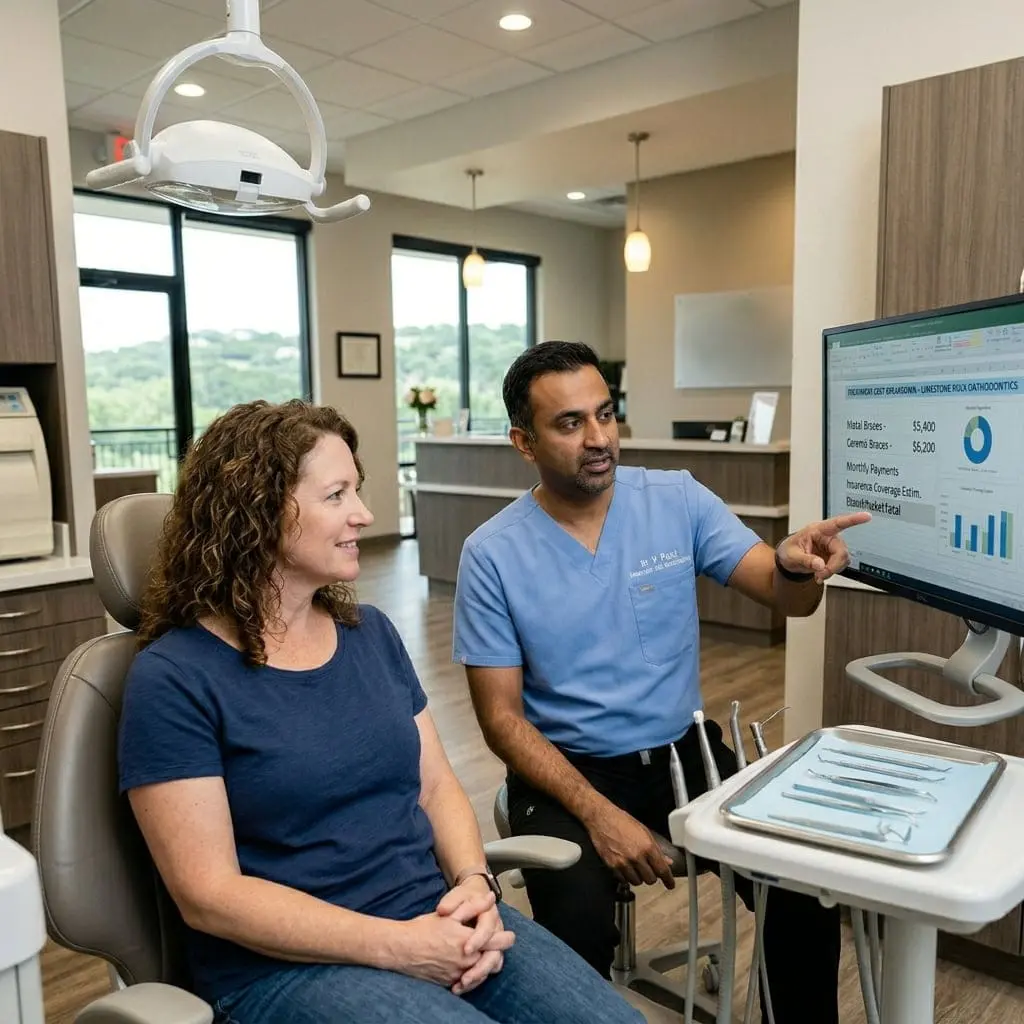
Braces typically cost $3,000 to $10,000 in the United States, with a national average around $5,108 (per the American Dental Association 2024 fee survey). Final cost depends on case complexity, treatment duration (12 to 30 months), and appliance type (metal, ceramic, lingual). At Limestone Hills, comprehensive metal braces start at $4,000 with 0% in-house financing from $149.99/month and no down payment required.
Limestone Hills publishes all starting prices on the website and files insurance claims on the patient’s behalf as a courtesy. Comprehensive metal braces start at $4,000, clear ceramic at $4,600, and children’s Phase 1 at $2,000. The fee covers the 3D CBCT scan, every adjustment visit, broken-bracket repairs for active patients, and the first set of retainers. No surprise retainer bill at the end of treatment.
Cost of Braces by State
Treatment fees vary across the United States by regional cost-of-living and provider type (orthodontist vs general dentist offering aligner brands). The table below shows commonly-published typical ranges per published surveys; case complexity and individual provider pricing drives the final number in any market.
| State | Braces (typical range) | Invisalign (typical range) |
|---|---|---|
| Texas | $4,000-$7,000 | $4,000-$7,500 |
| California | $4,500-$8,500 | $5,000-$8,000 |
| New York | $5,000-$8,500 | $5,000-$8,500 |
| Florida | $3,500-$6,500 | $4,000-$7,000 |
| Illinois | $3,500-$6,000 | $4,000-$6,500 |
Ranges reflect commonly-published national averages per ADA 2024 fee survey + CareCredit/Synchrony ASQ360 2023 + AAO regional data. Specific pricing in any market depends on case complexity and the provider; consult a local orthodontist for accurate quotes.
Braces Cost at Limestone Hills
Limestone Hills publishes all starting prices on the website and confirms the exact case cost at the free consultation after a clinical exam and 3D scan. Starting fees below.
- Metal braces: from $4,000 comprehensive (24-month average treatment)
- Clear ceramic self-ligating braces: from $4,600 comprehensive
- Phase 1 children’s interceptive: from $2,000 (9 to 12 months, ages 7 to 10)
- Monthly financing: from $149.99/month with no down payment and 0% interest in-house
All fees at Limestone Hills are all-inclusive: diagnostic exam, 3D CBCT scan, every adjustment visit, broken-bracket repairs for active patients, and the first set of retainers are covered.
How Case Complexity Affects Braces Cost
Within any practice, the final treatment fee depends on three factors: case complexity (minor crowding vs full bite correction), treatment duration (12 to 30 months), and appliance type (metal, ceramic, lingual, or clear aligners). The table below shows typical complexity-to-cost mapping for orthodontic treatment.
| Case | Typical duration | Cost range |
|---|---|---|
| Mild (minor crowding or spacing) | 6 to 12 months | $3,000 to $5,000 |
| Moderate (alignment + minor bite) | 12 to 18 months | $4,000 to $6,500 |
| Comprehensive (full bite correction) | 18 to 24 months | $5,000 to $8,000 |
| Complex (surgical or skeletal) | 24 to 30 months | $6,500 to $13,000 |
What is Included in the Braces Quote
The biggest source of price-shock at the end of orthodontic treatment is fees the patient was not expecting. The list below is what an all-inclusive braces quote covers at most reputable practices, and the items that are often unbundled and billed separately at clinics that headline a low starting price.
Almost always included
- Initial consultation and clinical exam. The visit where the doctor diagnoses the case and recommends treatment. At Limestone Hills this consultation is free for new patients under 18 and $100 for adults (applied to the treatment fee if the adult starts treatment).
- Digital 3D imaging. Cone-beam CT scan and digital intraoral scan that replace traditional plaster impressions. The diagnostic foundation for the full treatment plan.
- The appliance itself. Brackets and wires for braces; aligner trays for Invisalign. Includes the lab work, shipping, and any per-stage manufacturing fees the practice incurs.
- Every adjustment or check-in visit. Most practices see active patients every 6 to 10 weeks. Each visit is included in the all-inclusive fee, regardless of how many the case ends up needing.
- The first set of retainers. Retainers are mandatory long-term to prevent relapse. The first set at the end of active treatment is typically included.
Sometimes unbundled (ask before signing)
- Refinement aligners (Invisalign cases). Most plans cover an unlimited number of refinements within a fixed window (usually 5 years); a few clinics charge per refinement set after the first refinement round.
- Broken-bracket repairs. Most practices repair a broken bracket for free if the patient is in active treatment and the breakage is occasional. Repeated breakages may carry a fee.
- Lost or broken retainers. The first set is usually included; replacement sets after that are billed at $150 to $350 per arch depending on retainer type.
- Adjunct appliances like expanders, TADs (temporary anchorage devices), or MARA/Herbst functional appliances. When clinically indicated, these are billed separately on top of the base treatment fee.
How Treatment Duration Affects Braces Cost
Treatment duration and case complexity are tightly coupled. A 6-month alignment-only Invisalign case is priced differently than a 24-month comprehensive case because the chair time, the number of appliance stages, and the diagnostic complexity differ substantially. Most practices group cases into three duration tiers and price each tier accordingly.
Short cases (6 to 12 months): minor crowding, minor spacing, single-arch refinement, or post-relapse cleanup of a previous orthodontic case. These cases typically use limited aligner counts (Invisalign Lite or Express tier) or a partial-arch fixed appliance. Pricing usually falls 30% to 50% below the full comprehensive rate.
Standard cases (12 to 18 months): most adult and teen Invisalign or braces cases. Moderate alignment, mild to moderate bite correction, full-arch coverage. This is the mid-tier price point most patients pay.
Long cases (18 to 30 months): comprehensive bite correction, skeletal class II or class III correction, large extraction-space closures, surgical-orthodontic cases. Pricing reaches the upper end of the practice’s fee range. Limestone Hills confirms the projected duration at the consultation after reviewing the 3D scan; the fee quoted at consultation reflects the projected complexity and does not change mid-treatment if the case takes a few months longer than the original estimate.
HSA, FSA, and Tax-Advantaged Payment for Braces
Orthodontic treatment qualifies as a medical expense under IRS section 213. That makes it eligible for Health Savings Account (HSA) and Flexible Spending Account (FSA) dollars, which are funded with pre-tax income and can pay any portion of treatment.
The savings math is straightforward: an adult patient in the 24% federal income-tax bracket plus 7.65% FICA effectively pays 31.65 cents less per dollar contributed to an HSA or FSA. On a $5,000 braces fee, fully funding from pre-tax HSA dollars saves about $1,580 compared to paying with post-tax income. Most Limestone Hills patients combine HSA or FSA pre-tax payments with the in-house monthly plan: the down-payment is paid from HSA/FSA, and the monthly payments come from regular checking.
FSA dollars carry a use-it-or-lose-it rule per plan year. Patients planning to start treatment near the end of the calendar year often front-load the FSA contribution toward the orthodontic fee to avoid forfeiting the balance. Limestone Hills provides itemized treatment-cost letters on request for HSA/FSA reimbursement substantiation.
How Different Insurance Plans Cover Braces
Not all dental insurance plans cover orthodontics the same way. The coverage structure depends on the plan type, the orthodontic rider attached to the plan, and the lifetime maximum benefit. Below is how the four common plan types handle orthodontic treatment.
- PPO (Preferred Provider Organization): the most common employer-sponsored plan type. PPO plans with an orthodontic rider typically cover 50% of the treatment fee up to a lifetime maximum of $1,500 to $3,500 per patient. Patients can see any orthodontist; in-network providers may have a negotiated allowable fee schedule that reduces the patient’s out-of-pocket. Limestone Hills files PPO claims on the patient’s behalf at no additional charge.
- HMO and DHMO (Dental HMO): lower premium but more restrictive. HMO plans typically require the patient to use only in-network providers and may not cover comprehensive orthodontic treatment at all, or may cover it at a capped rate. Patients with HMO coverage should verify orthodontic benefits before scheduling treatment.
- Discount dental plans: not insurance but a discount-card structure. The patient pays a monthly membership fee and gets a 10% to 25% discount off the regular fee at participating providers. Useful for patients without traditional insurance but who want some structural discount.
- Medicaid and CHIP: state-specific. Most state Medicaid programs cover orthodontic treatment only when medically necessary (severe skeletal discrepancy, cleft palate, craniofacial anomaly). Cosmetic alignment cases are generally not covered.
Adult Medicare does not cover orthodontic treatment. Children’s CHIP programs sometimes do for medically necessary cases.
How Patients Pay for Braces
Most patients combine 3 to 5 financing mechanisms to reach the final out-of-pocket. The dominant paths are: (1) dental insurance with an orthodontic benefit (typically 50% coverage up to a $1,500 to $3,500 lifetime maximum), (2) in-office 0% financing with monthly payments, (3) external financing through CareCredit or Cherry, and (4) tax-advantaged HSA or FSA dollars.
Limestone Hills offers in-house monthly financing from $149.99/month with no down payment and 0% interest. CareCredit and Cherry are also accepted. HSA and FSA pre-tax dollars can pay any portion of treatment.
Does Insurance Cover Braces?
Most dental insurance plans with an orthodontic rider cover braces at the same percentage as comprehensive treatment, typically 50% up to a $1,500 to $3,500 lifetime maximum per patient. The benefit applies once per patient regardless of how many providers are involved. Medical insurance generally does not cover orthodontics unless the treatment is medically necessary (sleep apnea, TMJ disorder, or surgical bite correction).
Limestone Hills accepts all major PPO orthodontic plans and files claims on the patient’s behalf at no additional charge. The front-desk team verifies the exact orthodontic benefit before treatment begins so the family knows the out-of-pocket cost in advance.
Common Questions About Braces Cost
How much do braces cost without insurance?
Without dental insurance, comprehensive braces typically cost $3,500 to $7,500 in the United States. At Limestone Hills in Austin, metal braces without insurance start at $4,000 with 0% in-house financing from $149.99/month and no down payment. Care Credit, Cherry, and HSA/FSA dollars also stretch the cost across longer payment terms.
How much do braces cost for adults compared to teens?
Adult braces and teen braces cost the same at most orthodontic practices because case complexity (not patient age) drives pricing. Limestone Hills prices a Phase 2 adolescent comprehensive case and an adult comprehensive case identically. Adult cases sometimes take 2 to 4 months longer because adult bone remodels more slowly, but the fee structure is the same.
Is it cheaper to get braces or Invisalign?
Braces and Invisalign are priced comparably at most orthodontic practices. At Limestone Hills, metal braces start at $4,000 and Invisalign starts at $4,700, with clear ceramic in between. The cost gap is smaller than most patients expect because both treatments require the same diagnostic work and the same clinical supervision. Choice between the two should be driven by clinical fit and lifestyle preference, not price.
Can you really get braces for under $3,000?
Most legitimate orthodontic practices in the United States price comprehensive metal braces at $3,500 or higher because the fee includes diagnostic imaging, every adjustment visit, broken-bracket repairs for active patients, and the first retainers. Quotes below $3,000 typically exclude retainers, exclude refinements, or apply to extremely short single-arch alignment cases. At Limestone Hills, comprehensive metal braces start at $4,000 all-inclusive.
How long does braces treatment take?
Most comprehensive braces cases at Limestone Hills finish in 18 to 24 months. Mild crowding or spacing cases finish in 12 to 14 months. Complex cases involving bite correction or skeletal issues extend to 28 to 30 months. The exact timeline is confirmed at the free consultation after a clinical exam and 3D scan.
Sources. Cost ranges referenced in this article reflect commonly-published national averages from the American Dental Association 2024 fee survey, the CareCredit/Synchrony ASQ360 2023 orthodontic cost study, and American Association of Orthodontists regional cost data. Practice-specific pricing at Limestone Hills is published transparently on the site and confirmed at the free consultation after a clinical exam and 3D imaging.

Braces Pricing for Austin and Hill Country Families
Limestone Hills Orthodontics serves families across Austin and the surrounding Hill Country. Patients regularly travel to the practice from Lakeway, Cedar Park, Round Rock, Bee Cave, Westlake, Steiner Ranch, and the Northwest Hills neighborhoods because all-inclusive pricing and 0% in-house financing apply uniformly regardless of the family’s home neighborhood. Within Austin proper, the practice draws from Tarrytown, Davenport Ranch, River Place, Four Points, Jester Estates, Anderson Mill, and Cat Mountain.
Texas has no state-level orthodontic-fee regulation, so the cost range tracks national averages. Pricing varies more by provider scope (orthodontist-only practices vs general-dentist providers offering Invisalign as a side service) than by Austin neighborhood. Most Texas dental insurance plans with an orthodontic rider follow the same 50% / $1,500-$3,500 lifetime maximum structure as national plans, and Limestone Hills files claims with every major Texas insurer on the patient’s behalf at no additional charge. The front-desk team verifies the exact orthodontic benefit before treatment begins so Austin families know the out-of-pocket cost in advance.