
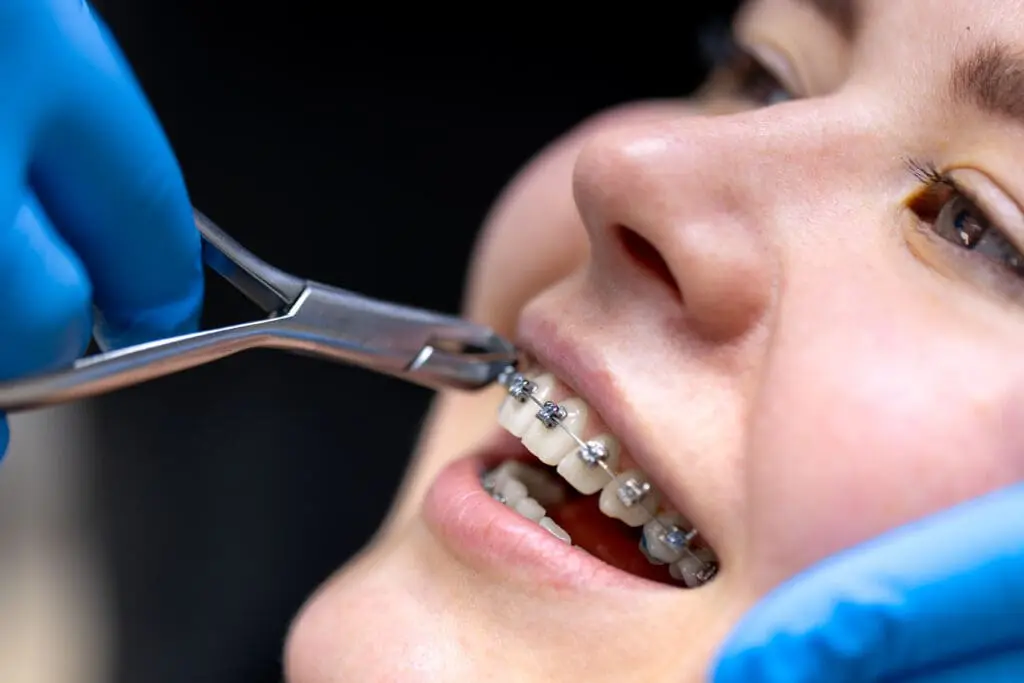
An open bite, where some teeth do not touch even when the jaws are closed, is treated according to its cause and severity. A mild to moderate dental open bite is closed with braces or aligners and vertical elastics while the cause, such as a tongue thrust or thumb-sucking habit, is corrected.
Larger cases may need temporary anchor screws to intrude back teeth, and a significant skeletal open bite in an adult is corrected with orthodontics coordinated with an oral and maxillofacial surgeon. Because open bite relapses more readily than most problems, retention and habit control are central, not optional.
The decision that changes everything in an open bite is not which appliance to use. It is whether the open bite is dental or skeletal. In Dr. Rodrigo Viecilli’s clinical framework at Limestone Hills, that single distinction sets the entire plan.
That judgment is exactly where a biomechanics background earns its keep. Dr. Viecilli is an ABO Diplomate with a PhD in orthodontic biomechanics, a co-inventor of the SmartArch wire system, and an author of 27+ publications.
Across 5,000+ treated cases in Austin he has had to separate the open bite that closes cleanly with controlled tooth movement from the one where the jaws are the real cause and forcing teeth would not hold.
The same depth applies to the mechanics once the cause is known. Closing an open bite often means intruding back teeth in a controlled way, frequently with temporary anchor screws, and controlled intrusion is a force problem before it is an appliance problem.
What an Open Bite Actually Is
An open bite means that when the jaws close all the way, some teeth still do not touch and a gap stays open. The word “anterior” refers to the front of the mouth and “posterior” refers to the back. In the most familiar form, the front teeth do not touch even when the back teeth are closed, leaving a clear vertical space at the front.
It is a vertical problem, which makes it different from an overbite or an underbite. Those describe how the upper and lower teeth sit front to back. An open bite describes a failure of the teeth to meet up and down, so a person can have a normal front-to-back relationship and still have an open bite.
That gap is not only cosmetic. When the front teeth do not meet, biting into food, speaking clearly, and closing the lips comfortably can all be affected, because the teeth that normally do that work are not in contact.
This page explains the causes and the treatment logic in depth so a reader can understand the problem. The specific diagnostic workup, pricing, timeline, and the Limestone Hills stability protocol live on the open bite treatment page, which is where a real plan is built.
Anterior Versus Posterior Open Bite
The location of the gap matters because it points toward different causes and different mechanics. There are two broad patterns, and a case can sit clearly in one or blend features of both.
Anterior open bite. This is the common type. The back teeth close together but the front teeth do not meet, so a gap remains at the front of the mouth. It is the pattern most associated with prolonged thumb sucking and with a tongue thrust, because both hold or push the front teeth apart.
Posterior open bite. Here the front teeth meet but one or more back teeth do not contact their opposing teeth, leaving a gap toward the back, often on one side. It is less common and is frequently tied to how teeth erupted, to a lateral tongue posture, or to other localized factors rather than a thumb habit.
Naming the pattern is a first step, not a diagnosis. Two patients with an anterior open bite that looks similar in the mirror can need very different treatment, because the gap is a symptom and the cause underneath it is what the plan has to address.
What Causes an Open Bite
Most open bites trace back to one of three causes, and sometimes to a combination. Identifying which one is in play is the work that makes treatment durable.
Prolonged thumb or finger sucking. A sucking habit that continues well past the early years can hold the upper and lower front teeth apart while the jaws and teeth are still developing. The thumb or finger acts as a constant spacer during growth, and over time the front teeth settle into a position that does not meet.
Tongue thrust. A tongue thrust is a pattern where the tongue pushes forward against or between the front teeth at rest and during swallowing. A person swallows hundreds of times a day, so even a light forward push, repeated that often, is a steady force that can keep the front teeth apart or reopen a gap that was closed.
Skeletal growth pattern. “Skeletal” means the cause is in the jaw bones rather than the teeth. In some patients the jaws grew in a vertical pattern that rotates the bite open, so the teeth can be reasonably aligned while the bones underneath set them apart. This is the cause that most often changes the treatment path.
These causes are not mutually exclusive. A long thumb habit can coexist with a tongue thrust, and an unfavorable growth pattern can be made worse by a habit on top of it. Untangling that combination is a diagnostic task, which is why an open bite is evaluated with a full workup rather than treated by appearance alone.
Dental Versus Skeletal, and Why It Changes the Plan
Every open bite sits somewhere between two causes, and the position on that line decides the treatment. This is the single most important judgment in the case.
A dental open bite means the jaw bones are positioned reasonably well and the problem is in the teeth and the habit acting on them. The front teeth did not erupt or settle into contact, often because a thumb or the tongue held them apart. Moving the teeth and removing the cause can close the gap, because the foundation underneath is sound.
A skeletal open bite means the jaw bones themselves grew in a pattern that opens the bite. The teeth may be acceptably aligned, but the bones they sit in are oriented in a way that holds the bite open. Moving teeth can mask a mild version of this, but it cannot reposition the bones.
The reason this distinction governs everything is biology. Closing a dental open bite is controlled tooth movement, which orthodontics does precisely. Trying to close a significant skeletal open bite by moving teeth far enough to compensate can overstress the teeth and their support, and the result is more likely to relapse because the skeletal cause is still there.
In a still-growing child, a skeletal tendency can sometimes be guided while growth is available, and habit interception alone is occasionally enough. In an adult whose growth is finished, a significant skeletal open bite usually needs orthodontics coordinated with an oral and maxillofacial surgeon, because the bones have to move and only surgery moves them.
The line between those two outcomes is exactly what a 3D evaluation is for, and it is detailed on the open bite treatment page.
Treatment by Severity, Matched to the Cause
Once the cause and the severity are known, treatment follows a logical ladder. The same open bite at different severities can land on different rungs, and the cause is corrected alongside the mechanics, never instead of them.
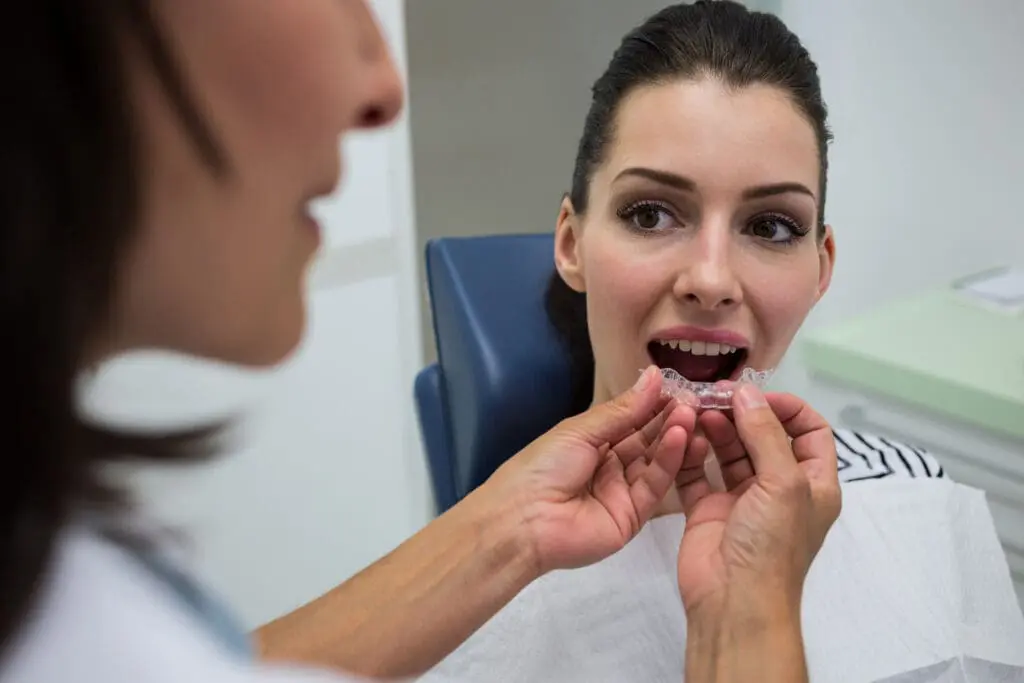
Mild to moderate dental open bite: braces or aligners with elastics. For a dental open bite of modest size, braces or clear aligners with vertical elastics bring the front teeth into contact while the cause is addressed in parallel. If a tongue thrust is the driver, tongue-posture retraining is part of the plan, because closing the gap without changing the force that opened it invites relapse.
Larger dental open bite: temporary anchor screws for controlled intrusion. Some open bites close best by intruding the back teeth so the bite rotates closed at the front. That movement needs a fixed anchor that teeth alone cannot reliably provide.
So a temporary anchorage device, a small temporary screw seated in the bone, is used as the anchor, then removed once the movement is done. This is where biomechanics depth matters, because controlled intrusion is a precise force problem.
Significant skeletal open bite in an adult: surgical coordination. When the cause is the jaws and growth is complete, orthodontics is coordinated with an oral and maxillofacial surgeon, who repositions the bone while the orthodontist aligns the teeth so they fit afterward.
Limestone Hills provides the orthodontic side and coordinates it. How that coordination works is described on the orthognathic surgery page, and the dental-versus-skeletal decision behind it is covered in jaw surgery vs braces.
| Typical cause | Usual nature | General approach |
|---|---|---|
| Prolonged thumb or finger sucking, growth essentially complete | Dental, mild to moderate | Braces or aligners with vertical elastics, plus stopping and accounting for the habit |
| Tongue thrust, dental open bite | Dental, mild to moderate | Tooth movement to close the gap combined with tongue-posture retraining so the force is changed, not just the teeth |
| Over-erupted back teeth driving the bite open | Dental, moderate to larger | Controlled intrusion of the back teeth using temporary anchor screws as a fixed anchor |
| Unfavorable vertical jaw growth, child still growing | Skeletal tendency, growth available | Habit interception and growth guidance evaluated case by case, sometimes reducing later need |
| Skeletal growth pattern, adult, growth complete | Skeletal, significant | Orthodontics coordinated with an oral and maxillofacial surgeon who repositions the bone |
The table summarizes structure. It does not assign a plan, because severity, the exact cause, and whether growth is finished all change the answer, and that is determined from imaging and a full diagnostic review.
The Relapse and Retention Reality
Open bite carries a notably higher tendency to return than many other bite problems, and being honest about that shapes how it is treated. The reason is mechanical and worth understanding.
When a gap is closed but the force that created it is still present, that force keeps acting after treatment. An untreated tongue thrust does not stop pushing because the teeth now touch, and a continuing habit does not lose its effect because braces came off. The same pressure that opened the bite can slowly reopen it.
This is why the cause is treated alongside the gap, not after it. Tongue-posture retraining, habit cessation, and where relevant an airway assessment are part of the plan precisely because they remove or reduce the force that would otherwise undo the result.
Retention for an open bite is also more demanding than for many cases. The general principle, and the reason it is not a casual afterthought, is that an open-bite result is typically held with a clear removable retainer paired with tongue-posture or biting habits, rather than relying on a bonded wire behind the teeth alone.
A bonded wire holds tooth positions; it does not retrain the tongue or change a habit. The exact retention regimen is set per patient and is detailed on the open bite treatment page rather than prescribed generically here.
The Candid Part: Closing the Gap Is the Easy Half
Here is the honest version that does not always make it into a first conversation. Mechanically closing an open bite is the more straightforward part of the work. Keeping it closed is the hard part, and open bite is one of the more relapse-prone problems in orthodontics.
The reason is that an open bite is rarely just a tooth-position problem. It is usually a tooth position created and maintained by something else, a habit, a tongue posture, or a skeletal pattern. Treat only the teeth and leave the cause in place, and the case is being set up to drift back.
That is why Dr. Viecilli’s framework at Limestone Hills puts so much weight on identifying the cause before choosing the mechanics. A plan that says “close the bite” is incomplete. A plan that says “identify the cause, close the bite, and change the force that opened it, then retain it accordingly” is the one that holds.
Stating this plainly is not discouraging. It is the opposite. A patient who understands that retention and habit control are central, rather than optional cleanup at the end, is the patient whose result lasts. The durable answer depends on addressing the cause, not just the gap.
Austin and the Hill Country
Limestone Hills treats open bite patients from across Austin and the surrounding Hill Country, including Lakeway, Cedar Park, Round Rock, Bee Cave, and Westlake. The educational picture above does not change by neighborhood, but the plan always does.
A young patient with a thumb habit and a tongue thrust and an adult with a skeletal open bite are different clinical problems with different paths.
The first and most useful step for an Austin-area patient is finding out which kind of open bite a case is, because the dental-versus-skeletal answer determines everything that follows. A consultation with 3D CBCT imaging answers that question directly.
The full diagnostic workup, treatment options with pricing, the timeline, and the Limestone Hills stability protocol are on the open bite treatment page, which is also the route to a free Austin consultation for a patient who wants that question answered for their specific case.
Common Questions About Open Bite Treatment
What is an open bite?
An open bite is a bite where some teeth do not touch even when the jaws are fully closed. In the most common type the front teeth do not meet while the back teeth are closed, leaving a visible vertical gap at the front. It is a vertical problem, separate from an overbite or underbite, and it can be caused by the teeth, by a habit, or by the way the jaws grew.
What causes an open bite?
The common causes are prolonged thumb or finger sucking that holds the front teeth apart during growth, a tongue thrust where the tongue pushes forward against or between the teeth at rest and during swallowing, and a skeletal growth pattern where the jaws developed in a way that opens the bite. Sometimes more than one factor is present, which is why the cause is identified from a full diagnostic workup rather than assumed.
Can braces fix an open bite?
For a dental open bite that is mild to moderate, braces or aligners with vertical elastics can close the gap, and the cause, such as a tongue thrust, is addressed at the same time. Larger or skeletal cases may need temporary anchorage devices to intrude back teeth, or surgical coordination when the jaws are the cause. The honest answer depends on whether the problem is dental or skeletal, which a 3D evaluation determines.
When does an open bite need surgery?
Surgery enters the conversation when the open bite is skeletal and significant in an adult whose growth is complete, meaning the gap traces to jaw position rather than tooth position and is too large to close stably by moving teeth alone. In that situation orthodontics is coordinated with an oral and maxillofacial surgeon. In a still-growing child, habit control and growth guidance can sometimes reduce or avoid that path.
Why does an open bite relapse?
An open bite has a notably higher tendency to return than many other bite problems because the forces that opened it, especially an untreated tongue thrust or a continuing habit, are still present after the gap is closed. If only the teeth are moved and the cause is left in place, the same pressure can reopen the bite. Durable correction requires addressing the cause and a more demanding retention plan.
Sources. Standard orthodontic literature on open bite malocclusion, including the distinction between anterior and posterior open bite, the common etiologies of prolonged digit sucking, tongue thrust, and unfavorable vertical skeletal growth, and the dental-versus-skeletal classification that governs treatment selection.
Literature on open bite treatment mechanics, including vertical elastics in a dental open bite, posterior intrusion using temporary anchorage devices, growth modification and habit interception in growing patients, and combined orthodontic and orthognathic surgical management of significant skeletal open bite in adults.
The relapse tendency of open bite and its retention implications are stated qualitatively as a notably higher tendency than many other malocclusions; no relapse percentage, success rate, or fixed treatment duration is asserted, because such specifics could not be independently verified and vary by cause, severity, and patient. Clinical observations from Limestone Hills Orthodontics, Austin, TX.