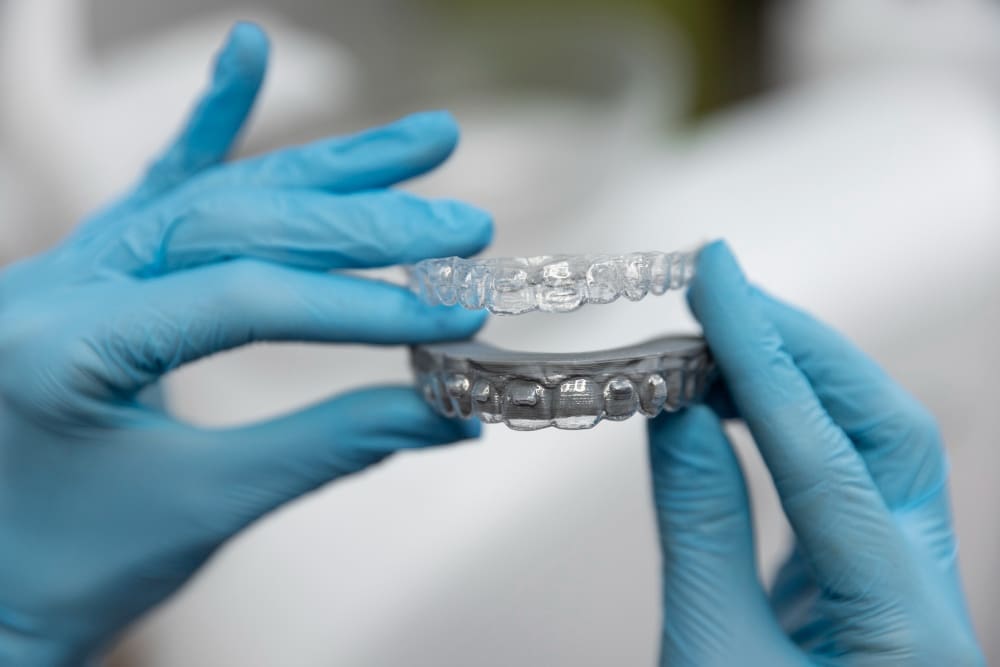
Short answer. The ALF (Advanced Lightwire Functional) appliance is a thin, springy wire fixed to the inside of the teeth and bent into loops that push the teeth outward. It moves teeth, mostly by tipping them; it does not separate the bones of the upper jaw. A rapid palatal expander (RPE) is a rigid screw appliance that loads the seam in the roof of the mouth until the two halves of the upper jaw separate, which widens the jaw itself in growing children. No study has shown the ALF opening that seam, and claims that it moves skull bones, improves posture or treats sleep apnea rest on case reports, not controlled studies.
By Rodrigo F. Viecilli, DDS, PhD, board-certified orthodontist at Limestone Hills Orthodontics in Austin, TX, who has treated more than 5,000 patients.
What the ALF appliance is
ALF stands for Advanced Lightwire Functional, a name also given as Advanced Light Force. It was designed by Darick Nordstrom, DDS, and dates to the 1980s. The appliance is a thin, springy wire that runs along the inside of the teeth from molar to molar, held by small wire clasps around the molars and bonded composite. Loops bent into the wire, called omega loops, are opened to push the teeth outward. Published descriptions give the wire as 0.025 to 0.028 inch Elgiloy, a cobalt-chromium-nickel alloy.
Its users present it as a cranial, osteopathy-based system rather than as a tooth-moving spring. They describe effects on the skull, breathing, posture and the nervous system, and the academy that trains them says its results reach “the brain and the body.”
Dr. Viecilli’s position. The ALF is a wire bent as a spring to deliver forces that expand the teeth. It does not replace a skeletal expander, which acts on the bones, and for skeletal expansion it is biomechanically inferior to a rapid palatal expander (RPE).
What a wire spring can and cannot move
A spring stores force when it is bent and gives it back as it straightens. The ALF is built to stay light: the stiffness of a round wire falls with the fourth power of its thickness, so a slightly thinner wire is far softer, and loops add length that softens it further. The push is gentle by design, and it fades as the teeth move and the loops relax, until the next adjustment.
That push lands on the crowns of the teeth, on the tongue side, far from the tooth’s center of resistance, a point partway down the root. A force applied there tips the tooth: the crown moves outward much more than the root. The arch measures wider at the teeth, but the bone of the upper jaw underneath does not get wider, and the outer wall of bone over the roots gets thinner. Light force is a good way to move teeth. It is not a way to separate bones.
How a rapid palatal expander is different
The upper jaw is two bones joined along a seam in the roof of the mouth, the midpalatal suture. In children the seam is a band of fibrous tissue between the bones, not solid bone. An RPE widens the jaw by pulling that seam apart, and four features of its design make that possible:
- It is rigid. The RPE is a screw on a metal frame cemented to the back teeth. It does not bend, so it cannot relax the way a spring does.
- It opens by a fixed amount. Each turn of the screw opens it 0.25 millimeters whether the bone is ready or not. At Limestone Hills children usually turn it twice a day for 10 to 14 days; see how to turn a palate expander.
- The load builds until the seam gives. Teeth cannot move through bone as fast as the screw opens, so the force passes through them into the jaw. Loads measured in children during expansion rose as high as 120 newtons, about 27 pounds, and dropped once the suture separated.
- It holds the bone apart while it heals. After the last turn the expander stays locked for 3 to 6 months while new bone fills the opened seam.
The visible sign that it worked is a gap between the two upper front teeth, usually in the first week or two: the two halves of the jaw have moved apart and carried the teeth with them. Some tipping of the anchor teeth happens too, so an RPE widens the jaw and the teeth at once. An ALF has no screw and no rigid frame, so it can only do the tooth part.
| Principle | ALF (wire spring) | RPE (screw expander) |
|---|---|---|
| What delivers the force | A thin wire bent into loops | A screw on a rigid metal frame |
| How the force behaves | Light, and fades as the loops straighten | Builds with each turn until the suture separates, up to about 120 newtons in children |
| What moves | Teeth tip outward | The two halves of the upper jaw separate, with some tipping of the anchor teeth |
| Proof that it worked | Wider arch at the teeth only | A gap between the upper front teeth; a CBCT scan shows the opened suture |
| Holding the new width | Not designed to | Locked in place 3 to 6 months while bone fills in |
Why age decides which expander works
The suture tightens and then fuses with age, and the age varies from person to person. In a CBCT study of 140 people aged 5 to 58, the suture usually showed its early, unfused stages up to age 13; from 11 to 17 it was often in a tighter, transitional stage; and 3 of 13 boys aged 14 to 17 already showed fusion in the back part of the palate. That is why the decision rests on a scan, not on a birthday.
Once the suture has matured, a tooth-anchored RPE mostly tips teeth too. The fix is to put the force into the bone itself: a MARPE is an expander anchored with small miniscrews in the palate. In a 2021 review of patients aged 16 and older, MARPE succeeded in about 93% of cases, on very low certainty evidence, with some tipping and thinning of the bone over the teeth. When the suture is fully fused, an oral surgeon releases it and the expander does the rest.
What the studies show
No randomized trial or controlled study of the ALF has been published. The reports in the literature are case reports and descriptions written by dentists who use it. Here is each claim made for it, next to the evidence:
| Claim made for the ALF | What the evidence shows |
|---|---|
| It widens the jaw bone | Not shown. In a randomized trial of 42 children about 9 years old, an RPE opened the suture by 4.1 mm at the front, while a quad helix, a heavier wire spring than the ALF, did not open it at all and thinned the bone over the molars. |
| It works like an expander | In CBCT scans of 16 patients seen for a second opinion after non-surgical expansion with four appliance types (the ALF, two other airway appliances and a miniscrew expander), the suture had not opened in any. The change was tooth tipping, with thinner bone and gum recession in 10. These were dissatisfied patients, so the series shows what failure looks like, not how often each appliance fails. |
| Light, slow force is gentler on the suture | In 6-week-old rats, a very light nickel-titanium wire widened the palatal suture over 3 weeks. Rat sutures are not human sutures, no human study has shown the same with the ALF, and in children even the heavier quad helix did not open the suture. |
| It moves or “unlocks” skull bones | No controlled study. A 2016 systematic review of cranial osteopathy, the idea the ALF is built on, found its diagnostic methods unreliable and strong evidence that it works almost non-existent. |
| It opens the airway and treats sleep apnea | No controlled study of the ALF. The 16 second-opinion patients had been treated for sleep apnea and reported no relief. |
| It improves posture, height, TMJ problems and headaches | Case reports and testimonials only. A 2009 article by an ALF user predicted that patients would grow taller and that the shoulders and hips would realign; it reported no measurements. |
| It is gentle, so bone loss and recession are rare | Tipping teeth outward thins the bone over the roots. Recession appeared in 10 of the 16 second-opinion patients, and a 2026 clinical report described treating ALF complications in adults. |
For comparison, skeletal expansion has been studied in children with sleep apnea and a narrow palate. Across 17 studies of 314 children, the apnea-hypopnea index fell on average from 8.9 to 2.7 events an hour within 3 years of RPE treatment, 26% of the 90 children with that measure reached a normal value, and the authors called for randomized trials. It helps some children as part of medical care; it is not a guaranteed cure. More is in orthodontic treatment for sleep apnea.
About ALF before and after photos: a wider smile in a photo shows that the teeth moved outward. It cannot show whether the bone of the jaw widened. Only a CBCT scan of the jaw base before and after treatment can.
ALF vs RPE vs MARPE at a glance
| Appliance | How it is held | What it moves | Who it fits | Cost |
|---|---|---|---|---|
| ALF | Thin wire along the inside of the teeth | Teeth, mostly by tipping | Not a substitute for skeletal expansion | One provider lists $4,000 to $6,000 for 6 to 18 months |
| RPE | Rigid screw cemented to the upper first molars | The two halves of the upper jaw, plus some tooth tipping | Children and young teens with an open suture, usually ages 7 to 14 | At Limestone Hills, adds $500 to the comprehensive treatment fee |
| MARPE | Expander anchored with miniscrews in the palate | The upper jaw after the suture has matured | Older teens and adults, confirmed by CBCT | At Limestone Hills, from $4,000 depending on the case |
| Surgically assisted expansion | Expander plus a surgical release of the suture | The upper jaw when the suture is fused | Adults whose suture is too fused for MARPE | Quoted with the oral surgeon |
Why the ALF appeals, and who offers it
The ALF is sold as gentle, natural and holistic, with no screw to turn and no heavy pressure. Of the practice websites in the top search results for “ALF appliance” that we reviewed on November 13, 2026, most were general, holistic or airway-focused dental offices, and an orthodontic practice among them advised parents to be skeptical. The gentle force is real, and it is exactly why the appliance tips teeth rather than widening bone.
A light spring is not wrong in itself. Wire expanders are a standard way to correct a crossbite caused by tipped teeth or mild narrowness in a young child, and Limestone Hills uses one for that. The problem starts when a wire spring is sold as jaw growth, cranial correction or a sleep apnea treatment. See crossbites in children.
Questions to ask before starting an ALF
- Is the narrowness in my teeth or in my jaw? A CBCT scan answers it with measurements.
- What stage is the suture in? If the goal is a wider jaw, ask why a skeletal expander is not recommended.
- What will show that the bone widened, and not just the teeth? Ask for CBCT measurements of the jaw base before and after.
- What happens to the bone over the roots? Tipping can thin it; ask how it will be checked.
- Who diagnosed the breathing problem? Sleep apnea is diagnosed by a physician with a sleep study, not by a dental exam.
- What is the total cost, and what finishes the treatment if the teeth still need aligning?
How Limestone Hills widens a narrow upper jaw
Every expansion plan starts with a 3D CBCT scan that measures the width of the jaw and the stage of the suture. In growing children, usually ages 7 to 14, Dr. Viecilli uses a custom RPE cemented to the upper first molars. In older teens and adults whose suture has begun to fuse, he places a MARPE in the office. When the suture is fully fused, he plans surgically assisted expansion with an oral surgeon and manages the orthodontics before and after.
Details are on the palatal expander and MARPE pages, and does my child need a palatal expander covers the signs to watch for. Why tongue exercises cannot widen an adult jaw either is explained in does mewing work.
ALF appliance questions, answered
What does an ALF appliance do?
It pushes teeth outward with light force from a thin wire spring fixed to the inside of the teeth. The teeth tip outward and the arch measures wider at the teeth. No study has shown it separating the bones of the upper jaw.
Can an ALF appliance replace a palatal expander?
Not for widening the jaw itself. Bone widens only when an appliance loads the suture hard enough to separate it and holds it rigidly while new bone fills in: an RPE in a growing child, or MARPE or surgically assisted expansion after the suture matures. An ALF only moves teeth.
Does the ALF appliance work for adults?
It can tip an adult’s teeth, but it cannot widen an adult’s upper jaw, because the suture has matured. Adults who need a wider jaw are evaluated with a CBCT scan for MARPE or surgically assisted expansion.
Can the ALF appliance treat sleep apnea or TMJ problems?
No controlled study shows that it does. Sleep apnea is diagnosed by a physician with a sleep study. In children with a narrow palate and diagnosed sleep apnea, skeletal expansion with an RPE may help as part of medical care, but it is not a guaranteed cure.
How much does an ALF appliance cost?
One provider that offers it lists $4,000 to $6,000 for 6 to 18 months of treatment. At Limestone Hills a standard RPE adds $500 to the comprehensive treatment fee, and MARPE starts at $4,000 depending on the case.
Limestone Hills Orthodontics is on RM 2222 in Northwest Austin. The first visit is free for new patients who have not been in orthodontic treatment in the last 12 months. Book a free orthodontic consultation or call (512) 720-6399.
Sources. Delz E. The ALF (Advanced Lightwire Functional Appliance) creating facial beauty and balance. Int J Orthod Milwaukee. 2009;20(2):23-27. PubMed 19739498. Bronson JM, Bronson JA. Early treatment with the ALF functional appliance. Int J Orthod Milwaukee. 2014;25(1):11-14. PubMed 24812735. Li K, Guilleminault C. Surgical and non-surgical maxillary expansion: expansion patterns, complications and failures. Orthod Fr. 2022;93(Suppl 1):35-46. doi:10.1684/orthodfr.2022.87. Hansson S, Josefsson E, Lund H, et al. Skeletal effects of posterior crossbite treatment with either quad helix or rapid maxillary expansion: a randomized controlled trial with 1-year follow-up. Angle Orthod. 2024;94(5):512-521. doi:10.2319/010424-9.1. Utreja A, Bain C, Turek B, et al. Maxillary expansion in an animal model with light, continuous force. Angle Orthod. 2018;88(3):306-313. doi:10.2319/070717-451.1. Sander C, Hüffmeier S, Sander FM, Sander FG. Initial results regarding force exertion during rapid maxillary expansion in children. J Orofac Orthop. 2006;67(1):19-26. doi:10.1007/s00056-006-0507-y. Angelieri F, Cevidanes LHS, Franchi L, et al. Midpalatal suture maturation: classification method for individual assessment before rapid maxillary expansion. Am J Orthod Dentofacial Orthop. 2013;144(5):759-769. doi:10.1016/j.ajodo.2013.04.022. Kapetanović A, Theodorou CI, Bergé SJ, Schols JGJH, Xi T. Efficacy of miniscrew-assisted rapid palatal expansion (MARPE) in late adolescents and adults: a systematic review and meta-analysis. Eur J Orthod. 2021;43(3):313-323. doi:10.1093/ejo/cjab005. Guillaud A, Darbois N, Monvoisin R, Pinsault N. Reliability of diagnosis and clinical efficacy of cranial osteopathy: a systematic review. PLoS One. 2016;11(12):e0167823. doi:10.1371/journal.pone.0167823. Camacho M, Chang ET, Song SA, et al. Rapid maxillary expansion for pediatric obstructive sleep apnea: a systematic review and meta-analysis. Laryngoscope. 2017;127(7):1712-1719. doi:10.1002/lary.26352. Kim SH, Park JJ. Treatment of complications associated with the Advanced Lightwire Functional Appliance in adult patients. J Clin Orthod. 2026;60(1):36-49. PubMed 41739660. ALF InterFACE Academy, alftherapy.com, and ALF provider pages, read November 13, 2026 (designer, wire, claims, one published price range). Expansion protocol and fees from the Limestone Hills Orthodontics palatal expander page, Austin, TX.