
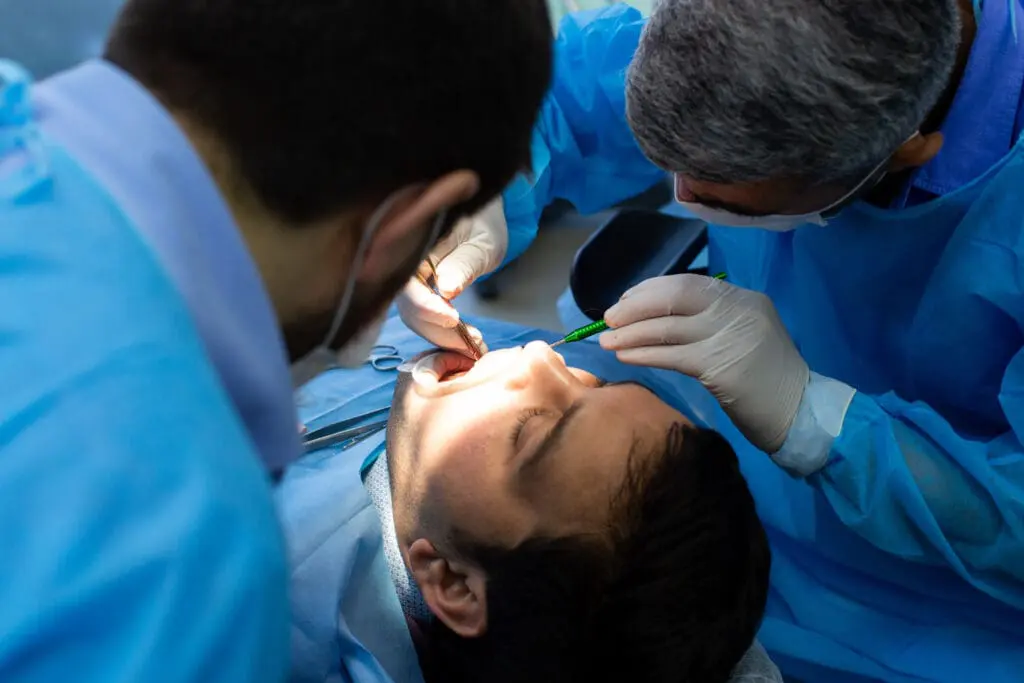
Jaw surgery is needed instead of braces alone when the problem is skeletal, not dental: a jaw bone is significantly out of position, the face is pronouncedly asymmetric, or the bite gap is too large to close by moving teeth in an adult who is done growing. Braces move teeth within the jaws; surgery, planned jointly with an oral and maxillofacial surgeon, repositions the jaw bones themselves.
The hardest call in this area is not how to do the surgery. It is whether a case truly needs it. In Dr. Rodrigo Viecilli’s clinical framework at Limestone Hills, that decision turns on a precise diagnostic question: is the discrepancy in the teeth, or in the bones that carry them?
That distinction is exactly where a biomechanics background matters. Dr. Viecilli is an ABO Diplomate with a PhD in orthodontic biomechanics, a co-inventor of the SmartArch wire system, and an author of 27+ publications.
Across 5,000+ treated cases in Austin he has had to draw the line repeatedly between a case that braces can stably camouflage and one where moving teeth far enough would damage them.
Getting that judgment right protects patients from two opposite errors: operating when orthodontics alone would have held, and forcing teeth to mask a skeletal problem that will relapse. The surgical decision at Limestone Hills is always made jointly with an oral and maxillofacial surgeon.
Dental Problems Versus Skeletal Problems
Every bite problem sits somewhere on a spectrum between two causes. At one end the jaw bones are well positioned and only the teeth are crooked, tipped, or crowded. At the other the teeth may be reasonably aligned but the jaw bones themselves are in the wrong place relative to each other and to the face.
Braces and aligners are tools for the first kind. They move teeth through bone, within the jaw they sit in. They are precise and powerful for that job. What they cannot do is pick up a jaw bone and move it, because the bone is the anchor the teeth move against, not the thing being moved.
When the jaw bones are the problem, repositioning them is a surgical task. That is what orthognathic surgery does: an oral and maxillofacial surgeon repositions the upper jaw, the lower jaw, or both into a correct relationship. Orthodontics still aligns the teeth so they fit once the bones are moved, which is why the two are always coordinated.
So the real question is never “braces or surgery” as if they were rival products. It is whether the problem is dental or skeletal, and the answer decides whether the bones have to move too.
The Signs That Point Toward Surgery
A handful of patterns raise the question of whether a case is skeletal. None of them is self-diagnosing, and confirming the cause requires 3D imaging and a full workup, but these are the situations where Dr. Viecilli looks hardest at the bones.
A jaw that is significantly out of position. When the lower jaw sits well behind the upper, or projects clearly ahead of it, and the cause is the position of the bone rather than tilted teeth, the gap can be too large for orthodontics to close stably on its own.
Pronounced facial asymmetry. When one side of the face and jaw is noticeably different from the other, the asymmetry usually lives in the bone. Moving teeth does not correct a jaw that grew unevenly; repositioning the bone does.
A very large bite discrepancy that is skeletal. A large open bite where the front teeth do not meet, or a severe deep bite or crossbite that traces to jaw position rather than tooth position, often exceeds what tooth movement can resolve without harming the teeth and their support.
Function as well as appearance. Skeletal discrepancies can make biting, chewing, and sometimes breathing harder, not just change how the profile looks. When function is affected and the cause is the bone, surgery is more often the path that produces a stable, healthy result.
The recurring theme is magnitude and cause. Mild to moderate problems that are dental in origin are orthodontic territory. Large problems that are skeletal in origin are where the surgical conversation belongs, and that conversation always includes an oral and maxillofacial surgeon.

Why Braces Alone Hit a Limit
Orthodontics can sometimes mask a skeletal discrepancy by moving teeth to compensate, an approach clinicians call camouflage. It tips and repositions the teeth so the bite meets acceptably even though the bones underneath are still off. For a mild to moderate, well-selected case it can be a legitimate choice.
The limit is biology. To camouflage a large skeletal gap, the teeth have to be moved a long way, often beyond where the bone and gum support them comfortably. Pushed far enough, teeth can tip out of their bony housing, roots can come too close to the edge of the bone, and the gums can recede. A result achieved that way is also more likely to relapse.
This is where Dr. Viecilli’s biomechanics depth changes the call. The question is not only “can the teeth be moved into a passable bite,” but “can they be moved there safely and held there.” When the honest answer is that camouflage would overstress the teeth or will not stay, surgery is not the aggressive option. It is the stable one.
Stating that limit plainly protects the patient. Forcing an orthodontic-only result onto a skeletal problem trades a visible surgery for a slow, hidden cost to the teeth and their support.
Surgery-First Versus Braces-First Sequencing
When a case is surgical, the orthodontist and the oral and maxillofacial surgeon decide together how to sequence the orthodontics and the operation. At a high level there are two broad approaches, and the choice is a joint clinical decision, not a fixed rule.
The conventional, braces-first sequence. The patient wears braces or aligners first, through a pre-surgical phase that positions the teeth correctly within each jaw. Once the teeth are set so the bite will fit after the bones move, the surgeon performs the repositioning. Orthodontic finishing then settles the bite.
The surgery-first approach. In selected cases the surgery is performed earlier, with the corrective tooth alignment completed mostly afterward. This can shorten the time the patient spends with an obvious discrepancy, but it is not appropriate for every case and depends on the diagnosis and on close orthodontic and surgical coordination.
What matters for a patient weighing this is understanding that the orthodontics and the surgery are one coordinated plan built by two specialists together, and that the sequence is chosen for the specific case. Limestone Hills provides the orthodontic side and coordinates it with the surgeon.
What Recovery Actually Looks Like
Recovery from orthognathic surgery is a staged process, and it is worth describing honestly in qualitative terms rather than with numbers that do not apply to every case.
There is an initial healing period measured in weeks. Swelling is expected and then subsides, the diet is modified while tissues heal, and activity is limited for a time. This early phase is the most noticeable part of recovery and is managed closely by the surgical team.
After the initial healing comes a longer settling period measured in months. The bite, the muscles, and the soft tissues continue to adjust, and the orthodontic finishing phase completes the detailing of how the teeth meet. Full settling is gradual rather than a single endpoint.
The exact length of each phase varies by the specific procedure, the individual patient, and the operating surgeon. Limestone Hills does not assign a fixed timeline to a procedure it does not perform. The oral and maxillofacial surgeon provides case-specific recovery guidance, and the orthodontic plan is built around that guidance rather than a generic schedule.
The Cost Reality
Cost in a surgical case is split across providers, and being clear about that split prevents surprises.
Limestone Hills provides the orthodontic coordination: the diagnostic workup, the pre-surgical and post-surgical tooth alignment, and the joint planning with the surgeon. That orthodontic portion is quoted directly by the practice in a consultation, the same way any other treatment is.
The surgery itself, the oral and maxillofacial surgeon’s fee, and the hospital or facility charges are billed separately by those providers. The amounts depend on the procedure, the surgeon, the facility, and the patient’s medical coverage. A blog cannot put a number on that responsibly, and Limestone Hills does not estimate fees for care it does not deliver.
The honest framing is that a surgical case has at least two separate cost conversations: one with the orthodontic practice and one with the surgical team. Limestone Hills makes the orthodontic side specific at consultation so the patient understands who bills for what before committing.
When the Patient Is Still Growing
The surgical conversation above applies to an adult whose facial growth is essentially complete. In a growing child the picture can be different, and that distinction is worth stating at a high level.
While a child is still growing, some skeletal discrepancies can be influenced with growth modification, using orthodontic appliances to guide the developing jaws rather than surgically repositioning finished bone. This does not work for every problem or at every age, and it does not apply once growth is done, but it is a reason a young patient’s plan can look very different from an adult’s.
This is one of the clearest arguments for an early orthodontic evaluation. Guiding a developing skeletal discrepancy while growth is still available sometimes reduces, and occasionally avoids, what would otherwise become a surgical case in adulthood. It does not guarantee that outcome, and severe discrepancies can still need surgery later.
For an adult reading this, the practical takeaway is simpler. Growth modification is no longer on the table once growth is finished, so when the discrepancy is skeletal and large in an adult, the realistic options are surgical correction or carefully bounded orthodontic camouflage, evaluated case by case with the surgeon involved.
Braces Alone Versus Combined Surgery and Orthodontics
| Dimension | Orthodontics Alone | Combined Surgery and Orthodontics |
|---|---|---|
| Underlying cause | Dental: teeth crooked, tipped, or crowded within well-positioned jaws | Skeletal: the jaw bones themselves are significantly out of position or asymmetric |
| What moves | Teeth move through bone within the jaw they sit in | The jaw bone is repositioned surgically; teeth are aligned to fit before and after |
| Typical case fit | Mild to moderate discrepancies, or larger ones suitable for bounded camouflage | Large skeletal discrepancies, pronounced asymmetry, function affected by jaw position |
| Providers involved | Orthodontist; at Limestone Hills, an ABO Diplomate | Orthodontist and oral and maxillofacial surgeon, planned jointly from the start |
| Stability consideration | Strong for dental problems; camouflage of a large skeletal gap risks relapse and tooth strain | Addresses the skeletal cause directly, which supports a stable result for the right case |
| Cost structure | Single orthodontic fee quoted at consultation | Orthodontic coordination quoted by Limestone Hills; surgeon and facility billed separately |
The table summarizes structure. It does not rank the two paths, because the correct one is set by the diagnosis, not by preference, and that diagnosis comes from imaging and a joint orthodontic and surgical review.
The Candid Part: Surgery Sounds Frightening, and Here Is What Is Actually Involved
It is worth naming the fear directly, because most patients feel it. The phrase “jaw surgery” sounds drastic, and the instinct is to look for any way to avoid it. That reaction is normal and Dr. Viecilli treats it as something to talk through, not around.
Here is the honest counterweight. Orthognathic surgery is a planned, elective procedure performed by an oral and maxillofacial surgeon. It is not an emergency and nothing about it is rushed. It is scheduled only after diagnostic imaging, joint orthodontic and surgical planning, and a pre-surgical orthodontic phase, and the patient has time to understand the plan before agreeing to it.
It is also not proposed lightly. Surgery enters the conversation only when the discrepancy is skeletal and large enough that moving teeth alone would either fail to correct it or would do it at a real cost to the teeth and their support. In those cases the surgery is not the risky choice. It is the path that produces a stable, healthy result the patient can keep, which is the opposite of drastic.
The frightening-sounding option and the stable option are sometimes the same option. Dr. Viecilli’s job, with the surgeon, is to be honest about which cases genuinely need it, so a patient is never operated on unnecessarily and never pushed into a fragile orthodontic-only result that quietly relapses.
Austin and the Hill Country
Limestone Hills treats patients from across Austin and the surrounding Hill Country, including Lakeway, Cedar Park, Round Rock, Bee Cave, and Westlake. For cases that turn out to be skeletal, the practice provides the orthodontic coordination and works with an oral and maxillofacial surgeon so the tooth movement and the bone repositioning are planned as one project.
The first and most useful step for an Austin-area patient is simply finding out which kind of problem a case is. A consultation with 3D CBCT imaging answers the dental-versus-skeletal question directly, which is the answer that determines everything that follows.
How the surgical and orthodontic sides are coordinated, and what Limestone Hills does versus what the surgical team does, is described on the orthognathic surgery page. The same page is the route to a free Austin consultation for any patient who wants that question answered specifically.
Common Questions About Jaw Surgery vs Braces
When is jaw surgery actually needed instead of braces?
Jaw surgery is considered when the problem is skeletal rather than dental, meaning the upper or lower jaw bone is significantly out of position, the face is pronouncedly asymmetric, or the bite discrepancy is too large to close by moving teeth alone in an adult whose growth is complete. Braces reposition teeth within the jaws; they cannot move the jaw bones themselves. When the bones are the problem, surgery coordinated with an oral and maxillofacial surgeon is the path to a stable result.
Can braces alone fix a severe overbite or underbite?
Sometimes, when the discrepancy is dental and mild to moderate, orthodontics can compensate by tipping and moving teeth, an approach often called camouflage. When the discrepancy is skeletal and large, moving teeth far enough to mask it can be unstable or unhealthy for the teeth and gums. The deciding factor is whether the jaw bones are well positioned and only the teeth are off, which is assessed from 3D imaging and a full diagnostic workup before any plan is set.
Does orthognathic surgery require braces too?
Almost always. Orthodontics and surgery are coordinated, not alternatives. Braces or aligners align the teeth within each jaw so the bite fits correctly once the surgeon repositions the bone, and orthodontic finishing follows the surgery. The orthodontist and the oral and maxillofacial surgeon plan the case together from the start so the tooth movement and the bone movement match.
What does recovery from jaw surgery involve?
Recovery is a staged process. There is an initial healing period measured in weeks, with swelling and a modified diet, followed by months of gradual settling as the bite and tissues stabilize and orthodontic finishing completes. Exact timelines vary by the specific procedure, the patient, and the operating surgeon, so the oral and maxillofacial surgeon gives case-specific guidance rather than a fixed schedule.
Is jaw surgery elective and is it planned in advance?
Yes. Orthognathic surgery is a planned, elective procedure, not an emergency one. It is scheduled only after diagnostic imaging, joint orthodontic and surgical planning, and a pre-surgical orthodontic phase. Nothing is rushed. The decision to operate is made deliberately because the skeletal discrepancy cannot be corrected stably any other way, and the patient has time to understand the plan before committing to it.
Sources. Standard literature on orthognathic surgery indications, the distinction between dental and skeletal malocclusion, orthodontic camouflage versus combined surgical-orthodontic treatment, pre-surgical and post-surgical orthodontic sequencing including surgery-first approaches, and growth modification in skeletal discrepancies during active growth.
Recovery is described qualitatively as a weeks-long initial healing phase followed by a months-long settling phase; exact timelines vary by procedure, patient, and surgeon and are not stated as fixed figures.
Cost is described structurally as a separate orthodontic fee with surgeon and facility charges billed independently; no surgical dollar amounts are stated, because specifics could not be independently verified and depend on the surgeon, facility, and coverage. Clinical observations from Limestone Hills Orthodontics, Austin, TX.