
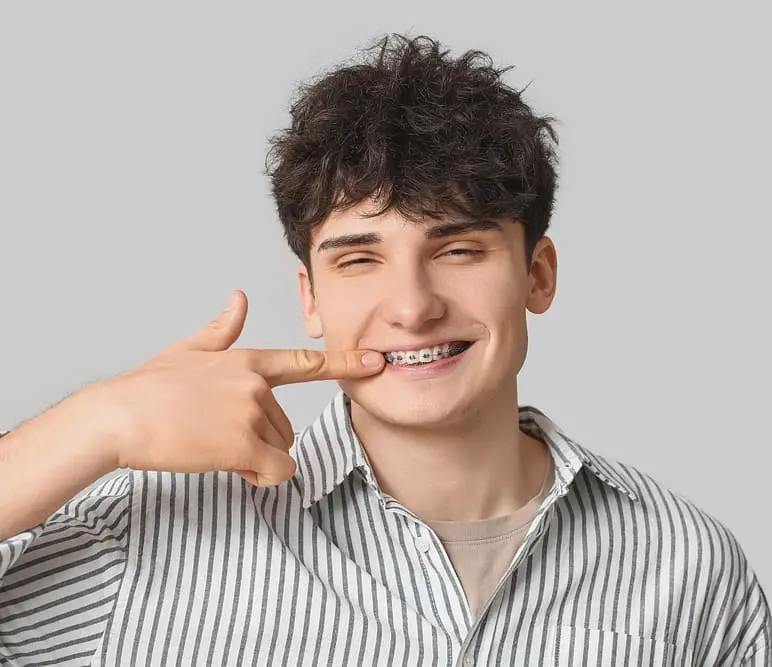
Braces change tooth position within the jawbone. That can secondarily affect lip support and smile width. The underlying skeletal architecture of an adult face does not change from braces alone. Patients with severely flared upper teeth see modest lip-support change after retraction. Patients with a narrow upper jaw see modest smile widening after expansion. Significant skeletal change requires Phase 1 growth modification in growing children or orthognathic jaw surgery in adults.
Dr. Viecilli holds a PhD in orthodontic biomechanics from Indiana University and has authored 27 peer-reviewed publications on how orthodontic forces translate into tooth movement, tissue response, and the soft-tissue drape over the resulting tooth positions. His clinical position is that the cosmetic effect of adult braces on facial appearance is real but modest, and that the viral social media claims of dramatic facial sculpting from braces alone almost always misattribute growth, maturation, or weight change to the appliance.
The honest expectation Dr. Viecilli sets at the Limestone Hills Orthodontics consultation is improved smile aesthetics for every adult patient, modest lip-support change for the subset with severely flared incisors, and visible skeletal change only for the subset whose case actually involves jaw surgery or Phase 1 growth modification.
What Braces Actually Change About the Face
Orthodontic treatment moves teeth within the alveolar bone, which is the bone that holds the tooth roots. As teeth move, the soft tissue that drapes over them, primarily the lips and the cheek tissue near the smile corners, adapts to the new tooth positions. That adaptation is the source of every legitimate facial change patients see from braces.
The list is shorter than the internet suggests. Smile aesthetics improve in nearly every case. Lip support changes when severely flared front teeth retract. Smile width can change when a narrow upper jaw is expanded. In growing children, the lower-face profile can change when Phase 1 growth modification influences jaw growth. In adult cases involving orthognathic jaw surgery, the skeletal jaw position itself changes.
Nothing else on the face changes from braces alone in an adult. The cheekbones do not move. The chin does not project further forward. The nose does not change shape. The eye orbits do not shift. These structures are determined by skeletal architecture set during adolescent growth.
Dental Movement Versus Skeletal Change Versus Growth Modification
Three different mechanisms produce three different scales of facial change. Confusing them is the single biggest reason viral internet claims about braces overstate the cosmetic effect.
Dental movement is what braces and aligners do in every patient. Teeth move within the bone. The bones themselves do not move. The cosmetic effect is limited to smile aesthetics, modest lip support in some cases, and modest smile width in expansion cases.
Skeletal change means the underlying bones themselves move. In adults, this happens only through orthognathic jaw surgery performed by an oral and maxillofacial surgeon. The surgeon repositions the upper jaw, lower jaw, or both. Orthodontic treatment is coordinated before and after the surgery.
Growth modification is what Phase 1 orthodontic treatment does in children roughly ages 7 to 11 whose jaws are still growing. Functional appliances, expanders, and headgear influence the direction or magnitude of jaw growth during the growth phase. The skeletal effect is real and durable, but it is only available while the patient is growing.
| Mechanism | What Moves | Available For | Facial Effect |
|---|---|---|---|
| Dental movement | Teeth within bone | Any age | Smile aesthetics; modest lip support; modest smile width |
| Skeletal change | The bones themselves | Adults via jaw surgery | Significant; affects profile, jaw projection, chin position |
| Growth modification | Direction of active growth | Children roughly ages 7 to 11 | Real and durable; depends on growth potential |
What Braces Do Not Change Without Surgery
The list of facial features that do not change from braces in an adult is long, and patients deserve an honest accounting of it before treatment.
Skeletal jaw position does not change. If the lower jaw is set back relative to the upper jaw (skeletal Class II) or in front of it (skeletal Class III), braces cannot move the jaw. They can compensate dentally, which means tilting the teeth to mask the skeletal mismatch, but the skeletal mismatch itself remains.
Chin projection does not change. The chin is part of the mandibular bone. Its forward projection is set by mandibular architecture, not by where the lower teeth sit. A receding chin in an adult cannot be brought forward by braces. Genioplasty or mandibular advancement surgery are the procedures that change chin projection.
Cheekbones, nose, and eye orbits do not change. These structures are part of the midface and upper face. Orthodontic forces do not reach them and would not move them if they did. Patients who hope braces will reshape these features are setting up disappointment.
The “snatched jawline” claim is mostly internet myth. The viral before-and-after posts attributing a dramatically sharper jawline to braces almost always involve adolescent patients whose jaws were still growing during treatment, or adult patients who lost weight, or both. The braces did not produce the jawline. The growth or the weight loss did, and the timing happened to overlap with treatment.
Lip Support: The Legitimate Yes
Lip support is the one routine cosmetic facial change from adult braces that is real, predictable, and visible up close. It applies to a specific case profile and not to every patient.
When the upper front teeth are severely flared forward, the upper lip drapes over them in an outward position. As the teeth retract back into the arch during treatment, the lip support moves inward with them. The change is typically 2 to 4 millimeters of lip retraction in profile view for a severely flared case. That is visible at conversation distance but rarely from across a room.
Patients whose front teeth are already in a balanced upright position see little to no lip-support change. Patients with a skeletal Class III pattern, where the upper teeth sit behind the lower teeth, may see no lip retraction at all, because the case mechanics push the upper teeth forward rather than back. The clinical exam at the Limestone Hills Orthodontics consultation includes a profile assessment and a written prediction of expected lip-support change for the specific case.
Smile Width and Smile Arc
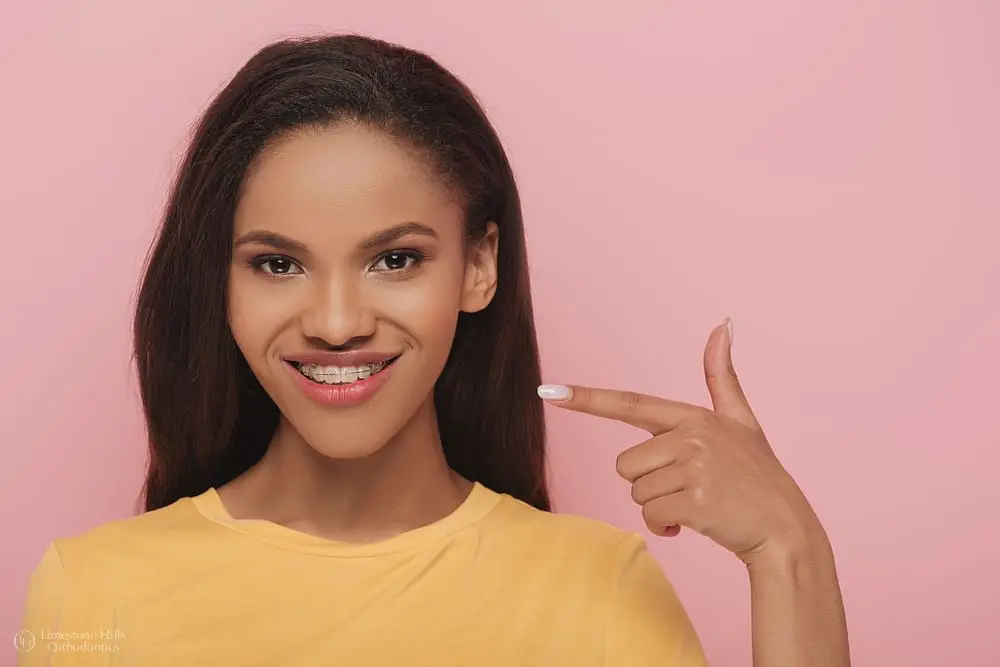
Smile aesthetics is the change every braces patient gets, and the change patients overestimate before treatment and underestimate after. Three smile elements change predictably.
Smile width changes in cases where the upper jaw was narrow before treatment. A palatal expander used in growing children, or coordinated expansion mechanics in adults, widens the upper arch. The smile shows more teeth at full smile, eliminating the dark triangles that appear at the corners of a narrow smile. The cosmetic effect is visible at social distance.
Smile arc is the curve the upper teeth follow when the patient smiles. A flat smile arc shows the upper teeth in a straight line. An ideal smile arc follows the curve of the lower lip. Braces can level the upper arch to produce a smile arc that matches the lower lip curve, which reads as a more youthful and attractive smile.
Tooth display at rest and at full smile changes when severely worn, intruded, or extruded teeth are repositioned vertically. The case is uncommon, but for the right patient the cosmetic change is meaningful and noticeable at social distance.
When Jaw Surgery Is Actually Required
Some adult patients seek dramatic facial change that braces alone cannot produce. Honest case planning at the consultation distinguishes patients whose case is dental from patients whose case is skeletal and would actually benefit from orthognathic jaw surgery.
Skeletal Class II with severe lower jaw retrusion in an adult is one such case. The lower jaw is set back. Braces can tilt the lower teeth forward to compensate, but the chin and lower-face profile do not change. Mandibular advancement surgery moves the lower jaw forward into a balanced position, and the orthodontic treatment is coordinated before and after the surgery to align the teeth in the new jaw position.
Skeletal Class III with severe lower jaw protrusion or a long midface is another. The lower jaw sits in front of the upper jaw, or the midface is vertically long. Jaw surgery is the only treatment that addresses the skeletal cause. Braces alone in these cases produce dental compensation that masks the skeletal mismatch without correcting it.
Severe asymmetry, where one side of the jaw is longer or wider than the other, is a third surgical indication. Adult open bite where the front teeth do not meet at full closure, when caused by skeletal vertical excess rather than tongue habit, is a fourth. Dr. Viecilli coordinates surgical cases with oral and maxillofacial surgeons in the Austin area. The surgical orthodontics overview covers the workflow, timing, and combined-fee structure in full.
When Growth Modification Works (Phase 1 in Growing Children)
Children whose jaws are still growing have access to a class of skeletal change adults do not. Phase 1 orthodontic treatment, typically performed between ages 7 and 11, uses functional appliances, palatal expanders, or headgear to influence jaw growth during the active growth window.
A growing child with a narrow upper jaw can be expanded skeletally through the midpalatal suture. The change is real bone separation, not dental tipping, and the skeletal effect remains after treatment. A growing child with a retrusive lower jaw and remaining growth potential can use a functional appliance to encourage forward mandibular growth during the growth spurt. The skeletal effect is more modest than what jaw surgery produces in an adult, but it is real and durable.
The window closes as the patient matures. By the late teens for most patients, the same appliances that produced skeletal change at age 9 produce only dental tipping. The honest distinction at the consultation for a growing child is whether the case has a skeletal component that benefits from Phase 1 timing, or whether the case is purely dental and can wait for full braces in adolescence. The Phase 1 treatment overview covers the indications, appliance options, and timing decision in full.
Face-Shape Questions From Austin and Hill Country Patients
Adult patients across the Austin metro arrive at Limestone Hills Orthodontics with face-shape expectations shaped by social media, friends who had braces as teens, and orthodontic before-and-afters that mix dental cases with surgical cases without distinguishing them. The consultation is the place that distinction gets made honestly. Adults commuting in from Lakeway, Cedar Park, Round Rock, Bee Cave, Westlake, and Steiner Ranch are asked at the consultation what facial outcome they are hoping for, and the clinical exam plus 3D CBCT scan determine whether the case is dental, skeletal, or both.
For adult patients whose primary motivation is dramatic profile change, the honest answer is sometimes that braces alone are not the right treatment, and that a combined orthodontic-surgical case is what their goal actually requires. For adults whose motivation is improved smile aesthetics, the honest answer is that braces produce that change reliably and that the facial profile will look essentially the same from across a room. Austin-area families with growing children get a separate set of options because Phase 1 timing is available to them. Dr. Viecilli writes the realistic facial-change expectation into the treatment plan at the consultation, before any financial commitment.
Common Questions About Braces and Face Shape
Do braces actually change your face?
Yes, but modestly in adults. Braces move teeth within the jawbone, which can secondarily affect the lips and smile aesthetics. Severely flared upper teeth retracting back can produce a visible lip-support change. Expansion of a narrow upper jaw can widen the smile. The underlying skeletal structure of the face does not change in adults from braces alone. Significant skeletal change in adults requires jaw surgery. Significant skeletal change in growing children can come from Phase 1 growth modification.
Will braces make my jawline more defined?
Generally, no, not from braces alone. The jawline is a function of mandibular bone position and soft-tissue drape over that bone. Braces do not move the mandible. Viral social media claims about jawline sculpting from braces typically misattribute one of three things: natural facial growth that would have happened anyway, soft-tissue maturation from adolescence into adulthood, or weight loss during treatment. The honest expectation for adult braces is improved smile aesthetics with little visible change from across a room.
Do braces change your lip shape?
Sometimes, modestly. Lip support refers to how the upper and lower lips drape over the front teeth. When the upper front teeth are severely flared outward, retraction back into alignment moves the lip support inward by 2 to 4 millimeters in some cases. This is visible up close in profile. It is rarely visible from social distance. Patients with already-aligned front teeth, or with skeletal Class III where the upper teeth are not flared, see little to no lip-shape change.
Can adult braces change your face shape?
Adult braces change tooth position and can change smile aesthetics, lip support in severely-flared cases, and smile width when expansion is performed. They do not change the skeletal architecture of an adult face. Skeletal change in an adult requires orthognathic jaw surgery, which Dr. Viecilli coordinates with an oral surgeon for cases of severe Class II or Class III malocclusion. Patients seeking dramatic facial change should ask whether their case is dental, skeletal, or both during the consultation.
How long does it take to see facial changes from braces?
Visible smile-aesthetic changes appear in the first 3 to 6 months as the teeth begin to align. Lip support changes from retraction follow the retraction itself, which typically happens in the middle 6 to 12 months of treatment. Final soft-tissue settling continues for 6 to 12 months after braces are removed as the lips and cheeks adapt to the new tooth position. Patients should evaluate facial change 12 months after treatment ends, not at debanding.
Sources. American Association of Orthodontists, consumer guidance on orthodontic treatment outcomes and growth modification (aaoinfo.org). Proffit W., Fields H., Larson B., Sarver D., “Contemporary Orthodontics,” chapters on soft-tissue response and treatment planning (Elsevier). Talass M.F., Talass L., Baker R.C., “Soft-tissue profile changes resulting from retraction of maxillary incisors,” American Journal of Orthodontics and Dentofacial Orthopedics. Bishara S.E., “Class II malocclusions: diagnostic and clinical considerations with and without treatment,” Seminars in Orthodontics. McNamara J.A., “Components of Class II malocclusion in children 8 to 10 years of age,” Angle Orthodontist. Clinical observations and case records from Limestone Hills Orthodontics, Austin, TX.