
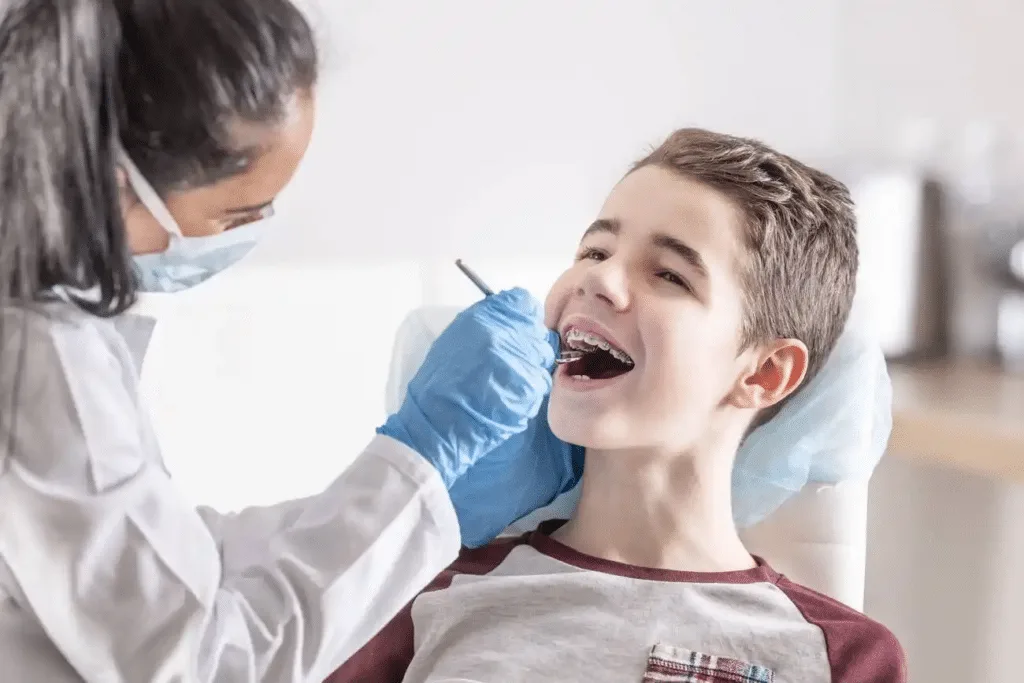
Most children get braces between roughly 9 and 14, once enough permanent teeth have erupted for comprehensive treatment. The first orthodontic check should happen earlier, around age 7, so timing-sensitive problems can be caught while the jaws are still growing. Exact timing depends on each child’s development, not on a fixed age.
Age 7 is not when most children get braces. It is the age when an orthodontist can first read how a child’s jaws and teeth are developing, which is a different and earlier question.
Across 5,000+ treated cases at Limestone Hills in Austin, Dr. Rodrigo Viecilli, an ABO Diplomate with a PhD in orthodontic biomechanics, uses the age-7 visit to assess three things that are hard to judge any earlier: jaw growth direction, whether a crossbite is present, and the trajectory of crowding as permanent teeth arrive.
For most children that visit ends in monitoring, not braces. The value of the check is timing, catching the small number of problems that are easier to guide early and confirming that everyone else can simply wait.
The Age-7 First Check, and Why That Age
Answering the question “When do kids get braces?”, the American Association of Orthodontists recommends that every child have a first orthodontic evaluation no later than around age 7. That is a screening recommendation, not a prediction that a 7-year-old needs braces.
Age 7 is chosen for a clinical reason. By that point most children have their permanent first molars and several permanent incisors, mixed in with baby teeth. That specific combination is the earliest moment an orthodontist can see the bite take shape.
With the first molars in, the back-tooth relationship can be assessed. With the incisors erupting, the front bite and early crowding become readable. Before this stage there is little for an orthodontist to evaluate, because the developing pattern has not shown itself yet.
Dr. Viecilli treats the age-7 visit as a diagnostic window rather than a treatment trigger. What is assessable at 7 is jaw growth direction, the presence of a crossbite, and whether the space available is tracking ahead of or behind the permanent teeth still to come. Those are exactly the issues where early information changes the options later.
There is a reason a trained eye matters at this age rather than a wait-and-see approach at home. A developing crossbite or a jaw-growth pattern often looks unremarkable to a parent, because a young child adapts to it and shows no pain or obvious sign. The pattern is visible to an orthodontist long before it is visible across the dinner table.
The age-7 recommendation also reflects what is treatable while a child is still growing. Some bite and jaw issues respond to early guidance precisely because the bones are still developing. Once growth slows in the teenage years, the same issue can require a longer course or, in select cases, a more involved correction. Reading the pattern at 7 keeps the easier options on the table.
Why Most Braces Land Between Roughly 9 and 14
Comprehensive braces work on permanent teeth. Most children do not have enough permanent teeth in place for that until somewhere between roughly 9 and 14, which is why that range is the typical treatment window.
The reason is the mixed-dentition period. Between about age 6 and the early teens a child carries a changing mix of baby and adult teeth as the permanent set erupts. Comprehensive treatment is usually planned once most of the permanent teeth have arrived, so the orthodontist is aligning a near-complete set rather than chasing a moving target.
Eruption timing varies a great deal from child to child. Two children the same age can be a year or more apart in dental development, so a sibling who started braces at 11 is not a schedule for a younger brother or sister. The trigger is dental development, not the calendar.
This is why a precise universal age cannot be given honestly. The well-established guideline is the age-7 evaluation. The treatment age is a range that depends on how a specific child is developing, which is what the screening visit is designed to track.
Within that range, several factors push the start date earlier or later for an individual child. How quickly the baby teeth are lost and replaced is the largest one. A child whose permanent teeth erupt early may be ready toward the lower end of the window, while a later-developing child of the same age may be better served by waiting another year.
The severity of the problem also matters. A bite issue that is straightforward may be timed for convenience around the permanent set, while a more involved correction may be sequenced to take advantage of a growth stage. The orthodontist weighs the dental readiness against the nature of the problem rather than starting on a birthday.
For parents, the useful takeaway is that a number quoted by a friend or found online is at best an average. The child in front of the orthodontist is the only relevant data point, and the screening visit is what converts a population average into an individual recommendation.
Early Treatment Versus Comprehensive Treatment
Orthodontic care for children can happen in one phase or two, and the difference matters when a parent is trying to understand timing.
Early treatment, sometimes called interceptive or Phase 1, is a short, targeted course while a child still has many baby teeth. It addresses a specific developing problem, such as a crossbite or a jaw-growth issue, rather than aligning every tooth. It is followed later by a second phase once the permanent teeth are in.
Comprehensive treatment is the full course of braces or aligners on the permanent teeth, the phase most people picture. For the majority of children this single comprehensive phase, started in the roughly 9 to 14 window, is all that is needed.
Two-phase care is the right path for a defined subset of children, not the default. The decision to use it comes from specific diagnostic findings at the age-7 check, not from a preference to start early.
The detail of how each path works is covered separately. For the practice’s children’s pathway see early treatment for children at Limestone Hills, and for how the two phases fit together see two-phase orthodontic treatment.
One point about early treatment is worth stating plainly for parents. A short first phase does not shorten or replace the later comprehensive phase in most cases. It addresses a specific developing problem so the second phase can start from a better position.
The goal of early care is a better outcome, not a faster finish. A parent should expect both phases when two-phase treatment is recommended, and should ask the orthodontist to explain what the first phase is meant to accomplish.
Signs a Child Should Be Seen Sooner
Age 7 is the recommended upper bound for a first check, not a waiting period. Some signs warrant an evaluation earlier, because the issue interacts with jaw growth and is sometimes easier to guide while a child is younger.
A parent should seek an earlier orthodontic look for a crossbite, where upper and lower teeth bite into the wrong relationship, or for teeth that clearly do not meet when the child closes. Both can shift how the jaws grow if left unaddressed.
Severe crowding, difficulty chewing or biting, mouth breathing paired with dental concerns, and front teeth that protrude noticeably are also reasons not to wait. A persistent thumb or finger habit past the toddler years belongs on the same list, because sustained pressure can move teeth and influence the bite.
None of these signs guarantees that treatment starts immediately. They mean the developing pattern deserves a trained look sooner, so an orthodontist can decide whether to act, guide, or monitor. Acting early on the right problem can simplify what is needed later.
It also helps parents to know what is not on this list. Slightly crooked baby teeth, normal gaps between baby teeth, and front teeth that erupt with a gap or a mild rotation are usually not causes for concern on their own. Baby teeth are placeholders, and some irregularity at this stage often resolves as permanent teeth come in.
The distinction the orthodontist is drawing is between cosmetic appearance and developmental direction. A child can have teeth that look uneven and a perfectly healthy growth pattern, or teeth that look acceptable while a crossbite quietly steers the jaw. The age-7 screening exists to tell those two situations apart, which is hard to do without training.
What an Age-7 Visit Actually Involves
The age-7 visit is calmer than many parents expect. It is a screening, and for most children it ends without any appliance.
The orthodontist reviews how the teeth are erupting, how the upper and lower jaws relate, whether a crossbite or significant crowding is present, and whether any habit is affecting development. Imaging may be used to see what has not erupted yet. The output is a clear answer: treat now, plan for later, or monitor.
For the large majority of children that answer is monitor. The child is seen periodically as growth and eruption continue, and comprehensive treatment is timed for when the permanent teeth are ready, rather than started prematurely.
That monitoring period has real value even when nothing is being treated. It means the eventual plan is based on how a specific child actually developed, and that timing-sensitive problems are caught at the point where guidance is most effective rather than after the window has closed.
Monitoring visits are typically spaced months apart and are short. The orthodontist tracks eruption, confirms that the bite is developing as expected, and adjusts the projected start date as the picture clarifies. For a parent, this stage is mostly reassurance, with a clear signal when the timing for braces is finally right.
It is also the stage where a plan can change in the child’s favor. A space concern noted at 7 sometimes resolves on its own as the jaws grow, which means treatment that once looked likely turns out to be unnecessary. Watching the pattern rather than committing early is what makes that better outcome possible.
The Honest Part
Most children do not need early or two-phase treatment. The age-7 check exists to find the minority who benefit from early guidance and to confirm that everyone else can wait for a single, efficient phase of braces.
An early visit is a screening, not a sales funnel. A well-run evaluation often ends with the recommendation to do nothing yet and return for a periodic check. Being told a child needs no treatment now is a normal and good outcome, not a missed opportunity.
Dr. Viecilli’s standard at Limestone Hills is to recommend early treatment only when the diagnostic findings support it. When waiting produces the better result, that is what is advised, and the reasoning is explained to the parent in plain terms rather than wrapped in urgency.
Austin and the Hill Country
Limestone Hills runs age-7 checks for families across Austin and the surrounding Hill Country, including Lakeway, Cedar Park, Round Rock, Bee Cave, and Westlake. The timing principle does not change by neighborhood.
The recommendation, however, is individual. A 7-year-old in Steiner Ranch with a developing crossbite and a 7-year-old with a textbook bite leave the same screening with very different plans, and that is the point of seeing each child rather than applying a single age rule.
For Austin parents weighing when to start, the practical step is the screening itself. It converts a general age question into a specific answer for a specific child. The practice’s full children’s pathway is described at early treatment for children at Limestone Hills.
Common Questions About When Kids Get Braces
When do kids usually get braces?
Most children get braces between roughly 9 and 14, once enough permanent teeth have come in for comprehensive treatment. The exact timing depends on each child’s growth and tooth eruption, not on a fixed birthday. The first orthodontic check should still happen around age 7 so timing-sensitive problems can be flagged early.
Why does the first orthodontic check happen at age 7?
By about age 7 a child usually has a mix of baby and permanent teeth, and the first molars and incisors are in. That mix lets an orthodontist see how the jaws are growing and whether a crossbite, severe crowding, or a habit is steering development off course while there is still time to guide it.
Does an age-7 visit mean a child gets braces right away?
Usually not. For most children the age-7 visit is a screening that ends in continued monitoring, with comprehensive treatment planned for later when more permanent teeth are in. Only a minority of children need early interceptive treatment, and that decision is based on specific findings, not on age alone.
What signs mean a child should be seen sooner than age 7?
A parent should seek an earlier evaluation for a crossbite, teeth that do not meet correctly, severe crowding, difficulty chewing, a thumb or finger habit past the toddler years, or front teeth that protrude noticeably. These can affect jaw growth, and earlier guidance is sometimes easier than later correction.
Is early treatment always better than waiting?
No. Early treatment helps a specific subset of children and is not better by default. For most children, waiting until enough permanent teeth are present gives a more efficient single phase of braces. An honest evaluation should tell a parent when waiting is the smarter choice.
Sources. American Association of Orthodontists guidance on the first orthodontic check by age 7, and standard mixed-dentition and interceptive-treatment literature, stated qualitatively. Specifics that could not be independently verified are stated qualitatively rather than as exact figures. Clinical observations from Limestone Hills Orthodontics, Austin, TX.