
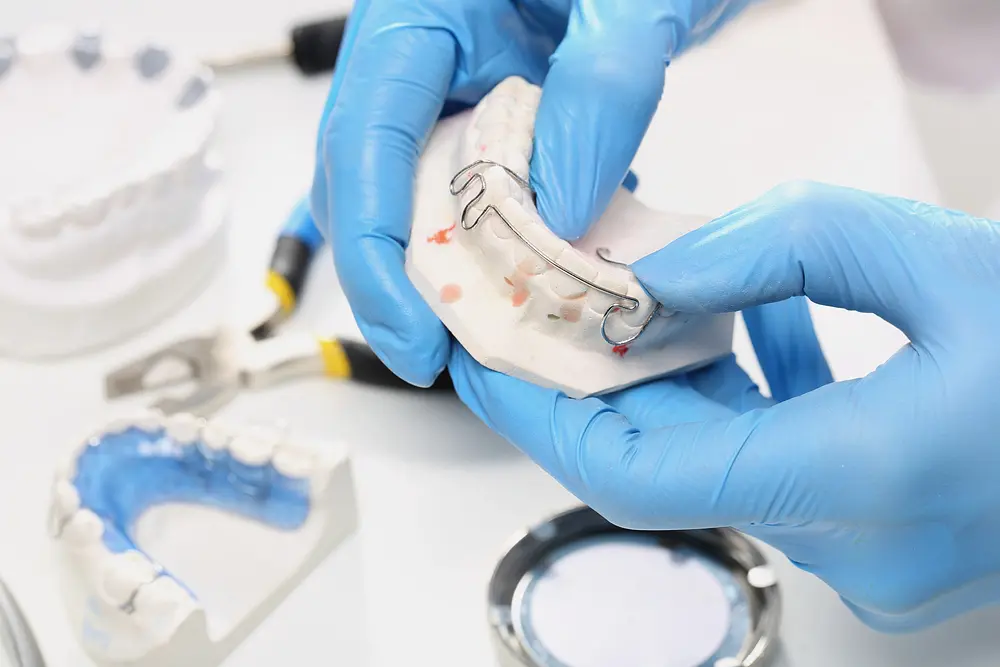
Rinse a retainer in cool water every time it comes out, clean it daily with a soft brush and a little mild soap rather than abrasive toothpaste, keep it away from heat and hot water that warp a clear retainer, store it in a ventilated case instead of a napkin, and follow the treating orthodontist’s individualized soak guidance for retainer care tips. Care steps differ by retainer type.
Across more than 5,000 cases treated at Limestone Hills Orthodontics in Austin, Dr. Rodrigo Viecilli sees the same two failure points again and again: a clear retainer warped by heat, and a retainer coated in biofilm because it was scrubbed with toothpaste or left to dry out.
The reason heat is so damaging is structural. A clear retainer is a thin thermoplastic shell molded to the exact position of the teeth. Plastic softens with heat, so even mild warping from a dishwasher or a hot car changes the fit, and a retainer that no longer matches the teeth no longer holds the result.
Biofilm matters for a different reason. A sticky bacterial layer builds on any oral appliance within hours. Abrasive toothpaste scratches the surface and gives that film more places to anchor, which is why Dr. Viecilli teaches a soap-and-soft-brush routine instead.
The Daily Cleaning Routine
A retainer collects the same plaque and bacteria that teeth do. Cleaning it is a short routine that runs every time the retainer comes out of the mouth, not a once-a-week project. The order of the steps is what keeps it simple.
The core routine has five steps. It takes well under a minute and works for clear thermoplastic retainers and Hawley retainers alike. A bonded retainer is cleaned differently and is covered in its own section below.
- Remove gently. Take the retainer out with clean hands, easing it off evenly rather than prying one side. Rough removal is a common cause of cracks over time.
- Rinse in cool water. Rinse the retainer under cool or lukewarm running water right away to clear loose debris before anything dries onto it. Never hot water.
- Brush gently with mild soap. Use a soft-bristle toothbrush and a small amount of mild liquid soap. Brush all surfaces lightly, including the inside that touches the teeth. Skip abrasive toothpaste.
- Rinse again. Rinse thoroughly so no soap residue is left, since residue tastes unpleasant and can irritate the gums.
- Reinsert or store. Put the retainer back in after the teeth are brushed, or place it directly into a clean ventilated case. It does not need to dry out first.
Brushing the teeth before reinserting a retainer matters as much as cleaning the retainer itself. Seating a clean retainer over unbrushed teeth traps food and acid against the enamel for hours, so the two habits work together.
What Damages a Retainer
Most retainer failures are not random. They trace back to a short list of avoidable mistakes. Knowing the list is the fastest way to make a retainer last as long as the material allows.
Heat. Heat is the single biggest threat to a clear thermoplastic retainer. Hot tap water, boiling water, a dishwasher, a clothes dryer, a windowsill in direct sun, and a car on a warm Austin afternoon can all soften and distort the shape, and even slight warping changes the fit.
A Hawley retainer tolerates heat better but its acrylic can still deform, and Dr. Viecilli treats the cool-water rule as universal for safety.
Abrasive toothpaste. Toothpaste is formulated to scrub enamel, and its mild abrasives leave microscopic scratches on softer retainer plastic and acrylic. Those scratches cloud a clear retainer and give bacteria a foothold. Mild soap and a soft brush clean just as well without the abrasion.
Drying out and chemical soaks. Letting a retainer sit dry between wears can make some materials brittle, and harsh chemicals cause their own damage. Bleach, high-strength hydrogen peroxide, isopropyl alcohol, and alcohol-based mouthwash degrade retainer materials with repeated exposure and can discolor them.
Any soaking solution should follow the treating orthodontist’s individualized guidance rather than a generic internet recipe.
Pets. Dogs are strongly drawn to the smell of a worn retainer, and a chewed retainer is one of the most common reasons a replacement is needed. A retainer left on a nightstand, a couch, or a bathroom counter is within reach. The ventilated case exists partly to solve this.
Wrapping it in a napkin. A retainer folded into a paper napkin or tissue at a restaurant or school cafeteria is nearly invisible and gets thrown away constantly. This is one of the most frequent loss patterns Dr. Viecilli hears about at Limestone Hills. The rule is simple: the retainer goes in its case or in the mouth, never in a napkin.
Storage and Travel
Where a retainer lives when it is not in the mouth decides whether it survives. Two principles cover almost every situation.
Use a ventilated case, every time. A hard case with airflow holes protects the retainer from being crushed, lost, or chewed, and the ventilation lets a damp retainer breathe instead of sealing moisture in. A sealed airtight container can encourage bacterial and fungal growth on a wet appliance.
The case only works if it is used consistently, so keeping it in a predictable spot is part of the habit.
Keep it away from heat and pets. The same heat that warps a retainer in a car warps it on a sunny shelf, so storage stays out of direct sun and away from heat sources. The case also stays out of a dog’s reach.
Travel adds two specific risks. The first is the napkin problem on planes and in restaurants, where a retainer set down briefly is easy to lose. The cased-or-mouth rule travels too. The second is heat: a retainer left in checked luggage in a cargo hold, in a hot rental car, or near a beach bag in the sun can warp before anyone notices.
For trips, Dr. Viecilli’s practical advice to Limestone Hills patients is to keep the retainer in its case in a carry-on or a pocket, never in checked baggage, and to know where the treating orthodontist’s office is reachable if a retainer is lost or damaged far from home. A retainer that goes missing on a trip is a far smaller problem when it is caught and reported quickly.
Retainer Care Tips by Its Type
Retainers are not all the same appliance, and the care differs in meaningful ways. The three common types are clear thermoplastic retainers, Hawley retainers, and bonded or fixed retainers. The table summarizes how care differs, and the notes below add the detail that matters for each.
| Retainer type | How it is cleaned | Biggest risk to manage |
|---|---|---|
| Clear thermoplastic (Essix-style) | Cool-water rinse, soft brush, mild soap, rinse again; soak only per orthodontist guidance | Heat warping and surface scratching that clouds the shell |
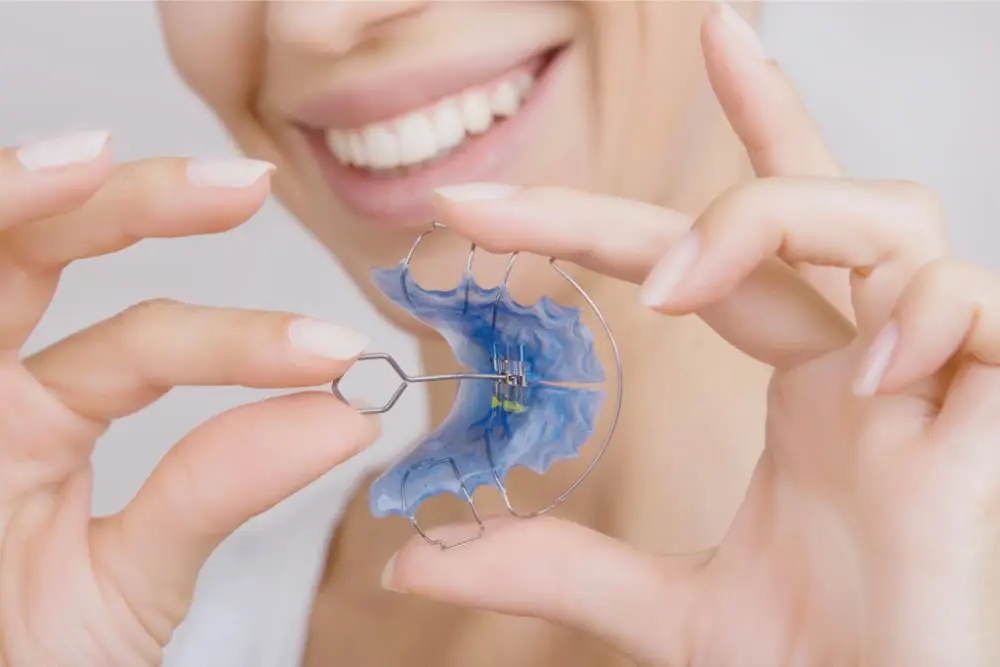
| Hawley (acrylic plate with a wire) | Soft brush and mild soap on the acrylic and around the wire; rinse well; soak only per guidance | Acrylic deformation from heat and a bent labial wire from rough handling |
| Bonded / fixed (wire behind the teeth) | Cleaned in place: brush the wire and teeth, then floss under the wire daily with a threader or superfloss | Plaque and tartar along the wire from skipped flossing, and a quietly loosened bond |
Clear Thermoplastic Retainers
A clear retainer is the most heat-sensitive of the three because it is a thin plastic shell. The daily five-step routine applies directly. The non-negotiable rule is cool or lukewarm water only, never a dishwasher, and never left where sun or a hot car can reach it.
Cloudiness over time is usually mineral buildup or fine scratching rather than dirt. A soak can help, but the type of solution and how often to use it should follow the treating orthodontist’s individualized instruction, since solutions that suit one material can degrade another.
Hawley Retainers
A Hawley retainer has an acrylic body and a visible wire across the front teeth. It is sturdier than a clear retainer and tolerates handling better, but the acrylic can still deform with heat, so the cool-water rule still applies.
Cleaning uses the same soft brush and mild soap, with attention to the junction where the wire meets the acrylic, since debris collects there. The wire is adjusted to a precise shape, so it should not be bent or used as a handle. Rough removal that flexes the wire is a common reason a Hawley retainer stops fitting.
Bonded or Fixed Retainers
A bonded retainer is a thin wire fixed behind the front teeth. It is not removable by the patient and it is never described as permanent, because it can debond and is removed by the orthodontist when treatment goals change. Because it stays in place, hygiene is the entire job.
The wire and the surfaces around it are brushed daily like the rest of the teeth. The step most often skipped is flossing under the wire. A floss threader or a superfloss strand is used to pass floss beneath the wire and clean between each tooth. Without that step, plaque hardens into tartar along the wire, which causes gum inflammation and decay risk over time.
One quiet failure mode is a wire that loosens at one tooth without obviously breaking. It can trap food, irritate the tongue, or let a tooth drift. Dr. Viecilli advises Limestone Hills patients to have any change in how a bonded retainer feels checked promptly rather than waiting, because a small detachment is a fast fix and a missed one is not.
When a Retainer Needs Replacement
Here is the candid part. A retainer does not last forever, no matter how carefully it is cleaned and stored. A clear retainer in particular is a thin plastic appliance that flexes in and out daily and slowly fatigues. Good care meaningfully extends its useful life, but it does not make the material permanent.
Signs a clear or Hawley retainer is reaching the end of its service include visible cracks, a warped or no-longer-snug fit, persistent cloudiness or odor that cleaning no longer fixes, and a sharp or rough edge. A bonded retainer needs attention if the wire feels loose, lifts away from a tooth, or breaks.
A retainer that no longer fits well is not just worn out, it has stopped doing its job, and teeth can shift in the gap. The practical guidance is to treat any of those signs as a reason to have the retainer evaluated rather than to wait. Replacing a worn retainer is routine; recovering shifted teeth is not.
The Do and Don’t Summary
Everything above condenses into two short lists. These are the habits that decide how long a retainer lasts and how clean it stays.
| Do | Don’t |
|---|---|
| Rinse in cool water every time it comes out | Use hot water, a dishwasher, or leave it in a hot car |
| Brush gently with a soft brush and mild soap | Scrub with abrasive toothpaste |
| Store it in a ventilated case in a set spot | Wrap it in a napkin or tissue |
| Keep it away from pets and direct heat | Leave it within a dog’s reach |
| Floss under a bonded retainer daily with a threader | Soak any retainer in bleach or alcohol-based mouthwash |
| Follow the orthodontist’s individualized soak and wear instruction | Ignore cracks, warping, or a loose bonded wire |
Austin and the Hill Country
Limestone Hills treats retainer patients from across Austin and nearby communities including Lakeway, Cedar Park, Round Rock, Bee Cave, and Westlake. The care principles in this guide are universal and do not change by location.
One local detail is worth a note. Austin tap water is hard, so over weeks a clear retainer can pick up cloudy mineral film the same way a glass shower door does in the area. The everyday cool-water rinse is still fine; for any periodic deep clean, using filtered water with the solution the treating orthodontist recommends keeps that mineral haze down.
When a retainer is cracked, warped, lost, or no longer fitting, Limestone Hills Orthodontics checks the fit and remakes the retainer for Austin-area patients. A short visit settles whether the current retainer still protects the result or needs to be replaced before teeth can move.
Common Questions About Retainer Care
How do you clean a retainer?
A retainer is cleaned by rinsing it in cool water as soon as it comes out, then brushing it gently with a soft toothbrush and a little mild liquid soap, then rinsing again before it goes back in or into its case. Hot water is avoided because it can warp a clear retainer. Abrasive toothpaste is avoided because it scratches the surface and traps bacteria. Any deeper soak follows the treating orthodontist’s individualized guidance.
Can you use toothpaste to clean a retainer?
Regular toothpaste is not ideal. Most toothpaste contains mild abrasives that scratch retainer plastic and acrylic on a microscopic scale, and those scratches hold bacteria and stain. A soft-bristle brush with a small amount of mild liquid soap cleans a retainer effectively without scratching it. Dr. Viecilli advises Limestone Hills patients to keep toothpaste for teeth and soap for the retainer.
Why does hot water damage a clear retainer?
A clear retainer is a thermoplastic shell molded to the exact shape of the teeth. Heat softens that plastic, so hot tap water, a dishwasher, boiling water, or a hot car can distort the shape even slightly. A retainer that no longer matches the teeth no longer holds the result. Cool or lukewarm water only is the safe rule, which Dr. Viecilli emphasizes at every retainer delivery.
How do you clean a bonded or fixed retainer?
A bonded retainer is a thin wire fixed behind the front teeth, so it is cleaned in place. Brushing reaches the wire and the tooth surfaces around it, and a floss threader or superfloss is used to pass floss under the wire and clean between each tooth daily. Skipping that step lets plaque and tartar build along the wire, so Dr. Viecilli reviews the threader technique with every bonded-retainer patient.
Do retainers need to be replaced over time?
Yes. Even a well-cared-for clear retainer is a thin plastic appliance that flexes in and out daily and slowly wears, clouds, or cracks. Good care extends its useful life but does not make it last forever. Hawley and bonded retainers last longer but are not permanent either. Limestone Hills checks fit and wear and remakes a retainer when it stops protecting the result.
Sources. Standard orthodontic retainer-care guidance (thermoplastic heat sensitivity, biofilm hygiene, fixed-retainer flossing), stated qualitatively. Specifics that could not be independently verified are stated qualitatively rather than as exact figures. Clinical observations from Limestone Hills Orthodontics, Austin, TX.