
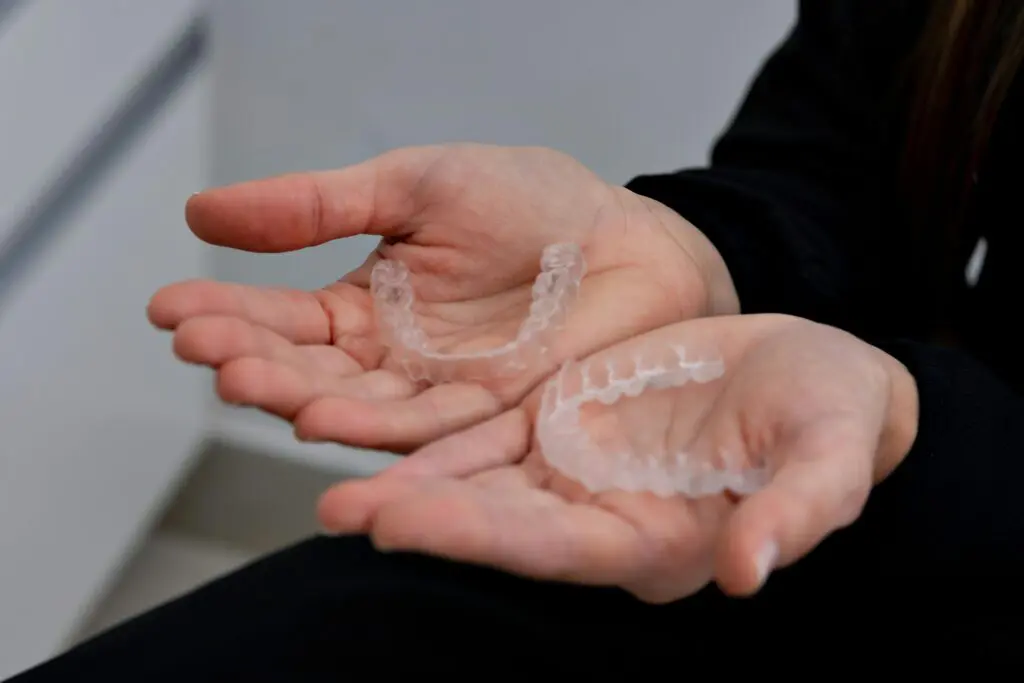
Short answer. Cleaning Invisalign aligners is a 30-second routine done morning and evening, plus a quick rinse after every meal. The daily protocol of how to clean invisalign is remove the aligner, rinse under lukewarm tap water, brush gently with a soft toothbrush and a drop of clear dish soap, rinse again, and reinsert after the teeth have been brushed. The weekly addition is a 15-minute deep-soak in Invisalign Cleaning Crystals or a denture-cleaner tablet dissolved in lukewarm filtered water. The list of things to skip is short and load-bearing: hot water (warps the plastic), toothpaste (abrasive scratches that trap bacteria), colored or scented mouthwash (stains and residue), and bleach (toxic and corrosive). Austin patients add one extra step because of the city’s hard water; the deep-soak step uses filtered or bottled water instead of tap.
Across roughly 5,000 cases treated at Limestone Hills Orthodontics, Dr. Viecilli sees more mineral buildup on Austin patients’ aligners than is reported in non-hard-water markets. Austin’s tap water runs at about 180 parts per million hardness, roughly 30 percent above the national average per the City of Austin Q3 2022 water quality summary, and the calcium and magnesium minerals deposit on aligner plastic the same way they deposit on shower doors. The fix is straightforward: keep the daily tap-water rinse, but switch the weekly deep-soak to filtered or bottled water with a dedicated cleaning solution. The cloudy yellowing that patients usually blame on the manufacturing lab is almost always Austin mineral buildup, and it resolves within one weekly soak.
The Daily Cleaning Protocol (30 Seconds, Morning and Evening)
Invisalign aligners are designed for a fast daily routine. The full process takes under a minute and runs twice per day, plus a quick rinse after meals. The order matters.
The five-step daily routine:
- Remove the aligner. Use clean hands, work the back edge free first, then lift evenly across the arch. Avoid pulling on the front teeth, which stresses the attachments.
- Rinse under lukewarm tap water. Hold the aligner under running water for 5 to 10 seconds to remove saliva and food debris. Lukewarm only; never hot.
- Brush with a soft toothbrush and clear dish soap. A pea-sized drop of clear, fragrance-free dish soap (Dawn, Seventh Generation, any clear variant) on a dedicated soft-bristle toothbrush. Brush the inside surface, the outside surface, and the biting edge. Light pressure; the goal is to dislodge biofilm, not scour the plastic.
- Rinse again. Rinse the soap off thoroughly under lukewarm tap water until no soap film remains.
- Brush the teeth, then reinsert. The most-skipped step matters most. Brushing the teeth before reinsertion removes the food residue and bacteria that get trapped against the enamel when the aligner goes back in. Patients who skip this step develop white spots and cavities faster than patients who do not, regardless of how clean the aligner itself is.
The dedicated toothbrush prevents cross-contamination from toothpaste residue, which is the most common reason home-cleaned aligners get scratchy. A spare soft-bristle toothbrush kept in a different drawer or cup from the regular toothbrush handles this for under three dollars a month.

What to Use (Aligner-Safe Tools and Cleaning Agents)
The short list of materials that work well with Invisalign plastic:
- Clear, fragrance-free dish soap. Dawn Free and Clear, Seventh Generation Free and Clear, Method Clear, or any unscented liquid dish soap. The clear formulation matters; dyed soaps leave residue.
- Soft-bristle toothbrush, dedicated to the aligner. Adult-size soft or extra-soft bristles. Replace every 8 to 10 weeks, the same interval as the regular toothbrush.
- Lukewarm filtered or tap water. Body-temperature, never hot. Tap water is fine for daily rinsing; filtered or bottled water is the upgrade for the weekly deep-soak in Austin.
- Invisalign Cleaning Crystals. The manufacturer’s official cleaning system, sold by Align Technology. One packet dissolved in lukewarm water makes a single 15-minute soak.
- Denture-cleaner tablets as an alternative. Polident or Efferdent tablets work as a substitute when the official crystals are unavailable. The active ingredient profile is similar enough that most orthodontists treat them as interchangeable for occasional use.
- 50/50 white vinegar and lukewarm water soak. A budget option for the occasional deep clean. Effective on mineral buildup, less effective on biofilm; rinse very thoroughly afterward because the smell is hard to remove.
- A dedicated Invisalign case for storage. The aligner case that comes with each tray. Keep the aligner in the case any time it is out of the mouth, even for a short meal. Clean the case itself once or twice per week with the same dish soap and toothbrush.
What NOT to Use (and Why)
The list of materials to avoid is short, and every entry has a specific reason. The cost of using the wrong cleaner is a damaged aligner that has to last until the next tray pickup.
- Hot water. Warps the aligner plastic permanently. The thermoformed shape that fits the teeth is heat-sensitive; even one hot rinse can distort the fit. Lukewarm only.
- Toothpaste. Abrasive particles (usually silica or hydrated silica) create microscopic scratches on the aligner surface. The scratches trap food particles and bacteria, hold staining compounds, and turn the aligner cloudy within a few days. Clear dish soap replaces toothpaste for aligner cleaning, every time.
- Colored or scented mouthwash. The dyes stain the aligner plastic, the alcohol degrades the surface over time, and the flavoring leaves residue that affects taste at every reinsertion.
- Strong soap or hand soap with fragrance. Heavy fragrances bond to the plastic and transfer to the mouth at reinsertion. Hand soaps with moisturizers also leave a film.
- Bleach. Toxic if any residue remains, and corrosive to the aligner plastic. Skip entirely.
- Isopropyl alcohol or rubbing alcohol. Degrades the plastic with repeated exposure. The disinfecting effect is real but the structural damage is not worth it for a 14-day appliance.
- Hydrogen peroxide at high concentrations. Occasional dilute use is tolerated by some patients, but the over-the-counter 3 percent solution used repeatedly causes the aligner to become brittle and yellow over the wear window. Skip it as a regular cleaner.
- Baking soda or any abrasive scrub. Same problem as toothpaste, more intense. Scratches the surface and clouds the plastic.
- Boiling water for sterilization. Worth repeating from the hot water rule: any temperature near boiling deforms the aligner. There is no scenario where boiling Invisalign is the right move.
The Weekly Deep-Clean Protocol
Daily brushing handles surface biofilm and most food residue. The weekly deep-soak handles the harder cases: mineral buildup, stain compounds that have started to bond to micro-scratches, and the biofilm in the tight grooves of the aligner that a toothbrush misses. The process takes 15 to 30 minutes of soak time plus about a minute of hands-on work.
The weekly routine:
- Dissolve the cleaning solution. One Invisalign Cleaning Crystals packet (or one denture-cleaner tablet) in enough lukewarm water to cover the aligner in a small clean cup or bowl. In Austin, use filtered or bottled water for this step; the mineral content in tap water competes with the cleaner.
- Submerge the aligner for 15 to 30 minutes. Both upper and lower trays can soak in the same container if both fit comfortably. Keep the aligners off the bottom of the cup if possible; a small kitchen strainer or a finger-loop on a piece of dental floss keeps them suspended.
- Brush gently while the aligner is still in the solution. A 20-second brush with the dedicated soft toothbrush near the end of the soak loosens the buildup the cleaning solution has softened.
- Rinse very thoroughly under running lukewarm water. 30 seconds minimum. Any residual cleaner left on the aligner gets tasted at reinsertion and is mildly irritating to the gums.
- Reinsert or store in the case. If reinserting immediately, brush the teeth first per the daily routine. If storing, dry the case interior briefly before closing it on the wet aligner.
The weekly soak fits naturally into laundry day, Sunday meal prep, or any other anchored weekly routine. Patients who pick a single day and stick to it almost never forget; patients who try to do the soak “when needed” usually skip weeks until the aligner is visibly cloudy.
What Causes Cloudy and Yellowing Aligners
Most aligner yellowing has one of four causes, and three of them are addressable with a small habit change.
- Mineral buildup from hard water. Calcium and magnesium deposits on the aligner plastic the way they deposit on shower doors. In Austin’s 180 PPM water, this is the most common cause of cloudiness in the first week. Fixed with the weekly filtered-water soak.
- Staining foods and drinks. Coffee, black tea, red wine, turmeric (curries and yellow rice), berries, beet juice, dark sodas, and tomato-based sauces all stain aligner plastic on contact. Aligners are food-grade plastic, not stain-resistant. The fix is removing the aligner before consuming any of these and rinsing the mouth before reinsertion. This is the same protocol that prevents staining of the teeth themselves during treatment.
- Smoking and tobacco use. Tobacco causes rapid, deep yellowing of the aligner plastic that does not rinse out. The aligners worn during a tobacco-use treatment cycle typically come out of the mouth visibly yellow by day 5 or 6 of a 14-day tray. Switching to the next tray clears the appearance but the underlying habit will yellow the next set just as fast.
- Toothpaste residue and abrasive scrubbing. Covered above; this is the surface-scratching cause that turns a clean aligner cloudy from light reflection rather than from staining. The fix is dropping toothpaste from the aligner cleaning routine entirely.
Light cloudiness in the second week of any tray is normal and clears at the next tray pickup. Visible yellowing within the first three days of a fresh tray means something in the cleaning routine needs adjustment.
Cleaning the New Tray When You Pick It Up
A new aligner tray arrives at the practice clean from the lab, but it has been handled during fitting and storage and should still be rinsed before first wear. The routine at tray pickup:
- Rinse the new tray under lukewarm water for 10 to 15 seconds before the first insertion. No soap needed; this is a debris rinse rather than a cleaning step.
- Save the previous tray as a backup. Limestone Hills provides a tray-storage case at the first appointment. The previous tray goes in the case and lives in a kitchen drawer or a bedside table; if the current tray is lost on a trip or damaged at a meal, the previous tray holds the teeth in position until the practice can issue a replacement.
- Clean the storage case once a week with the same dish soap and dedicated toothbrush as the daily aligner cleaning. The case picks up bacteria from contact with the aligner and is the most-forgotten step in the cleaning routine.
The backup-tray rule prevents the lost-tray scenario where a patient skips wear for several days because the next pickup is a week away. Treatment progression depends on continuous wear; the previous tray maintains the current position even though it does not advance treatment, which buys time without losing ground.
Common Cleaning Mistakes That Cause Case Delays
Most Invisalign case delays trace back to wear-time issues rather than cleaning issues, but a handful of cleaning mistakes cause real problems. The reality is that most patients underestimate how much daily mineral buildup happens in Austin’s hard water; the weekly deep-soak prevents the slow yellowing patients blame on the lab.
- Not brushing the teeth before reinsertion. Food residue trapped against the enamel under the aligner causes white spots and early cavities. The white spots are permanent. This is the single most damaging habit.
- Letting the aligner dry with saliva and food residue on it. Aligners stored dirty grow visible biofilm within hours. The biofilm is bacterial, transfers to the teeth on reinsertion, and is hard to remove with a dry-brushing pass. Always rinse before storing.
- Using toothpaste as the daily cleaner. Covered above. The scratches accumulate over the 14-day wear window, and by tray 5 or 6 the aligners are visibly cloudy from the first day.
- Drinking sugary or staining drinks with the aligner in place. The aligner holds sugar against the enamel for the duration of the drink, which functions like a slow-release cavity reservoir. Water is the only drink that goes well with aligners in. Everything else means the aligner comes out first.
- Eating with aligners in. Causes both staining and bite-force cracking of the aligner shell. The aligner is not designed for chewing pressure; removing it for meals is part of the protocol, not optional.
- Storing the aligner in a napkin or pocket. The number-one way aligners get lost. The case is the storage location; the case lives in a bag, pocket, or purse but the aligner lives in the case.
Most of these mistakes get caught and corrected at the routine adjustment visit, but the white-spot damage from skipped tooth-brushing is harder to reverse. The 30-second routine of brushing the teeth before reinsertion prevents the only cleaning mistake with permanent consequences.
Cleaning Invisalign in Austin’s Hard-Water Climate
Austin’s tap water is hard. The City of Austin’s quarterly water quality summary lists the system hardness at roughly 180 parts per million, with calcium at about 40 mg/L and magnesium at about 20 mg/L. That puts Austin at about 30 percent above the national average hardness of 138 PPM. The minerals are safe to drink and meet every federal water-quality standard, but they leave the same deposits on aligner plastic that they leave on faucets, glass shower doors, and dishwasher interiors.
The practical adjustment for Austin patients is small but load-bearing. Daily rinses under tap water are fine; the rinse is too brief for mineral buildup to deposit. The weekly deep-soak is where the change matters: using filtered or bottled water for the 15 to 30 minute soak prevents the cleaning solution from competing with the dissolved minerals in the soak water, and the aligner comes out genuinely clean instead of slightly less mineral-coated than it started. The same metro water reaches Limestone Hills patient households across Lakeway, Cedar Park, Round Rock, Bee Cave, Westlake, and Steiner Ranch, so the protocol is identical in every neighborhood. Patients on private well water in the Hill Country have variable hardness profiles and should default to filtered water for the soak as a safer baseline.
Common Questions About Cleaning Invisalign
Can you use toothpaste on Invisalign?
No. Toothpaste contains abrasive particles (usually silica) that scratch the aligner plastic on a microscopic scale. Those scratches trap bacteria, hold staining compounds, and cloud the aligner so it stops looking clear on the teeth. Clear dish soap with a soft-bristle toothbrush is the right combination. Patients who switch from toothpaste to dish soap notice the difference within a week: the aligners stay clearer for the full two weeks of wear instead of yellowing by day 8 or 9.
How do you remove yellow stains from Invisalign aligners?
Light yellowing usually rinses away with a 15 to 30 minute soak in Invisalign Cleaning Crystals dissolved in lukewarm water, followed by a thorough rinse and a soft-toothbrush scrub. Deeper yellowing from coffee, tea, red wine, or smoking is often permanent because the staining compounds bond to micro-scratches on the plastic; the next aligner tray usually clears the problem. The fix going forward is removing the aligner before consuming any staining food or drink, which is the same rule that protects the teeth from staining during treatment.
Is Invisalign cleaner necessary?
The Invisalign Cleaning System is not strictly required, but a weekly deep-soak in some kind of cleaning solution is. The official Invisalign Cleaning Crystals work well. Denture cleaner tablets (Polident, Efferdent) are an acceptable substitute that costs less per soak. A 50/50 white-vinegar and lukewarm-water soak is the budget option for the occasional deep clean. The one product that genuinely should be skipped is anything with strong bleach, isopropyl alcohol, or hydrogen peroxide at high concentrations, all of which degrade the aligner plastic over time.
Can I soak Invisalign in mouthwash?
No. Colored or scented mouthwash stains the aligner and leaves a flavor residue, and the alcohol in most mouthwash brands degrades the aligner plastic with repeated exposure. The clear, alcohol-free variants are less harmful but still not the right tool because they do not dissolve mineral buildup the way a dedicated cleaning solution does. Stick with Invisalign Cleaning Crystals, denture tablets, or a vinegar-and-water soak for the weekly deep clean. Use mouthwash for the mouth, not for the aligner.
How often do you need to clean Invisalign?
Aligners get cleaned every time they come out of the mouth. The daily rhythm is a 30-second routine in the morning when the aligner is removed for breakfast, a 30-second routine in the evening before bed, and a quick rinse under lukewarm tap water after every meal before the aligner goes back in. The weekly addition is a 15 to 30 minute deep-soak in a cleaning solution; many patients schedule the soak for the same time they do laundry or another weekly chore so it becomes a habit instead of an item to remember.
Sources. Align Technology, Invisalign Cleaning System and Cleaning Crystals product documentation (shop.invisalign.com). American Association of Orthodontists, “Caring for Your Aligners” patient resource (aaoinfo.org). City of Austin Water Quality Summary, Q3 2022 (austintexas.gov/department/water-quality-reports), reporting system-wide hardness of approximately 180 mg/L as CaCO3 with calcium at 40 mg/L and magnesium at 20 mg/L. Clinical observations on aligner cleaning patterns and mineral buildup in Austin’s water cited from Dr. Rodrigo Viecilli’s practice records across approximately 5,000 cases treated at Limestone Hills Orthodontics, Austin, Texas. Reviewed by Dr. Rodrigo Viecilli, DDS, PhD in Orthodontic Biomechanics (Indiana University), Diplomate of the American Board of Orthodontics.