
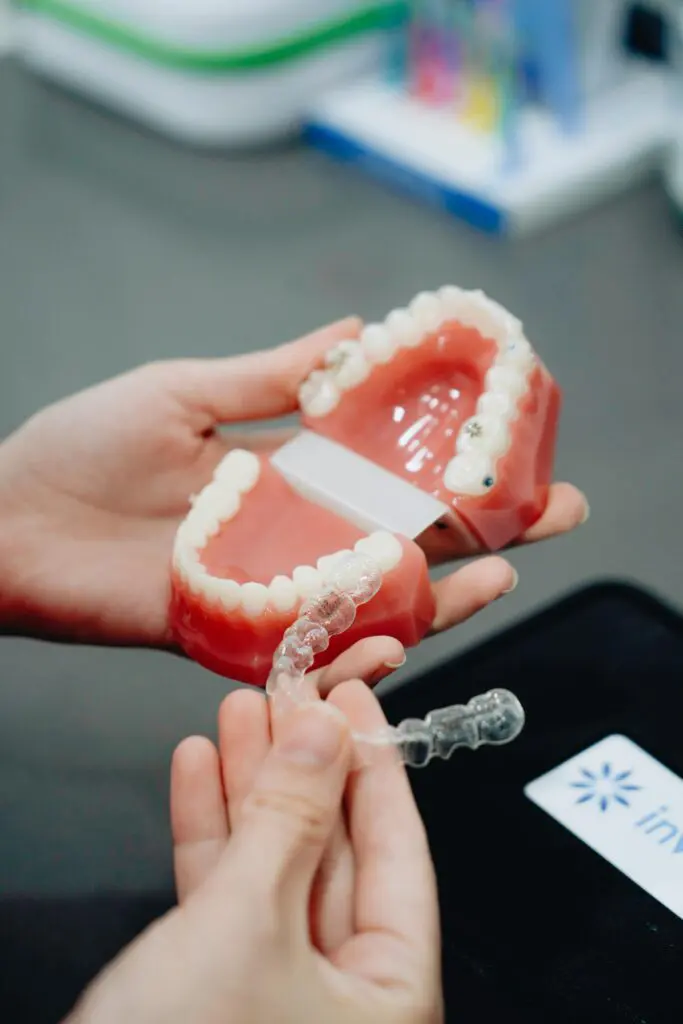
Most adult Invisalign cases at Limestone Hills Orthodontics finish in 12 to 18 months. Mild alignment cases finish in 6 to 9 months (Invisalign Lite tier, up to 14 trays). Comprehensive cases with bite correction or rotational complexity extend to 18 to 24 months. The largest controllable factor in duration is daily wear time.
Patients who hit the 22-hour target finish on schedule. Patients who wear aligners 16 to 18 hours per day routinely need refinement rounds that add 3 to 6 months. Dr. Viecilli provides a written duration estimate based on the ClinCheck plan at the free consultation.
Across roughly 1,200 adult Invisalign cases at Limestone Hills Orthodontics, the median finishing time is around 14 months. The 25th percentile finishes by 10 months and the 75th percentile takes 18 months. The single factor that moves a case across these bands more than any other is the patient’s wear-time discipline in the first three months.
Dr. Viecilli sees cases that lock into the 22-hour target during the first 90 days finish on schedule almost without exception. Cases that drift into the 16 to 18 hour range early routinely need a refinement round that adds 3 to 6 months.
Typical Invisalign Duration by Case Type
Align Technology packages Invisalign treatment into four main tiers (Express, Lite, Moderate, and Comprehensive), with a Complex sub-band inside Comprehensive for the most demanding cases.
The tier determines how many trays the lab fabricates and what range of movements the plan covers. The table below shows the typical duration band for each tier, the tray count Align allows, and a wear-time note specific to that complexity.
| Case type and Invisalign tier | Number of trays | Total time | Wear-time note |
|---|---|---|---|
| Minor (Invisalign Express, cosmetic touch-ups or relapse cleanups after prior orthodontic work) | Up to 7 trays | 3 to 6 months | 22 hours per day. Refinement rounds rare in well-selected Express cases. |
| Mild (Invisalign Lite, minor crowding under 4mm or small spacing) | Up to 14 trays | 6 to 12 months | 22 hours per day. Compliance lapses are visible quickly because every tray counts. |
| Moderate (Invisalign Moderate, mild bite correction with alignment) | 15 to 20 trays | 9 to 14 months | 22 hours per day. One refinement round common at the end of active treatment. |
| Comprehensive (Invisalign Comprehensive, full bite correction and alignment) | 20 to 40 trays | 12 to 24 months | 22 hours per day and consistent elastic wear. One to two refinement rounds expected. |
| Complex (severe rotations, extraction-space closure, or skeletal asymmetry; sub-band of Comprehensive) | 40 to 60+ trays | 18 to 30 months | 22 hours per day, elastic wear, and frequent attachment-design revisions. Multiple refinement rounds typical. |
The tier is selected at the ClinCheck planning stage based on the 3D scan and the clinical exam. A case that starts as Express or Lite sometimes escalates to Moderate or Comprehensive during refinement; that is normal and expected, not a sign of treatment failure.
What Determines How Long Invisalign Takes for Your Case
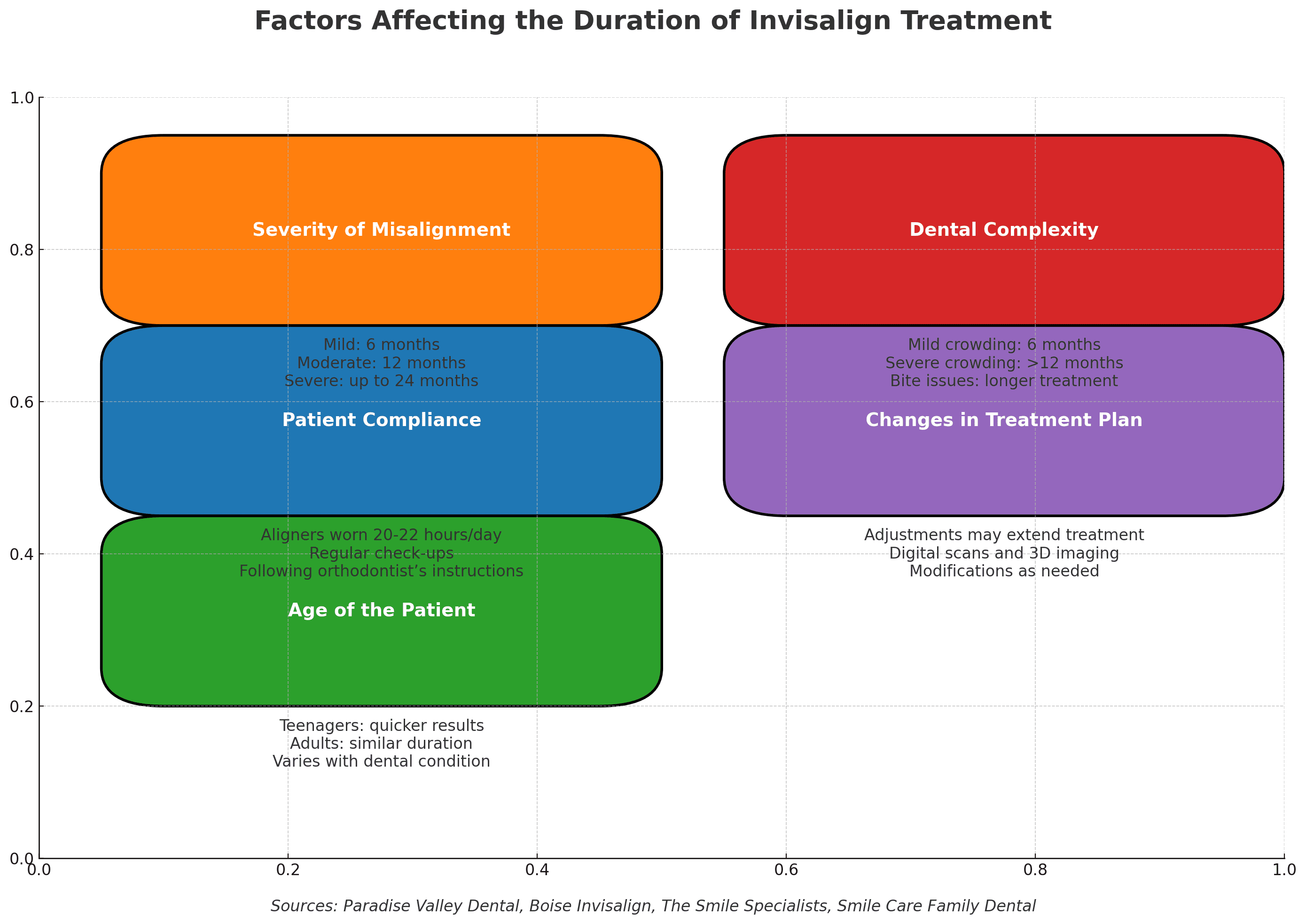
Six factors drive aligner-specific duration. Each operates independently, but they compound in real cases. A 28-year-old with mild crowding and disciplined wear lands at one end of the curve. A 45-year-old with severe rotations and inconsistent compliance lands at the other.
Alignment Severity and Spacing Pattern
Crowding is measured in millimeters of arch-length discrepancy. Mild crowding under 4mm typically resolves in the Lite tier. Moderate crowding of 4mm to 7mm requires Moderate or Comprehensive packages.
Severe crowding over 7mm often needs interproximal reduction or extractions, which extends duration into the 18 to 24 month range. Spacing cases generally move faster than equivalent crowding cases because aligners close space more predictably than they create it.
Bite Correction Depth
Class I alignment without bite correction is the fastest profile for Invisalign. Class II cases (upper jaw forward of lower) require elastic wear from the aligner and add 6 to 12 months over an equivalent alignment-only case.
Class III cases (lower jaw forward of upper) are the slowest aligner profile because the mechanics work against the natural bite geometry; mild dental Class III can finish in 15 to 20 months with elastic wear, while skeletal Class III in adults often coordinates with jaw surgery and runs 24 to 30 months around the surgical date.
Rotational Complexity
Aligners produce rotational movement less efficiently than fixed appliances because plastic trays lose grip on rounded tooth surfaces. A 30-degree rotation on a premolar or canine can add 2 to 4 months in aligners. A 60-degree or 90-degree rotation often requires multiple refinement rounds and specialized attachment designs.
Cases with multiple severe rotations are sometimes treated with hybrid sequencing (braces first for rotations, aligners after for finishing) at Limestone Hills, with Dr. Viecilli explaining the rationale at the consultation.
Patient Age
Adolescent bone remodels faster than adult bone, so a 14-year-old and a 32-year-old with identical alignment finish 3 to 6 months apart on average. Aligners narrow this gap slightly compared to braces because patient compliance with removable trays is generally higher in adults than teens. The single biggest adult advantage in aligner cases is reliable wear time.
Compliance Pattern
Compliance is the largest controllable factor in aligner duration. Align Technology designs the ClinCheck plan assuming 22 hours of daily wear. Patients hitting 22 hours per day finish on schedule.
Patients in the 18 to 20 hour range routinely need one refinement round (adding 3 to 6 months). Patients at 14 to 16 hours per day stall in the middle of treatment, often requiring two or more refinements and finishing 6 to 12 months past the original estimate.
Need for Hybrid Sequencing
A small share of comprehensive cases at Limestone Hills work better as hybrid sequencing: a short braces phase to handle severe rotations or large extraction closures, followed by an Invisalign phase to finish the alignment in a removable system. Hybrid cases run 18 to 24 months total but produce better clinical outcomes than aligners alone for the specific case types that require it.
Why Wear Time Matters More Than Tray-Change Cadence
The 22-hour-per-day target is not a marketing number. It is the design assumption Align Technology uses when the ClinCheck lab plans force vectors and tooth-movement increments for each tray. Below that wear time, the force the aligner applies to each tooth does not generate enough sustained pressure to remodel the bone around the tooth root on schedule.
The compounding problem is what happens when the aligner is out of the mouth. Teeth shift back toward their previous positions during the hours the aligner is removed.
A patient wearing the aligner 14 hours per day spends 10 hours per day allowing partial relapse, which means each tray accomplishes less net movement than the plan called for. By the end of a Lite-tier 14-tray series, the lost movement compounds into a case that needs a refinement scan and 4 to 6 more months of treatment.
The reality is most patients underestimate how much wear-time discipline matters in the first three months. That period determines whether the case finishes on schedule or extends 3 to 6 months for refinement. Dr. Viecilli’s clinical observation at Limestone Hills is that patients who set up phone reminders for tray reinsertion during the first 90 days almost always finish on the original timeline. Patients who rely on memory drift into the 16 to 18-hour range within 6 weeks.
Tray-change cadence (1 week versus 2 weeks per tray) is the secondary factor. Align Technology allows orthodontists to set the cadence based on how well each tray is tracking. Faster 7-day changes work when teeth are seating cleanly into each tray; slower 10 to 14 day cadence is appropriate for difficult movements.
The wear-time-versus-cadence relationship is asymmetric: a patient at 22 hours per day with 14-day cadence finishes faster than a patient at 16 hours per day with 7-day cadence, because the trays need to actually move teeth before the next tray is inserted.
Invisalign Tiers Explained: Express, Lite, Moderate, Comprehensive
Align Technology packages Invisalign as four main tiers with progressively more trays and longer duration windows. The orthodontist selects the tier at the ClinCheck planning stage based on what the 3D scan reveals.
Invisalign Express
Up to 7 trays, completed in 3 to 6 months for most patients. Designed for minor cosmetic touch-ups, single-tooth movements, or relapse cleanups after a previous orthodontic case. Refinement rounds are rare when the case is well-selected.
A small share of adult cases at Limestone Hills are Express tier. Most Express candidates are patients who had braces or aligners 10 to 20 years ago and have minor relapse they want corrected before a wedding, professional event, or other life moment.
Invisalign Lite
Up to 14 trays, dual or single arch, completed in 6 to 12 months for most patients. Designed for mild crowding under 4mm, small spacing, or single-arch finishing after a previous orthodontic case. Includes one refinement round at the end. The eligible profile is a minority of adult cases at Limestone Hills.
Invisalign Moderate
15 to 20 trays, dual or single arch, completed in 9 to 14 months. Covers mild bite correction in addition to alignment. Includes one refinement round. A sizable share of adult cases at the practice fall into this tier.
Invisalign Comprehensive
Up to 7 years of unlimited trays and refinements, covering full bite correction, severe alignment, and complex movements. Most cases finish in 12 to 24 months of active treatment. The largest share of adult cases at the practice are Comprehensive, with the trade-off being a longer duration in exchange for predictable handling of complex movements.
The escalation path from Lite to Moderate to Comprehensive sometimes happens mid-treatment if the case turns out to be more complex than the initial scan revealed. The fee structure at Limestone Hills includes the upgrade path so a case that escalates does not generate a surprise bill.
Refinement Rounds: What They Are and Why Most Cases Need Them
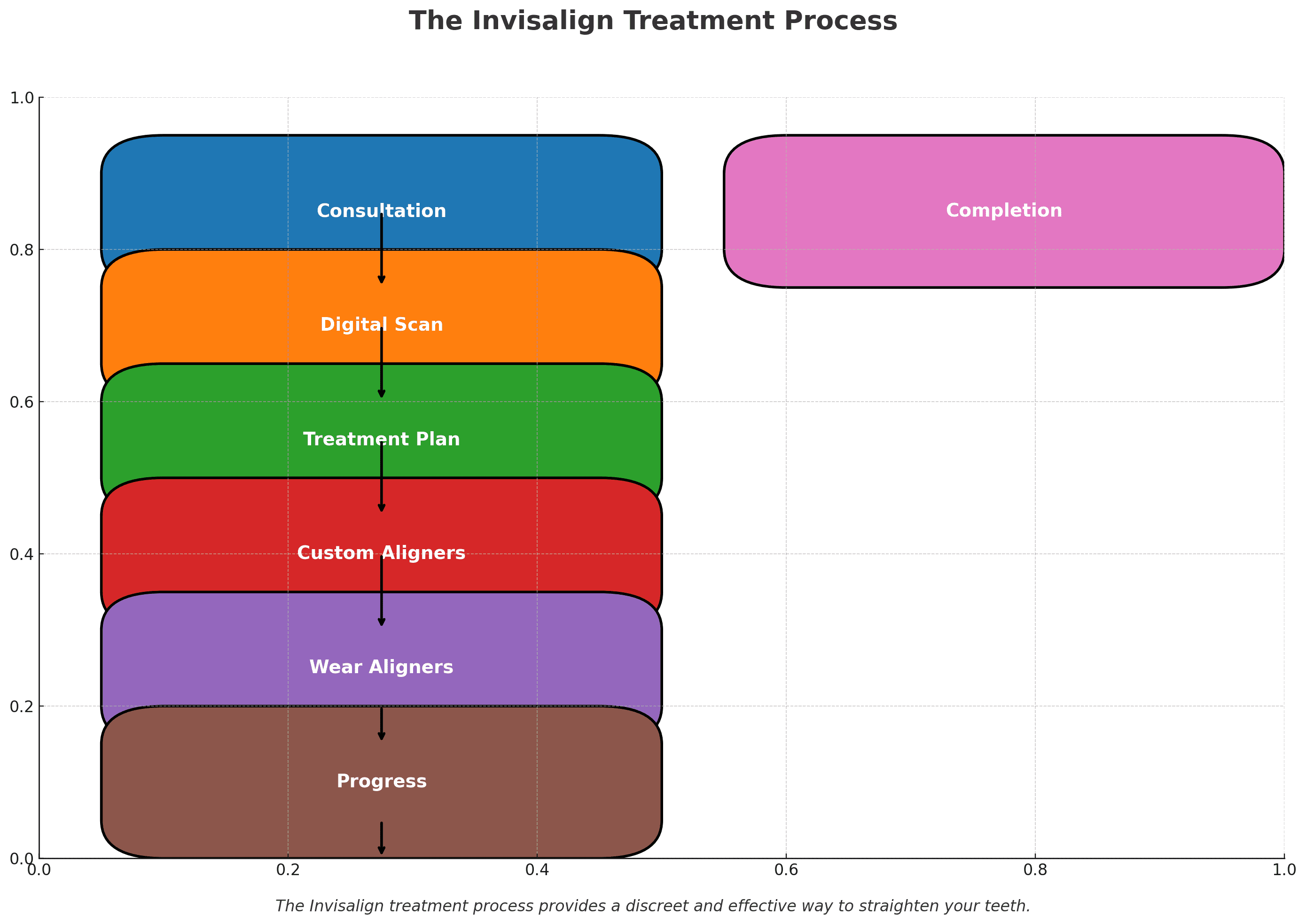
A refinement round is a second batch of aligner trays fabricated after the initial series finishes. The orthodontist scans the teeth again at the end of the first series, and Align fabricates new trays designed to finish movements that did not complete to the ClinCheck plan’s specifications. Refinements are common, expected, and not a sign of treatment failure.
Industry data shows that 60% to 70% of Invisalign cases require at least one refinement round. The reasons vary. Some teeth do not track the plan because of biological variation in how the tissue around the tooth root responds to force.
Others fall behind because the patient’s wear time slipped below 22 hours per day. A small portion require refinement because the original plan needed adjustment as the case revealed new clinical information.
A refinement round typically adds 3 to 6 months to the total treatment time. Most refinements use 6 to 14 additional trays. Complex cases may need 2 or 3 refinement rounds.
At Limestone Hills Orthodontics, refinements are included in the base Invisalign fee for up to 7 years from the start of active treatment, meaning patients do not pay per refinement set. Dr. Viecilli explains the refinement policy at the consultation so families understand the total time and total cost commitment.
How Limestone Hills Forecasts Treatment Time at the Consultation
The free consultation at Limestone Hills Orthodontics includes a clinical exam, a 3D cone-beam CT scan, and a digital intraoral scan. The diagnostic data feeds two parallel processes: Dr. Viecilli’s clinical judgment based on the exam findings, and the ClinCheck software’s algorithmic projection based on the digital model.
The consultation produces a written duration estimate in three forms: the projected number of trays in the initial series, the expected active-treatment window in months, and the likelihood that one or more refinement rounds will be needed based on case complexity.
Most patients leave the consultation with a clear range (for example, 12 to 16 months with one refinement likely) rather than a single point estimate, because aligner cases have more inherent variance than fixed-appliance cases.
The estimate at the consultation is held for the duration of treatment. If the case escalates from Moderate to Comprehensive during refinement, the timeline updates but the financial commitment does not. Dr. Viecilli sees families who appreciate the written estimate format because it allows scheduling decisions (work travel, school timing, wedding planning) to be made with realistic expectations rather than vague reassurances.
Treatment Timing for Austin and Hill Country Invisalign Patients
Limestone Hills Orthodontics treats adult Invisalign patients from across the Austin metro and the Hill Country. Regular patient flow comes from Lakeway, Cedar Park, Round Rock, Bee Cave, Westlake, Steiner Ranch, and the Northwest Hills neighborhoods.
Within Austin proper, the practice sees Invisalign patients from Tarrytown, Davenport Ranch, River Place, Four Points, Jester Estates, and Anderson Mill. The 12-to-18-month standard-case window applies the same way across every Austin-area neighborhood.
For Austin families, the practical timing factor is the consultation-to-banding window. Limestone Hills schedules new-patient Invisalign consultations within 7 to 14 days of the initial call. Once Dr. Viecilli approves the ClinCheck plan, the first aligners typically arrive within 3 to 5 weeks of the consultation.
Texas summer schedules and back-to-school timing influence the Austin-area scheduling pattern, so adult professionals targeting a summer-start commonly book consultations in April and May to allow time for ClinCheck approval and tray fabrication before vacation travel.
Common Questions About Invisalign Treatment Duration
How long do Invisalign attachments take to bond?
Attachment bonding is a single 30 to 45 minute appointment at the start of active treatment. The composite attachments are placed on specific teeth in the positions the ClinCheck plan calls for, then cured with a light. Most patients bond all attachments in one visit and leave the office wearing the first aligner tray. Attachments are removed at the end of active treatment in a similar single appointment.
Can Invisalign work in 6 months?
Yes, for genuinely mild cases. Invisalign Lite covers up to 14 trays and finishes most cases in 6 to 9 months. The eligible profile is minor crowding under 4mm, small spacing, or single-arch refinement after a previous orthodontic case. Comprehensive bite correction, severe rotations, and large extraction-space closures cannot finish in 6 months in any aligner system; those cases run 12 to 24 months.
Why is my Invisalign taking longer than expected?
The two most common reasons are inadequate wear time and unexpected rotational difficulty. Wearing aligners less than 20 hours per day prevents the lab-designed force vectors from translating into tooth movement on schedule. Severe rotations on canines and premolars are also among the slowest movements aligners produce. If a case has stalled across 2 consecutive check-ins, ask the orthodontist whether attachments need to be redesigned or whether a refinement scan is appropriate.
How long do you wear each Invisalign tray?
Most patients change to the next tray every 7 to 14 days. The Align Technology default is 1 to 2 weeks per tray; the orthodontist sets the exact cadence based on the case’s complexity and the patient’s tracking. Faster tray changes work when the teeth are tracking well to the ClinCheck plan; slower cadence is appropriate for difficult movements or when a tray is not fully seating.
Does Invisalign work faster than braces?
For mild and moderate cases with good wear-time compliance, Invisalign and braces finish within 2 to 4 months of each other on equivalent cases. For severe rotations, large extraction-space closures, and complex bite correction, braces are typically 3 to 9 months faster because fixed appliances generate higher force vectors and never come out of the mouth. The aligner-versus-braces decision is rarely about speed; it is about visibility, removability, and case suitability.
Sources. Align Technology clinician resources on the Invisalign Lite, Moderate, and Comprehensive package structures, tray-count ranges, and ClinCheck treatment planning.
Align Technology guidance on the 20-to-22-hour daily wear-time target and the role of compliance in case progression. American Association of Orthodontists patient resources on aligner treatment, refinement scans, and case-suitability factors.
Proffit WR, Fields HW, Larson BE, Sarver DM. Contemporary Orthodontics, 6th edition, Elsevier, on aligner biomechanics, rotational movement efficiency, and Class I, II, and III treatment timing.
Limestone Hills Orthodontics practice observations across roughly 1,200 adult Invisalign cases regarding median 14-month finishing time, the 25th and 75th percentile distribution, and the role of wear-time discipline in the first 90 days.