
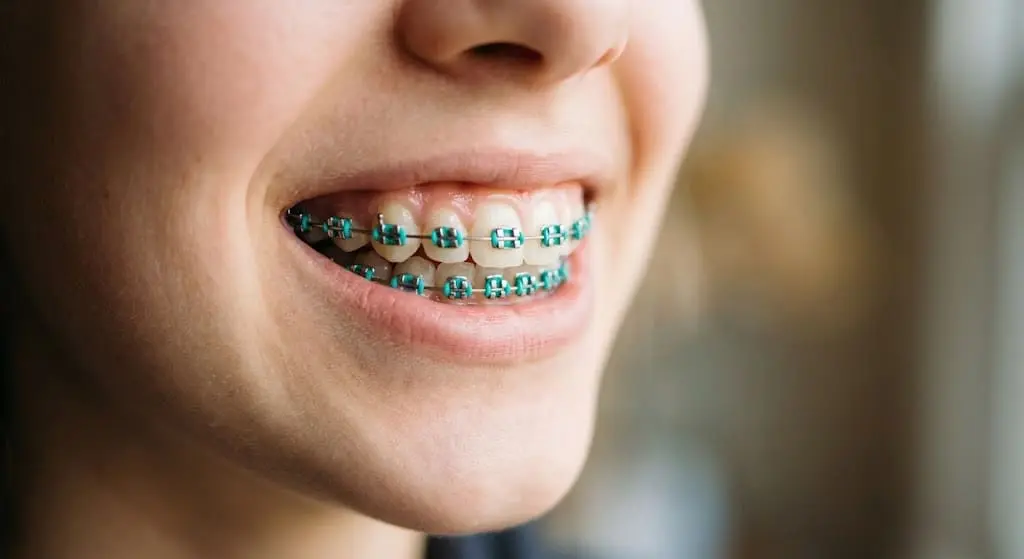
Braces colors are the small elastic ties that hold the wire to each bracket on metal braces, and they are replaced at every adjustment, so the choice is purely cosmetic and reversible. Cooler shades like deep blue, purple, and teal make teeth look whiter, while dark green, brown, true black, and yellow can look like trapped food. Clear and ceramic braces and clear aligners do not use colored ties.
Color is the most fun decision in orthodontics and the lowest stakes. The Limestone Hills team in Austin changes the elastic ties at every visit, so a patient sees the full color tray on a regular cycle and never has to live with a color choice for long.
What the team actually sees, across 5,000+ treated Austin cases supervised by Dr. Rodrigo Viecilli, an ABO Diplomate, is a clear contrast pattern. Cool tones sit next to enamel and make it look brighter. Warm yellows and dark browns do the opposite and can read like something stuck on the teeth in photos.
That observation is cosmetic, not clinical. It does not change how the braces move teeth. It only changes how the smile photographs between now and the next appointment, which for a teen posting to Instagram is the part that matters most.
How Braces Colors Actually Work
On traditional metal braces, a thin wire runs through a slot in each bracket and guides the teeth into position. Something has to hold that wire in the slot. On metal braces, that something is a tiny stretchy ring called an elastic ligature, and those rings are what come in colors.
The ligatures are not structural in a way that depends on color. A blue tie and a green tie do the same mechanical job. The color is dye in the elastic and nothing more, so choosing one over another has zero effect on how fast or how well the teeth move.
Because the elastics stretch and lose force over time, they are swapped out at every adjustment visit, usually every several weeks. New ties go on in whatever color the patient picks that day. That regular swap is the reason color is the lowest-stakes decision in the whole treatment.
One practical note. Lighter and clearer ties can take on stain from food and drink between visits, while saturated colors tend to hold their look. That difference is the single most useful thing to know before picking, and the rest of this guide builds on it.

Colors That Make Teeth Look Whiter
Teeth look whitest when the color next to them creates contrast in the cool direction. This is the same idea behind blue-tinted whitening products: a hint of cool tone tricks the eye into reading enamel as brighter than it is. The right band color borrows that effect for free.
Deep blues, true purples, and teal are the strongest performers. They sit against the tooth and push the perceived shade lighter. Darker navy and a cool gray or smoke shade work in the same way and are popular with patients who want the whitening effect without a bold look.
The colors that do the least for whiteness are the warm and pale ones. Yellow and gold can pull enamel toward a duller cast. Very light clear or white ties give almost no contrast, so they neither help nor hurt on day one, though they carry the staining caution covered later.
| Whitening effect | Band colors | Why |
|---|---|---|
| Makes teeth look whiter | Deep blue, royal blue, purple, teal, navy, cool smoke gray | Cool contrast pushes the eye to read enamel as brighter |
| Neutral, little effect | Clear, white, light pink, soft blue | Low contrast on day one; clear and white can stain before the next visit |
| Can make teeth look duller | Yellow, gold, light brown | Warm tones pull the perceived enamel shade toward yellow |
This is a guideline, not a rule. Skin tone, lip color, and natural enamel shade all play a part, and the Limestone Hills team is happy to hold a couple of sample ties up at the chair so a patient can see the contrast in a mirror before deciding.
Colors to Approach With Care
A few colors come with a predictable downside, and knowing it in advance saves a patient from a look they did not want for the next several weeks. None of these colors is forbidden. They simply tend to disappoint once they are on the teeth.
The food-look problem is the big one. Dark green can read like a piece of spinach or broccoli caught in the brackets. Brown and very dark shades can look like staining. True black is striking in theory but in photos it often reads as a gap or as something stuck between the teeth.
Yellow and gold sit in a different category. They do not look like food, but they tend to make enamel look more yellow by comparison, which works against most people’s goal of a brighter smile. Patients who love the color often pair it with a cool color to offset the effect.
Clear and white ties deserve their own caution. They look clean and subtle on the day they go on, but they pick up stain readily. Coffee, tea, curry, turmeric, tomato sauce, and dark sodas can tint them within days, so by the next visit they may look dingy rather than invisible.
- Dark green: can look like trapped leafy food in photos and in person.
- Brown and very dark shades: can read as staining on the teeth.
- True black: dramatic in theory, but often photographs like a gap or food.
- Yellow and gold: tend to make enamel look duller; best paired with a cool color.
- Clear and white: clean at first, but stain easily from coffee, curry, and tomato sauce.
For patients who still want one of these colors, the every-visit swap is the safety net. A color that did not work in real life is gone at the next appointment, so trying a bold or risky shade once carries no lasting cost.

School, Sports, and Holiday Combos
Color combinations are where braces get genuinely fun. Two ties in coordinated shades, alternating around the arch, turn a clinical appliance into something a patient looks forward to changing. The most popular combos pull from teams, schools, seasons, and holidays.
School and team spirit is the easiest starting point. A patient picks the two colors of a favorite school or sports team and wears them straight through a season. In Austin and the surrounding area, burnt orange and white is the obvious local pairing, and it happens to be a combo where the white band benefits from being swapped often.
Holidays give a built-in rotation. Because ties change roughly every several weeks anyway, the timing lines up well with the calendar, so the holiday closest to the next visit becomes the theme for that stretch.
| Theme | Combo idea |
|---|---|
| School or team spirit | The two colors of a favorite school or sports team, alternating around the arch |
| Winter holidays | Red and green, or icy blue and silver for a frost look |
| Valentine’s | Pink and red, or red and white |
| Spring and summer | Teal and lavender, or a bright multicolor rainbow |
| Fall and Halloween | Orange and a deep purple, skipping true black for a softer dark shade |
| Birthday or just for fun | A favorite color paired with deep blue so the smile still reads bright |
A useful trick for combos: keep at least one of the two colors in the cool family. A bright fun shade paired with a deep blue still gets some of the whitening contrast, so the smile photographs well even when the theme is bold. This is the kind of small detail that makes a combo Instagram-ready rather than just festive.
Picking by Style and Preference
Beyond whitening and themes, the best color is the one a patient will enjoy. There is no single right answer, and different people approach the tray very differently. A few patterns help a first-timer decide quickly at the chair.
Patients who want braces to be subtle usually do well with cool, muted shades. Smoke gray, deep navy, and clear-adjacent soft blues are low-key, and the cool ones still help with brightness. Adults in metal braces often land here, picking something barely noticeable rather than no color at all.
Patients who want braces to be a feature lean the other way, into bold single colors or high-contrast combos that change with the season. For these patients the every-visit swap is part of the appeal, because each appointment becomes a chance to redesign the look.
Skin and lip tone can guide the call. Cool undertones often pair well with blues, purples, and teal, while warmer undertones can carry deeper jewel tones nicely. None of this is a hard rule, and the Limestone Hills team will hold sample ties at the chair so the patient sees the effect before committing.
Which Braces and Aligners Do Not Get Colors
This is the most important accuracy point in the whole guide, because the answer surprises a lot of families. Colored bands are a feature of traditional metal braces only. Not every type of orthodontic treatment offers them, and assuming they do leads to disappointment.
Self-ligating ceramic and clear braces do not use colored elastic ties at all. Instead of an elastic ring holding the wire, these brackets use a small built-in gate or clip that closes over the wire. There is no elastic to color, so the look stays consistently low-profile. For families weighing options, see clear braces at Limestone Hills.
Clear aligners such as Invisalign go a step further. There are no brackets and no wires, so there is nothing to put a color on. The trays are designed to be as close to invisible as possible. A patient whose main goal is a discreet look may prefer Invisalign at Limestone Hills for exactly that reason.
So the trade-off is straightforward. If colorful bands and the fun of changing them every visit are part of the appeal, metal braces at Limestone Hills are the option that delivers that. If an invisible look matters more, clear braces or aligners are the better fit, and the color question simply does not apply.
The Honest Part
Here is the candid note worth stating plainly. Band color is purely cosmetic. It does not speed treatment, slow it, or change the result in any way, and it resets at every single visit. There is genuinely no wrong choice, and no choice a patient is stuck with.
The one real catch is staining on the light shades. Clear and white ties look great the day they go on and are a popular pick for that reason, but they pick up tint from coffee, tea, curry, turmeric, and tomato sauce. By the next visit they can look dingy, which is the opposite of the clean look the patient wanted.
The practical takeaway is to treat color as play, not pressure. Trying a bold combo, a school theme, or even a risky shade once costs nothing because it is gone in a few weeks. The Limestone Hills team frames it that way for every patient, so the decision stays fun rather than fraught.
Austin and the Hill Country
Limestone Hills treats metal-braces patients from across Austin and the surrounding Hill Country, including Lakeway, Cedar Park, Round Rock, and Bee Cave, and the colored ties are changed at every adjustment for all of them. The color tray does not change by neighborhood, and neither does the every-visit swap.
Local school and team colors are a natural starting point for combos. An Austin patient might run burnt orange and white through a season, while a teen in Round Rock or Cedar Park can pull from a home-school palette just as easily. The choice is universal and entirely up to the patient.
For Austin-area families, the practical advantage of an orthodontist-led practice is that the fun part and the clinical part are kept separate and clear. Dr. Rodrigo Viecilli, an ABO Diplomate, supervises the treatment that moves the teeth, while the color tray stays a low-stakes, change-it-anytime decision the patient gets to own at every visit.
Common Questions About Braces Colors
What braces colors make your teeth look whiter?
Cool tones tend to read whitest against natural enamel. Deep blues, purples, and teal create a contrast that makes teeth look brighter, similar to how a blue-tinted whitening shade works. Darker silver and navy can also help. Yellows, golds, and very light clear or white bands give the least whitening effect and can even make teeth look duller by comparison.
Which braces colors should you avoid?
Skip shades that can look like trapped food or stained teeth: dark green, brown, and very dark or true black often read that way in photos and in person. Yellow and gold can make enamel look dull. Clear and white ties look clean at first but pick up stain from coffee, curry, and tomato sauce, so they can discolor before the next visit.
Do clear braces and Invisalign come with colored bands?
No. Colored elastic ties are a feature of metal braces only. Self-ligating ceramic and clear braces hold the wire with a built-in mechanism rather than colored elastics, and clear aligners like Invisalign have no brackets or ties at all. If colorful bands are part of the appeal, metal braces are the option that offers them.
How often can you change your braces colors?
The colored ligatures are replaced at every adjustment visit, which is usually every several weeks. That means each appointment is a chance to pick a fresh color or combination. Because the choice is purely cosmetic and resets so often, there is no permanent or wrong decision, and a color that did not work can be swapped at the next visit.
Are braces band colors only for kids and teens?
Not at all. Adults in metal braces choose colors too. Many pick subtle, professional shades like deep blue, silver, or smoke that are barely noticeable, while others lean into bold combinations for fun. The choice is entirely personal, and the Limestone Hills team presents the full tray to every patient regardless of age.
Sources. Standard orthodontic guidance on elastic ligature color selection and staining behavior, stated qualitatively. Specifics that could not be independently verified are stated qualitatively rather than as exact figures. Clinical observations from Limestone Hills Orthodontics, Austin, TX.