
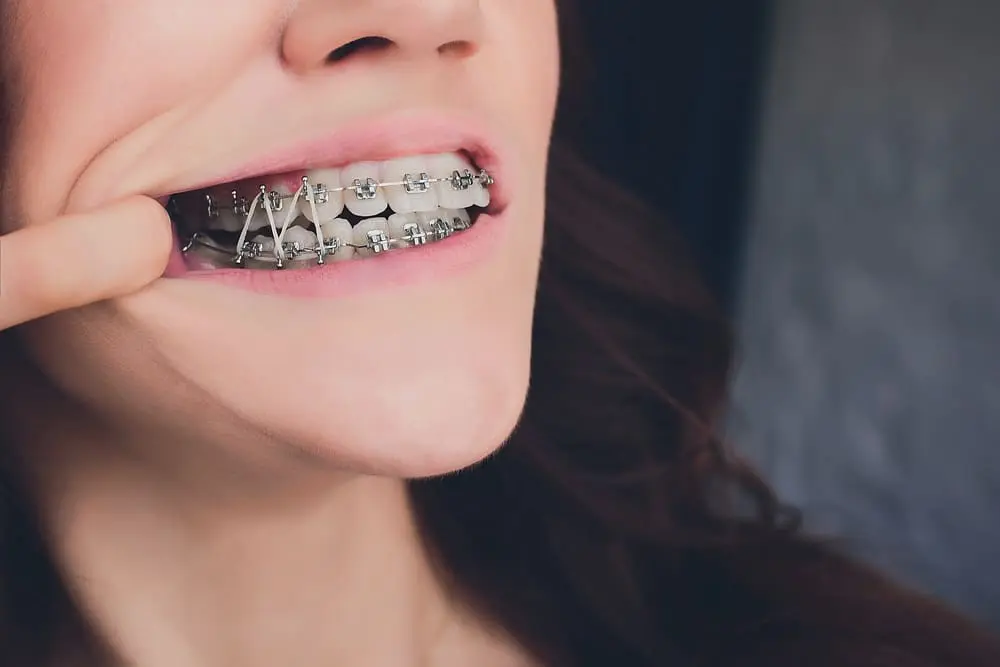
Orthodontic rubber bands (elastics) are tiny bands that connect the upper and lower braces to move the bite and jaws, which braces alone cannot do. Most are worn 22 or more hours a day, removed only to eat and brush, then replaced right away.
Wear is the single biggest factor in finishing on time. Every Limestone Hills Orthodontics patient in Austin is shown the technique in person at the first elastic visit.
Dr. Viecilli sees one pattern more than any other in cases that run long: elastics worn part-time. A patient wearing bands about 16 hours a day instead of the prescribed 22 or more is the single most common reason a treatment plan stretches by an extra 6 to 9 months.
The braces and the wires are working; the bite correction is not, because it depends almost entirely on the elastics being in the mouth.
For that reason the Limestone Hills first-elastic-visit protocol is built around making wear stick. Each patient leaves with a written compliance card, a suggestion to set a phone reminder for band changes, and a follow-up call from the practice at the one-week mark to catch a wear problem before it costs months rather than after.
What Orthodontic Rubber Bands Actually Do
Braces straighten the teeth within each jaw. They move teeth into a neat row on the top and a neat row on the bottom. What braces alone cannot reliably do is change how the top and bottom rows meet, which is the bite.
Elastics do that part. Each band stretches between a hook on the upper braces and a hook on the lower braces and applies a steady, gentle pull across the bite. Over weeks, that pull eases the jaws and teeth into a relationship where the bite fits together correctly.
The American Association of Orthodontists describes elastics as tiny rubber bands that apply extra force in ways braces alone cannot. The force is light by design. Consistency, not strength, moves the bite, which is why wearing the bands almost all day decides the result.
The Types of Elastics and What Each One Corrects
There is no single “rubber band.” The orthodontist chooses a configuration based on the specific bite problem, and most patients use more than one configuration over the course of treatment. The table below is the plain-language version of what each common type does.
| Elastic type | Where it attaches | What it corrects |
|---|---|---|
| Class II | Upper canine area to lower molar area | Overbite. Eases the upper teeth back and the lower teeth forward so the bite meets evenly. |
| Class III | Lower canine area to upper molar area | Underbite. Works the opposite way of Class II, easing the lower teeth back and the upper teeth forward. |
| Vertical (anterior) | Straight up and down between an upper and a lower tooth | An open bite where front teeth do not touch. Closes the gap so the front teeth meet. |
| Triangle | Three teeth (often one upper, two lower, or the reverse) | Settles the back teeth into firm contact and fine-tunes how a small group of teeth meets. |
| Box | Four teeth in a rectangle (two upper, two lower) | Brings a section of teeth into solid contact and improves stability where they meet. |
| Midline | Diagonally across the front, upper to lower on opposite sides | Lines up the center of the upper teeth with the center of the lower teeth when they are off to one side. |
Asymmetric setups, where one side of the mouth uses a different configuration than the other, are common when a bite is shifted more on one side. The instruction sheet always shows the exact teeth for that patient. The categories above are the map; the orthodontist draws the route.
How to Put Orthodontic Rubber Bands On
The first day feels clumsy for almost everyone. By day two or three it takes a few seconds. Limestone Hills Orthodontics has every patient practice the placement in the chair before they leave the first elastic visit, so the first time is supervised, not solo at the bathroom mirror.
The basic technique, using a mirror and a clean fingertip:
- Wash both hands. The fingers go in the mouth and on the braces, so clean hands come first.
- Hold the elastic between the thumb and index finger of one hand, or loop it over the small applicator hook included with the elastics.
- Look in a mirror and find the first hook the instruction sheet names, usually a hook near an upper canine. Loop one side of the band onto it.
- Stretch the band down (or across) to the second hook the sheet names, usually a hook near a lower molar, and slip the other side of the band onto it.
- Repeat on the other side of the mouth if the prescription calls for a band on both sides. Most do.
- Open and close the mouth once to confirm the bands sit on the right hooks and pull in the right direction.
The small plastic applicator hook handed out with the elastics makes step 3 and step 4 easier than bare fingers for most people. Removing a band is the reverse: a fingertip or the hook lifts it off one hook and it comes free.
The Wear Schedule: 22 or More Hours a Day
This is the rule that decides whether treatment finishes on schedule. The clinical evidence is consistent that near-full-time wear, about 22 hours a day, produces the most predictable bite correction.
The practical version of the rule:
- Wear them 22 or more hours a day. They go in after breakfast and stay in through the day and overnight.
- Remove them only to eat and to brush. Take them out for meals so they are not stretched out by chewing, take them out to brush so the teeth get cleaned properly, then put a fresh pair in right away.
- Replace immediately after eating or brushing. The few minutes a band is out for a meal is fine. The hours a band stays out because it was forgotten after a meal is where treatment time is lost.
- Move to nighttime-only wear only on instruction. Near the end of treatment some patients are told to wear elastics only overnight to hold the result. That step comes from the orthodontist, never from the patient deciding the bite looks done.
The reason removal-and-replace matters so much is force decay. Elastics lose the largest share of their pulling strength within the first 4 to 5 hours. A band left out through lunch and not replaced until dinner is several hours of zero force in the middle of the day, every day, which the projected timeline did not account for.
What to Do When a Band Breaks or Goes Missing
Elastics break, especially in the first week while the hands are still learning the technique. A band can also snap during the day or get left somewhere. None of this is a problem if the response is simple and fast.
Replace it right away with a fresh band. A broken or lost band is hours of missed force if it is not replaced quickly. The whole point of carrying spares is that a break never turns into a half-day gap.
Carry spares everywhere. A small bag of elastics in a backpack, a locker, a car, and a bathroom drawer means the answer to a broken band is always within reach. The practice restocks bands at every visit and between visits on request.
Do not double up to make up for lost time. This is the one that matters most. Wearing two bands on a hook to catch up does not speed correction.
The American Association of Orthodontists is direct that doubling up is a no-go: the extra force can harm the roots of the teeth and can slow tooth movement rather than speed it. The right response to missed wear is always to return to the normal single-band schedule, not to overcorrect.
If the hooks themselves break off the braces, or a band cannot be placed because a bracket has come loose, that is a call to the practice rather than a fix at home. Limestone Hills Orthodontics treats those repair visits as included for active patients.
The Most Common Elastic Mistakes (and Why They Cost Months)
Almost every case that runs long traces back to one of a short list of habits. None of them feel like a big deal in the moment, which is exactly why they accumulate.
Forgetting to replace bands after meals and brushing. The band comes out for lunch, the meal ends, life moves on, and the band goes back in three hours later. Repeated daily, that is roughly a quarter of the day with no force. This is the single most frequent wear failure.
Wearing fewer hours than prescribed. Evening-and-overnight wear instead of all-day wear feels like “still wearing them,” but it is roughly half the prescribed force time. The bite responds to total hours, and half the hours produces a fraction of the movement on the same calendar.
Doubling up to catch up. After a few light days, the instinct to wear two bands and make up for it is understandable and wrong. It does not accelerate anything and risks the tooth roots. Consistent single-band wear from today forward is the only thing that recovers the timeline.
Deciding the bite looks done and stopping early. The bite can look corrected before it is stable. Stopping elastics before the orthodontist confirms the result lets the teeth drift back, which is slower to redo than it was to do the first time.
Here is the candid part Dr. Viecilli raises at the first elastic visit, not after a delay: elastics only work when the patient wears them. The orthodontist cannot make up for missed wear with a stronger wire or a different appliance.
Inconsistent elastic wear is the single most common reason a case runs months longer than projected, and the practice would rather say that on day one than explain a delay six months later.
How Long Will Elastics Be Part of Treatment?
It depends on the bite. Some patients wear elastics for only a few months. Others wear some configuration for most of treatment, switching types as different parts of the bite are addressed. The orthodontist sets the duration based on how the correction is progressing, not on a fixed number of weeks.
What does not vary is the relationship between wear and time. Consistent near-full-time wear keeps the projected end date realistic; inconsistent wear is the most reliable way to push that date out. The instructions on which bands, how often, and how long are the part of treatment most under the patient’s own control.
Elastic Compliance for Austin and Hill Country Families
Limestone Hills Orthodontics treats families from across Austin and the surrounding Hill Country. Patients come from Lakeway, Cedar Park, Round Rock, Bee Cave, Westlake, Steiner Ranch, and Northwest Hills, with farther suburbs adding to the weekly rotation.
Every one of those families gets the same in-person elastic placement walkthrough at the first elastic visit, with the written compliance card and the one-week follow-up call.
That follow-up cadence matters more for families a 20 to 30 minute drive from the practice. The one-week phone check catches a wear problem early instead of waiting for it to surface as lost months at a routine appointment. A short call is far cheaper than a delayed finish for a family in Cedar Park, Davenport Ranch, Four Points, or River Place.
Routine elastic check-ins fold into the regular adjustment visits Austin-area patients are already scheduled for, so monitoring wear adds appointments only when a real problem needs hands-on attention. The compliance card handles the daily routine at home; the practice stays in reach for the rare snag.
Common Questions About Orthodontic Rubber Bands
How many hours a day do you wear orthodontic rubber bands?
Most orthodontists prescribe 22 or more hours a day, removing the elastics only to eat and to brush, then replacing them right away. The clinical evidence is consistent: near-full-time wear produces the most predictable correction, and elastics lose most of their pulling strength within the first 4 to 5 hours, which is why they are also changed several times a day. Near the end of treatment some patients move to nighttime-only wear, but only when the orthodontist gives that specific instruction. Wearing them only in the evening or overnight from the start is the most common reason a case runs months longer than projected.
What happens if I do not wear my rubber bands for a few days?
Tooth and bite movement slows or stalls, and the teeth can drift back toward the starting position. The forces from elastics are gentle and continuous; missing whole days removes the steady pressure the correction depends on. A few missed days will not undo treatment, but a pattern of inconsistent wear adds up to months of extra treatment time. The fix is to return to the full schedule right away, not to wear extra bands to catch up. Doubling up does not speed correction and can harm the tooth roots.
How often should you change orthodontic rubber bands?
Change them at least every 24 hours, and most patients do best changing them 3 to 4 times a day, typically after each meal and at bedtime. Elastics fatigue quickly: studies show the largest drop in pulling force happens within the first 4 to 5 hours of wear. A band that has lost its snap is still in the mouth but is no longer doing much work. Putting in a fresh pair after meals also means the strong force is applied when the mouth is clean.
Do orthodontic rubber bands hurt?
The first few days of a new elastic prescription usually bring mild soreness in the teeth and jaw, similar to the feeling after a braces adjustment. That is the normal sign the bite is starting to move. The soreness eases within a few days as the teeth respond, and an over-the-counter pain reliever taken per the label helps in the meantime. Soreness that is sharp, severe, or still at its peak after several days is outside the typical pattern and is worth a call to the practice.
What are Class II and Class III elastics?
Class II elastics correct an overbite. They run from a hook near the upper canine to a hook near the lower molar, easing the upper teeth back and the lower teeth forward. Class III elastics correct an underbite and run the opposite way, from the lower canine area to the upper molar area, easing the lower teeth back and the upper teeth forward. The orthodontist selects the configuration based on the bite, and the same patient may use different configurations at different stages of treatment.
Sources. American Association of Orthodontists, “Small Bands, Big Changes: Learn More About Orthodontic Elastics” (aaoinfo.org/treatments/orthodontic-elastics).
“Orthodontic Elastics: A Narrative Review of Biomechanics, Biological Responses, and Evidence-Based Clinical Guidelines for Everyday Practice,” PMC. “Evaluation of the Loss of Strength, Resistance, and Elasticity in the Different Types of Intraoral Orthodontic Elastics: A Systematic Review of In Vitro Studies,” PMC (force-decay within the first 4 to 5 hours).
“Orthodontic biomechanics with intermaxillary elastics,” PMC (Class II and Class III force direction and configuration).
Clinical observations and the first-elastic-visit compliance protocol from Limestone Hills Orthodontics, Austin, TX. Reviewed by Dr. Rodrigo Viecilli, DDS, PhD in Orthodontic Biomechanics (Indiana University), Diplomate of the American Board of Orthodontics.