
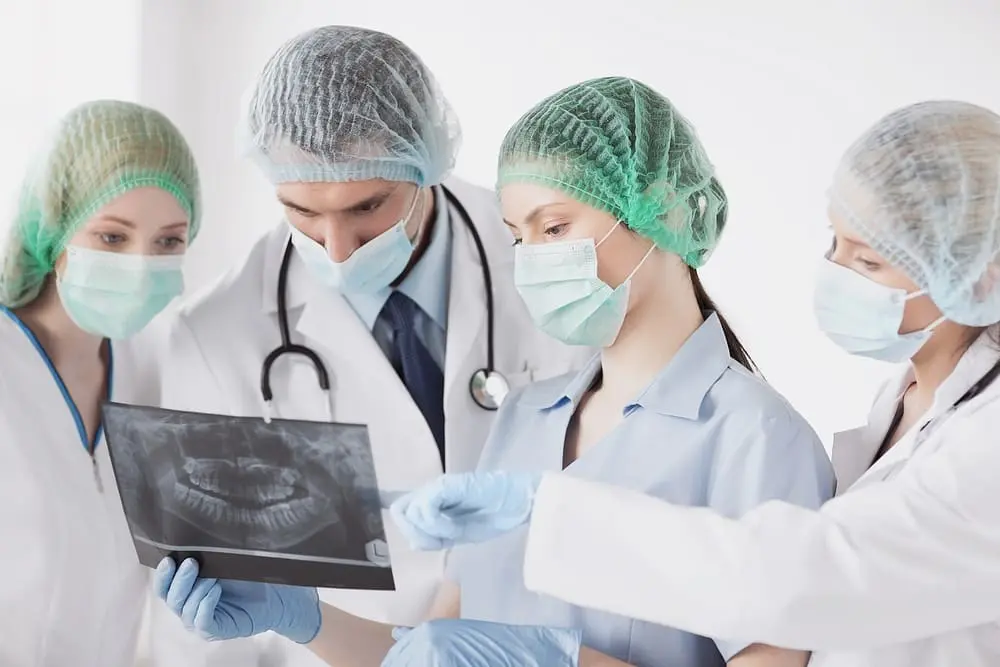
An impacted canine teeth is a pointed eye tooth, usually an upper one, that is stuck in the bone and cannot erupt on its own. A panoramic X-ray and a low-dose 3D CBCT scan locate it precisely.
Treatment is a coordinated pathway: an oral surgeon exposes the tooth and bonds a small bracket and gold chain to it, then the orthodontist applies slow, light traction over months to guide it into the arch. Left untreated it can damage neighboring roots, form a cyst, or be lost.
An impacted canine is one of the clearest cases where biomechanics decides the outcome. The tooth has to travel a long way through bone, often right past the roots of healthy neighbors, so the force has to be light, controlled, and correctly directed from the start.
Across 5,000+ treated cases at Limestone Hills in Austin, Dr. Rodrigo Viecilli, an ABO Diplomate with a PhD in orthodontic biomechanics and a co-inventor of the SmartArch wire system, plans these traction mechanics deliberately. The diagnostic depth that comes from reading the 3D position carefully is what protects the adjacent roots while the canine is moved.
That is also why the case is coordinated, not solo. The oral surgeon exposes the tooth; Dr. Viecilli designs and controls the slow traction. The pathway is shared by design, and it is described on the practice’s coordinated-care relationships.
What an Impacted Canine Is
The canines are the pointed eye teeth, one on each side of the upper and lower arch. They are among the last front teeth to come in, and the upper ones travel a long path through the bone before they reach their place. That long path is why they are the teeth most likely to get stuck.
Impacted means a tooth that is stuck and cannot erupt on its own. An impacted canine is sitting in the jawbone or under the gum, blocked from coming through, and it stays there unless it is found and guided in. Most impactions in this discussion are the upper, or maxillary, canines.
This is not a rare anatomical quirk. Roughly one to two percent of people have an impacted upper canine, a range that is widely and approximately reported rather than an exact figure. It is common enough that finding one is a routine part of reading a growing patient’s X-rays, not an unusual event.
The reason it matters is position. A canine stuck high in the bone often sits close to the roots of the front teeth next to it. Whether it is left alone or guided in changes the long-term health of those neighboring teeth, which is why an impacted canine is evaluated rather than watched indefinitely.
Why a Canine Becomes Impacted
There is rarely a single cause. An upper canine becomes impacted because something interfered with the long route it has to travel from high in the bone down into the arch. Several factors can do that, and a given case is often a combination rather than one reason.
Crowding is a common contributor. When there is not enough room in the arch, the canine can be deflected off its path and end up lodged in the bone instead of erupting into a space that was never there for it. The arch simply did not leave the tooth a clear route.
Position and guidance also play a part. The canine normally follows the root of the tooth ahead of it like a rail. When that guidance is missing or the neighboring tooth is small or absent, the canine can drift off course. The tooth can also be angled the wrong way from the start, pointing toward the roof of the mouth or across the arch.
The practical point is that the cause matters less than the position once the tooth is already stuck. The plan is built from where the canine actually sits and which way it points, not from the theory of how it got there. That is what the imaging is for.
How an Impacted Canine Is Found: Panoramic X-ray and CBCT
Detection is a two-step imaging question. The first step flags the problem; the second step locates it in three dimensions so it can be treated. Both are part of planning at Limestone Hills.
The panoramic X-ray flags it. A panoramic X-ray is a single wide image that captures both jaws and all the teeth in one view, including the ones still under the gum.
On that image an erupting canine that is missing from where it should be, or sitting at an odd angle, stands out. This is often the first sign, and it frequently appears on a routine film taken during a child’s regular orthodontic evaluation.
The CBCT locates it precisely. A CBCT is a low-dose 3D scan. Where the flat panoramic image shows that a canine is impacted, the CBCT shows exactly where it is: how deep in the bone, which direction it is pointing, whether it sits toward the cheek or the roof of the mouth, and how close it is to the roots of the neighboring teeth.
That last detail is the one that changes the plan. If the buried canine is already touching or threatening the root of the front tooth beside it, the urgency and the direction of treatment shift. A flat X-ray cannot show that relationship reliably; the 3D scan can.
Dr. Viecilli treats the CBCT position as the foundation of the case. The surgical approach the oral surgeon uses and the exact direction the orthodontic traction pulls are both decided from that 3D picture, which is why the imaging step is not skipped or shortened.
The Treatment Pathway, Step by Step
Once the canine is located, the standard pathway is a coordinated sequence between two specialists. It is methodical, and each step depends on the one before it.
Step one: make room and prepare the arch. The orthodontist usually places braces first and creates the space the canine will move into. A tooth cannot be guided into a spot that does not exist yet, so opening and holding that space is groundwork that comes before anything surgical.
Step two: the surgical exposure. An oral and maxillofacial surgeon performs a minor procedure to uncover the buried tooth. This is a routine, well-established surgery. The surgeon lifts a small amount of gum or bone to reach the crown of the impacted canine and expose enough of it to attach to.
Step three: bond a bracket and a gold chain. While the tooth is exposed, the surgeon bonds a small orthodontic bracket to it with a fine gold chain attached. Gold is used because it is well tolerated in the tissue. The chain is the handle the orthodontist will pull on. The site is then closed, often with the chain left accessible.
Step four: slow orthodontic traction. Dr. Viecilli connects the chain to the orthodontic appliance and applies a light, controlled force that gradually guides the canine along a planned path into its place in the arch. The force is deliberately gentle. The tooth is encouraged to move through bone slowly, not dragged.
Step five: finish and align. Once the canine reaches the arch, it is brought fully into position and aligned with the rest of the teeth, and the case is finished like a standard comprehensive orthodontic treatment. The exposure and traction are the difficult middle; the finish is conventional.
The Timeline, Realistically
This is a long process, and saying so plainly is more useful than a number that would not hold. The honest answer is months, and the range is wide because it depends on how the case starts.
The biggest variable is the position of the tooth. A canine that is only mildly displaced and pointing roughly the right way has a shorter, more direct path. A canine that is deep in the bone, angled across the arch, or sitting against the roof of the mouth has a longer and more carefully staged journey.
The patient’s biological response matters too. Teeth move through bone at a rate the body controls, and that rate varies between people. Light, controlled traction is paced to that biology on purpose, because forcing the tooth faster is what risks the neighboring roots and the canine itself.
The practical framing Dr. Viecilli gives families is to plan for a coordinated treatment measured in months, not weeks, with the exact length set by the depth and angle of the tooth on the CBCT and by how the individual patient responds. A specific timeline comes from the records, not from a blog.
What Happens If an Impacted Canine Is Left Untreated
An impacted canine that is found and then ignored is not a neutral situation. The risks are real, they tend to be silent, and they are the reason the tooth is evaluated rather than left alone.
- Damage to the roots of neighboring teeth. A buried canine sitting against the root of an adjacent tooth, often the lateral incisor next to it, can cause that root to resorb, which means it is gradually eaten away. This can happen with no pain and no outward sign until the neighboring tooth is already compromised.
- Cyst formation. A fluid-filled cyst can develop around the crown of a tooth that stays buried over time. A cyst can expand and affect the surrounding bone and nearby teeth, and dealing with it is more involved than guiding the canine in would have been.
- Eventual loss of the canine. The impacted tooth can become non-restorable over the long term, and the canine is a functionally important tooth in the bite and the smile. Losing it leads to its own restorative problem that is harder to solve than the original impaction.
Because the early damage is usually silent, the responsible course when an impacted canine is identified is periodic imaging and an orthodontic opinion, not a wait-and-see approach with no monitoring. The point is not alarm; it is that an identified impaction deserves a plan.
The Multidisciplinary Team
An impacted canine is not a solo orthodontic case. It needs an orthodontist and an oral and maxillofacial surgeon working from the same plan, and the coordination between them is what protects the result.
The division of labor is clear. The oral surgeon owns the surgical exposure and the bonding of the bracket and chain while the tooth is uncovered. Dr. Viecilli owns the diagnosis, the space management, and the slow traction that follows, and he sets the direction the surgeon needs before the procedure.
The sequence and the communication are the work. If the surgeon and the orthodontist are not aligned on where the tooth is and which way it should be guided, the exposure can be placed in a way that makes the traction harder. Planned together from the CBCT, the steps reinforce each other instead.
Limestone Hills handles this through its coordinated-care relationships, working with an oral surgery partner so the exposure and the orthodontic traction are sequenced as one project. Patients and referring providers can see how that coordination is organized on the Health Partners page, and the surgical side of the practice is described under surgical coordination.
Early Detection Versus Later Treatment
When an impacted or poorly positioned canine is found makes a real difference to how involved the treatment becomes. The two scenarios are different clinical problems, framed here at a high level without inventing ages or numbers.
| Consideration | Found early, during growth | Found later |
|---|---|---|
| Window available | An interceptive window may exist while the tooth is still developing and the arch is still guiding it | That window has usually closed; the tooth is already lodged |
| Possible measures | Simpler guidance steps can sometimes redirect the canine or reduce how involved later care becomes | The full surgical-exposure and traction pathway is usually required |
| Risk to neighbors | A buried tooth caught early has had less time to threaten adjacent roots | More time in place means more opportunity for silent root or cyst damage |
| Where it is seen | Typically on a routine panoramic X-ray during an early orthodontic evaluation | Often found when the canine simply never comes in and a film is finally taken |
The table compares scenarios; it does not promise that early detection avoids surgery, because it does not always. The point is narrower. Catching the pattern early gives the orthodontist more options, and the American Association of Orthodontists supports an early orthodontic evaluation, which is when these patterns are first seen.
The Candid Part: This Is Slow, Coordinated Work
Here is the honest framing Dr. Viecilli gives families with an impacted canine. This is not a fast fix. It is a long, multi-step process that involves two specialists, a minor surgery, and months of slow tooth movement, and setting that expectation up front matters more than a reassuring estimate.
The realistic expectation is patience and coordinated care. The canine has to be located in three dimensions, the arch has to be prepared, the tooth has to be surgically exposed, and then it has to be guided through bone at a pace the biology allows. Rushing any of those steps is what creates the complications, so the deliberate pace is the safe choice, not a delay.
The encouraging side of the same truth is that the outlook is materially better when the problem is found early. A poorly positioned canine caught during a child’s routine orthodontic evaluation gives the orthodontist options that are gone by the time an adult discovers the tooth never came in. The work is still real, but earlier detection is the single thing that most improves how it goes.
So the candid summary is straightforward. An impacted canine is a solvable problem with a well-established pathway, but it asks for patience and a coordinated team, and it rewards being found sooner rather than later.
Austin and the Hill Country
Limestone Hills treats impacted-canine patients from across Austin and the surrounding Hill Country, including Lakeway, Cedar Park, Round Rock, Bee Cave, and Steiner Ranch. The pathway does not change by neighborhood, but it is always coordinated with an oral surgeon so the exposure and the orthodontic traction are sequenced as one plan.
For Austin-area families, the practical message is that an impacted canine is best caught early on a routine film and then managed by a team. A consultation with panoramic and 3D CBCT imaging locates the tooth precisely and sets a realistic, coordinated plan. The surgical side of that plan is described under surgical coordination, and the path starts with a free Austin consultation.
Common Questions About Impacted Canine Teeth
What is an impacted canine tooth?
An impacted canine is a pointed eye tooth that is stuck in the jawbone or gum and cannot erupt into the dental arch on its own. It happens most often with the upper canines. Roughly one to two percent of people have an impacted upper canine, a commonly reported approximate range. Left in place it can press on and damage the roots of the neighboring teeth, so it is evaluated rather than ignored.
How is an impacted canine treated?
Treatment is usually a coordinated, two-specialist pathway. An oral surgeon performs a minor exposure of the stuck tooth and bonds a small bracket and a fine gold chain to it. The orthodontist then applies slow, light traction over months to guide the canine into its place in the arch. At Limestone Hills, Dr. Viecilli plans this and coordinates the surgical step with an oral surgeon.
Why are panoramic X-rays and CBCT used for an impacted canine?
A panoramic X-ray is a single wide image of both jaws that flags a canine that has not erupted. A CBCT is a low-dose 3D scan that shows exactly where the tooth sits, which way it points, and how close it is to the roots of the neighboring teeth. That 3D position decides the surgical approach and the direction of orthodontic traction, so both images are part of planning.
What happens if an impacted canine is left untreated?
An untreated impacted canine can resorb, meaning eat away, the roots of the adjacent teeth, sometimes the lateral incisor next to it, which can put those teeth at risk. A fluid-filled cyst can form around the buried tooth over time. The canine itself may eventually be lost. Because the damage is often silent, periodic imaging and an orthodontic opinion are the responsible course.
Does early detection of an impacted canine improve the outcome?
Generally yes. Finding a poorly positioned canine while a child is still growing can open an interceptive window where simpler measures sometimes guide the tooth in or reduce how involved later treatment becomes. Detected later, the same tooth usually needs the full surgical-exposure and traction pathway. The American Association of Orthodontists supports an early orthodontic evaluation, which is when these patterns are first seen.
Sources. Standard orthodontic and oral-surgery literature on impacted maxillary canines, including detection with panoramic radiography and cone-beam computed tomography, surgical exposure with bonded attachment and chain, and orthodontic traction, stated qualitatively.
The roughly one to two percent prevalence of maxillary canine impaction is given as a generally reported approximate range, not an exact figure. Timeline, treatment depth, and the early-versus-late comparison are stated qualitatively rather than as specific durations, ages, or success rates, because those vary by the depth and position of the tooth and the individual patient’s response.
American Association of Orthodontists guidance on early orthodontic evaluation, referenced qualitatively. Clinical observations from Limestone Hills Orthodontics, Austin, TX.