
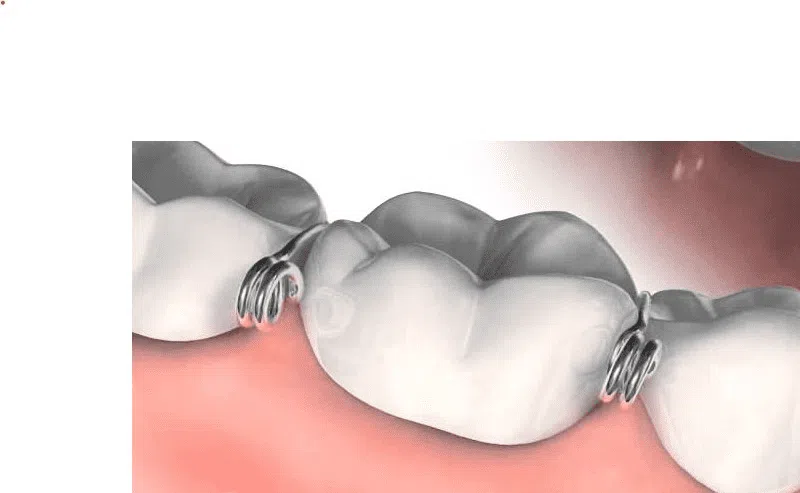
Spacers for teeth, also called orthodontic separators, are small rubber rings or metal spring clips, roughly 1 to 2 millimeters thick, that push two molars slightly apart so a metal band can be seated around the tooth. They go in about 5 to 10 days before banding and come out at the next visit.
The part most Austin patients are surprised by: standard bracket-and-wire braces almost never require spacers at all. Separators are reserved for banded appliances such as a palatal expander, a Herbst, or a quad-helix.
If a treatment plan is straight brackets and a wire, the molar attachment is bonded directly to the tooth rather than banded around it, so there is nothing to separate and no spacer appointment. That single distinction, banding versus bonding, decides who needs spacers and who never sees one.
“The belief that every braces case starts with spacers is a holdover from older banding protocols, when every molar got a metal band,” says Dr. Rodrigo Viecilli, ABO Diplomate and PhD in orthodontic biomechanics. “Bonded tubes changed that.
In a typical bracket-and-wire case at Limestone Hills, the molar attachment is glued directly to the tooth, so there is nothing to separate for. The patients who do need spacers are the ones getting a banded appliance, and that is a smaller group than most people expect.”
Surveys of specialist orthodontists confirm the shift: bonded molar tubes are now used by the large majority of practices precisely because they remove the separation step. So the honest answer to whether a patient needs spacers is usually that it depends on whether the plan includes a banded appliance, which is a diagnostic decision, not a default routine.
When Spacers Are Needed and When They Are Not
This is the question that matters most, so it deserves a direct answer. Spacers are needed only when the treatment plan calls for a metal band on a molar. In modern practice that means a banded appliance: a rapid palatal expander, a quad-helix, a Herbst, or a similar fixed device that anchors to banded molars.
Standard braces are different. The molar tube on bracket-and-wire treatment is bonded straight onto the enamel with adhesive, the same way the brackets on the front teeth are. Nothing wraps around the tooth, so nothing has to be separated first. That single change is why the spacer step disappeared for most patients.
| Treatment | Molar attachment | Spacers needed? |
|---|---|---|
| Standard metal or clear braces | Bonded tube glued to the tooth | No, in almost all cases |
| Palatal expander | Banded molars anchor the appliance | Yes, usually |
| Herbst or quad-helix | Banded molars carry the mechanics | Yes, usually |
| Clear aligners | No bands or bonded tubes | No |
So the next time someone mentions that braces “always start with painful spacers,” the accurate response is that this depends entirely on whether a banded appliance is part of the plan. For a large share of patients, it is not.
Why does the difference exist at all? A band has to fully encircle the molar, so the tooth has to be slightly separated from its neighbor for the band to pass through the contact and seat at the gumline. A bonded tube sits flat on the outer surface of the tooth and is held by adhesive, so the contact between teeth is never disturbed.
Early adhesives were not strong enough to trust on a hard-working molar, which is the historical reason banding was once routine. Adhesive chemistry caught up, bonded tubes became reliable, and the separation appointment stopped being a standard step for ordinary braces. It survives mainly for the banded appliances where a ring of metal still does a job adhesive cannot.
When Separators Go In and How Long They Stay
Separators are placed at a short appointment roughly 5 to 10 days before the banding visit. The window matters: too little time and the space has not opened; the planned gap stays open just long enough for the band to seat cleanly. The team picks the spacing appointment so the band visit lands right after the teeth have moved enough.
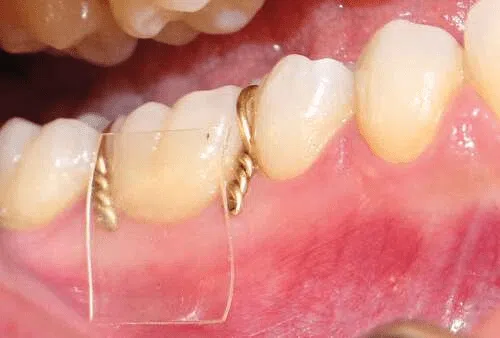
Placement takes only a few minutes per separator and is not painful at the time. An elastic ring is stretched with a small forked tool and slipped into the contact; a spring separator is hooked into place. The pressure builds over the next several hours rather than at the chair, so patients usually leave the spacing appointment feeling fine and notice the tightness later that day.
At the band appointment the separators come out in seconds, and that removal is essentially painless because the space they created relieves the pressure immediately. The teeth drift back together within days once the band or appliance is holding the new position, so the opened gap is temporary and closes on its own after it has served its purpose.
What Spacers Feel Like, Honestly
Patients describe heavy, steady pressure between the back teeth, like a piece of food stuck firmly that will not budge. It is an ache, not a sharp pain. Peer-reviewed comparisons of separator types report that discomfort is strongest on the first and second day, then tapers off, with most people barely noticing the separators by the end of the first week.
Here is a candid point Limestone Hills makes up front: the soreness is real, and it tends to peak before it improves. Knowing the curve helps. The worst is day one and two, the bite feels tender when chewing, and then it eases on its own. Expecting that pattern is far better than being surprised by it.
Eating and Caring for Teeth With Spacers In
Two rules cover most of it: keep food soft, and keep food off the spacers. Sticky and chewy items are the real enemy because they grab a separator and pull it out of place. Soft, cool foods also calm the early tenderness.
What to favor and what to skip
- Favor: yogurt, smoothies, soup, mashed potatoes, eggs, pasta, soft fruit, and other foods that need little chewing.
- Skip: gum, taffy, caramel, sticky candy, chewy bread, and anything that clings to the back teeth and can drag a separator loose.
Brushing continues normally, just gently around the molars. The one change is flossing: do not run floss through the spacer site, because the floss can lift the separator straight out. Floss the rest of the mouth as usual and leave the separator contacts alone until the band appointment.
What to Do if a Spacer Falls Out
Separators do come loose sometimes, and the reason is often a good one. Once the teeth have moved enough, the space is open and the separator has finished its job, so it can slip out near the end of its window without anything being wrong. The practice wants to know either way, but it is not always an emergency.
Use this rule of thumb, then call so the team can confirm:
- If a separator comes out within a day or two of placement, the space has not opened yet and it usually needs replacing. Call the office.
- If it falls out close to the banding appointment, the job may already be done. Call so the team can verify before the visit.
- If several come out, or the bite suddenly feels different, call promptly so the appliance plan stays on schedule.
Knowing which situation applies is exactly the kind of judgment a patient should not have to make alone, which is why the Limestone Hills team would rather field the call than have a patient guess.
Managing the Soreness
For most patients the discomfort is mild and short. An over-the-counter pain reliever such as ibuprofen or acetaminophen, taken per the label, covers the worst of the first day or two. Soft, cool foods during that same window reduce chewing pressure on tender molars.
What is normal: steady ache, tenderness when biting, the sense of something wedged between the back teeth, easing within a few days. What warrants a call: sharp or escalating pain, a separator that has clearly fallen out, or soreness that is not improving after several days. Limestone Hills tells every patient that line up front so the difference between normal and not is never a guessing game.
Spacers and Banded Appliances in Austin and the Hill Country
Limestone Hills Orthodontics treats patients across Austin and the surrounding Hill Country, including Lakeway, Bee Cave, Westlake, Cedar Park, Round Rock, and Steiner Ranch. Because separators are tied to banded appliances rather than to braces in general, most Austin families in standard treatment never deal with them at all.
For the patients who do get a banded expander or similar appliance, the spacer week is brief and predictable. Dr. Viecilli schedules a short check-in around banding so the office can confirm the separators did their job and the appliance seats correctly, which keeps the timeline tight whether a family is driving in from Round Rock or a few minutes away in central Austin.
Common Questions About Spacers
What does a spacer do for teeth?
A spacer, also called an orthodontic separator, gently pushes two molars apart to open about 1 to 2 millimeters of space. That space lets the orthodontist seat a metal band fully around the molar. Spacers are only used in cases that need molar bands, such as a palatal expander, a Herbst appliance, or a quad-helix. Most patients in standard bracket-and-wire braces never need a spacer because the molar attachment is bonded directly to the tooth instead of banded.
How long do teeth spacers stay in?
Separators usually stay in for about 5 to 10 days. That is enough time for the molars to move slightly apart and create room for the band. They are placed at one short appointment and removed at the next, when the band or appliance is fitted. If a spacer is in for longer than the orthodontist planned, the office should be called so the next visit can be scheduled.
How painful is a spacer?
Spacers feel like firm, steady pressure rather than sharp pain. Soreness is strongest on day one and two, then fades, and most people barely notice them by the end of the first week. The feeling is similar to having something stuck between the back teeth that will not come out. An over-the-counter pain reliever such as ibuprofen or acetaminophen and a few days of soft food handle it well for most patients.
Can you eat with spacers in?
Yes. Soft, non-sticky foods are best while spacers are in place. Patients should avoid gum, taffy, caramel, and other sticky or chewy foods that can pull a spacer loose. Flossing directly at the spacer site should be skipped because the floss can lift the separator out. Brushing continues as normal, just gently around the back teeth.
What happens if a spacer falls out?
A spacer sometimes works its way out on its own once the teeth have moved enough, and that can be a normal sign rather than an emergency. The office should still be called so the team can decide whether it needs to be replaced before the next appointment. If several fall out, or one comes out within a day of placement, replacement is usually needed to keep the space open for the band.
Sources. American Association of Orthodontists, patient resources on appliances and separators; Nationwide Children’s Hospital, “Dental: Wearing Separators” patient instructions (foods to avoid, flossing precaution, OTC analgesic guidance); Assessment of separation impact and perception of discomfort on various orthodontic separators, comparative clinical study, PMC8375918; Comparison between efficacy of four different types of orthodontic separators, PMC4190792; Bonded molar tubes, a survey of their use by specialist orthodontists, PubMed 22773677; Role of direct bonding molar tubes in fixed appliances, PMC5529802.
Clinical observations from Limestone Hills Orthodontics, Austin, TX.