
Dentofacial orthopedics is the branch of orthodontics that guides how the jaws and face grow, distinct from tooth-only orthodontics, which aligns teeth within jaws already set. It uses appliances during a child’s active growth to change the size or relationship of the upper and lower jaws, and the treatment window is finite.
The American Association of Orthodontists recommends a first evaluation by age 7 so an Austin orthodontist can catch skeletal problems while growth can still be guided, before the same case needs jaw surgery.
Dr. Viecilli holds a PhD in orthodontic biomechanics from Indiana University and 27 peer-reviewed publications on how orthodontic and orthopedic forces translate into bone response. His framing: dentofacial orthopedics is growth modification, guiding how the jaws and face develop. It is a different problem from tooth-only orthodontics, which aligns teeth within jaws already set.
The consequence of that distinction is timing. The window for guiding skeletal growth is tied to the patient’s own development, and it closes. A transverse deficiency or a retrusive jaw caught while a child is growing is a growth-modification case; the same problem caught after suture maturation is a surgical case or a dental compromise.
That is why Dr. Viecilli evaluates around age 7 for problems that are skeletal, not dental. The evaluation is assessment, not automatic treatment. Most children seen at that age need nothing yet, and he says so plainly.
What Dentofacial Orthopedics Means
The official dental specialty recognized by the American Dental Association is named Orthodontics and Dentofacial Orthopedics. It is the only dental specialty whose definition addresses the diagnosis, prevention, interception, and correction of skeletal and neuromuscular abnormalities of the developing or mature orofacial structures, not just the alignment of teeth.
The orthopedics half is the part the public hears least about. Orthopedics concerns bone; dentofacial orthopedics concerns the bones of the face and jaws, guiding how they grow. It is what an orthodontist does when the problem is the size or position of a jaw, not a tooth inside a normal jaw. Every board-certified orthodontist is trained in both halves, because real cases routinely require both.
Orthopedics Versus Orthodontics: The Distinction That Decides the Treatment
The clearest contrast between the two is one variable: what physically moves.
Tooth-only orthodontics moves teeth within the bone that already exists. The alveolar bone holding the tooth roots remodels as a tooth is guided into position, but the jaw itself does not change in size or position. Crowded, spaced, or rotated teeth in a jaw of normal size are a dental problem solved this way.
Dentofacial orthopedics changes the bone itself. An appliance applies force across a growth site, and the jaw grows differently than it would have. A palatal expander separating the upper jaw at the midpalatal suture is orthopedic; so is a functional appliance posturing the lower jaw forward to influence mandibular growth. The skeletal change is real and durable once growth completes.
Many cases combine both: orthopedic expansion of a narrow upper jaw first, then conventional alignment of the teeth in the wider arch. The distinction matters to a parent because the orthopedic half has a finite window and the orthodontic half does not.
Skeletal Discrepancy Versus Dental Discrepancy
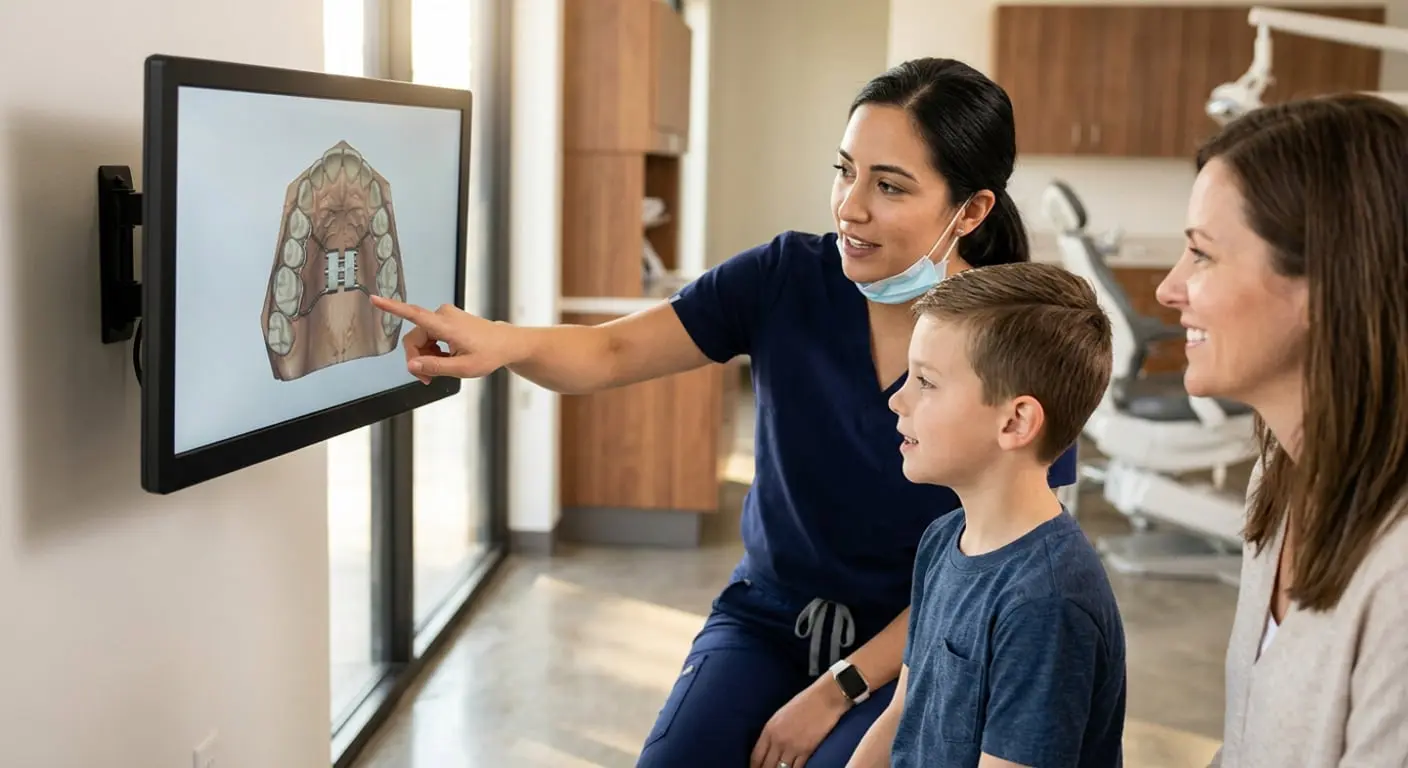
The single most important question at a consultation for a growing child is whether the problem is skeletal or dental. The answer determines the appliance and the timing.
A dental discrepancy is a problem with the teeth in jaws of acceptable size and relationship. The jaws fit together correctly; the teeth within them are crowded, spaced, tipped, or rotated. These cases are treated with conventional orthodontics and, for most children, can wait until the permanent teeth are in.
A skeletal discrepancy is a problem with the jaws themselves: an upper jaw too narrow for the lower, a lower jaw set too far back or too far forward, an excessive vertical face dimension. Tilting teeth can mask these but cannot correct them. The only treatments that address the skeletal cause directly are growth modification during growth and jaw surgery after it.
A 3D CBCT scan plus a clinical exam separates the two reliably, answering whether what looks like crowding is actually a too-narrow jaw, whether a deep bite is a skeletal mismatch, and whether growth potential remains. That separation is the point of an evaluation around age 7.
Conditions Dentofacial Orthopedics Addresses
The conditions appropriate for orthopedic treatment share one feature: the cause is the bone, not the tooth.
- Narrow upper jaw with posterior crossbite. When the upper jaw is too narrow, the upper back teeth bite inside the lower back teeth. In a growing child the jaw can be widened skeletally at the midpalatal suture. The same crossbite with normal jaw width is dental; the crossbite overview covers the split.
- Transverse deficiency. A constricted upper arch that crowds the teeth and narrows the smile, even without an obvious crossbite, can be a skeletal deficiency. Orthopedic expansion creates arch width by separating the bone, not by tipping teeth.
- Retrusive lower jaw (skeletal Class II). A lower jaw set too far back, often perceived as a deep overbite or a weak chin, can be guided forward with a functional appliance during the growth spurt. The skeletal effect is more modest than surgery produces in an adult, but real while growth remains.
- Protrusive lower jaw or deficient midface (skeletal Class III). An underbite where the lower jaw sits in front of the upper can sometimes be influenced early with a protraction facemask while skeletal sutures are still responsive.
- Some open bites and airway-related transverse problems. An open bite with a skeletal vertical component, or a narrow upper jaw that also constricts the nasal floor, can have an orthopedic dimension. The airway-focused orthodontics overview covers airway evaluation; the point here is that some of these problems are skeletal and growth-window dependent.
The Appliances, Conceptually
Orthopedic appliances all do the same thing: deliver force across a growth site so the bone develops differently. Each targets a distinct skeletal problem, as the table summarizes.
| Appliance | Skeletal Target | What It Does, Conceptually |
|---|---|---|
| Palatal expander | Narrow upper jaw, transverse deficiency | Produces tension at the midpalatal suture so the two halves of the upper jaw separate, widening the arch through bone, not tooth tipping. |
| Functional appliance (Herbst, MARA) | Retrusive lower jaw (skeletal Class II) | Postures the lower jaw forward during the growth spurt to influence the direction and amount of mandibular growth. |
| Headgear | Excess forward upper-jaw growth | Applies a restraining force that slows forward growth of the upper jaw and upper teeth while the lower jaw catches up. |
| Protraction facemask | Deficient or retruded upper jaw (skeletal Class III) | Pulls the upper jaw forward while skeletal sutures remain responsive in younger children. |
| Chin cup | Excess forward lower-jaw growth | Directs a restraining force on the lower jaw to influence its growth direction in select Class III patterns. |
Expander mechanics, retention, and timeline are covered in the palatal expander overview. Every device in the table acts on growing bone, which is why each has a window.
Why the Treatment Window Is Tied to Growth
Orthopedic appliances work because growing bone responds to sustained force at a growth site. When growth slows and growth sites mature, the same force produces tooth movement instead of bone change. The window is not a marketing construct; it is the biology of the tissue.
The clearest example is the upper jaw. Its two halves are joined at the midpalatal suture. While that suture is immature, a palatal expander separates the halves and the body fills the gap with new bone. As the suture matures and interlocks, the same expander can no longer separate it predictably.
Published cone-beam research describes the suture progressing through maturation stages, with skeletal expansion generally reliable into the early-to-mid teens and less predictable thereafter, earlier on average in girls than boys. Once the suture is fused, opening the upper jaw requires a surgical or miniscrew-assisted approach.
Functional appliances follow the same logic on a different timeline, working best around the pubertal growth spurt when mandibular growth velocity is highest. Headgear and facemask therapy likewise depend on remaining growth. The orthopedic effect rides on growth and is available only while growth is happening.
This is the practical reason the AAO recommends a first orthodontic evaluation by age 7. At that age a child is in the mixed dentition, and an orthodontist can read jaw development before any window has closed. The evaluation identifies whether a skeletal problem exists that should be treated during growth, or whether the case is dental and can wait.
How This Connects to Phase 1 Treatment
Phase 1 treatment is the clinical setting where most dentofacial orthopedics happens. It is an early, limited course of treatment in a child who still has a mix of baby and permanent teeth, used to address a skeletal problem during the growth window before a later phase aligns the full permanent dentition.
Not every Phase 1 case is orthopedic, and not every orthopedic case is labeled Phase 1, but the overlap is large. The decision is not whether early treatment is good in the abstract; it is whether this child has a skeletal component that benefits from the growth window, weighed against a longer overall treatment span. The Phase 1 treatment overview covers indications and the two-phase trade-off.
What Happens When the Window Is Missed
A skeletal problem does not resolve on its own when the growth window closes. It persists, and the options narrow to two: surgery, or compromise.
- Orthognathic jaw surgery repositions the bone directly. A transverse deficiency that could have been expanded at age 9 may need a surgically assisted expansion in an adult. A severe skeletal Class II or III may need a jaw-repositioning procedure. The surgical orthodontics overview covers the workflow and combined-fee structure.
- Dental compromise means tilting teeth to mask a skeletal mismatch the surgery is not chosen to fix. The bite can be made to function, but the skeletal discrepancy remains. For some adults a compromise is the right choice given their goals and the surgical trade-offs; the honest framing is that it is a compromise.
Neither outcome is a failure of the patient or the family. Many skeletal problems are subtle at age 7 and become obvious only later, and many families never had the early evaluation that would have flagged the case. The distinction matters so parents understand that a problem caught during growth, and the same problem caught after it, are not the same treatment.
A Candid Word on the Age 7 Evaluation
The growth window is real and finite, and that fact is sometimes used to push early treatment a child does not need. Dr. Viecilli separates the two clearly. The recommended evaluation around age 7 is an assessment, not a treatment commitment, meant to find the small number of children with a skeletal problem that should be treated during growth.
Most children evaluated at that age need nothing yet. The correct outcome of a great many age 7 evaluations is observation: a record taken, a recall scheduled, no appliance. A recommendation to wait is a legitimate and common result, not a missed opportunity. The value is the screening, not a guarantee of treatment.
Dentofacial Orthopedics for Austin and the Hill Country
Families across the Austin metro arrive at Limestone Hills Orthodontics with a child whose dentist mentioned a narrow jaw, a crossbite, or a bite that “looks off,” and a reasonable question about whether anything needs to happen now. The skeletal-versus-dental distinction is exactly what the consultation answers.
Parents commuting in from Lakeway, Cedar Park, Round Rock, Bee Cave, Westlake, and Steiner Ranch get a clinical exam, a 3D CBCT scan, and a written assessment of whether the case has a skeletal component tied to the growth window or is purely dental and can wait.
For Austin-area children with a genuine skeletal problem, acting during the growth window is concrete: an expansion or functional-appliance phase done while growth remains can replace a surgical or compromise case later. For the larger group whose evaluation shows a dental problem or nothing yet, the honest answer is to monitor and recall.
Dr. Viecilli writes the recommendation, treat now or observe, into the plan at the consultation, before any financial commitment, so Hill Country families decide with the skeletal facts in front of them.
Common Questions About Dentofacial Orthopedics
What is dentofacial orthopedics?
Dentofacial orthopedics is the branch of orthodontics that guides how the jaws and face develop, rather than only aligning teeth within jaws that are already set. The official dental specialty recognized by the American Dental Association is named Orthodontics and Dentofacial Orthopedics, and it is the only specialty whose definition addresses skeletal and neuromuscular abnormalities of the developing or mature orofacial structures, not just the teeth. In practice it means using appliances during a child’s active growth to change the size, position, or relationship of the upper and lower jaws.
What is the difference between orthodontics and dentofacial orthopedics?
Tooth-only orthodontics moves teeth within the bone that already exists. The jaws do not change; the teeth are aligned inside them. Dentofacial orthopedics changes the bone itself by influencing jaw growth while the patient is still growing. A palatal expander opening the midpalatal suture is orthopedic. Brackets and wires straightening crowded teeth are orthodontic. The same orthodontist does both, and many cases combine them, but the mechanisms and the available treatment windows are different.
At what age does dentofacial orthopedics work?
The treatment window is tied to skeletal growth, not a fixed age. The American Association of Orthodontists recommends a first orthodontic evaluation by age 7, when an orthodontist can see jaw development and emerging permanent teeth in the mixed dentition. Functional appliances that influence lower-jaw growth work best around the adolescent growth spurt. Skeletal upper-jaw expansion through the midpalatal suture is generally reliable into the early-to-mid teens and becomes less predictable as the suture matures, after which surgical or miniscrew-assisted expansion is required.
What conditions does dentofacial orthopedics treat?
It addresses problems that are skeletal rather than purely dental: a narrow upper jaw causing a posterior crossbite, a transverse deficiency that constricts the arch, a lower jaw set too far back (skeletal Class II), a lower jaw or midface positioned forward (skeletal Class III), some open bites with a skeletal vertical component, and transverse problems that also narrow the airway. Crowded or rotated teeth in jaws of normal size and position are dental problems treated with conventional orthodontics, not orthopedics.
What happens if the growth window is missed?
A skeletal problem that could have been guided during growth does not disappear when the window closes; it becomes harder to treat. After growth and suture maturation, the same correction usually requires orthognathic jaw surgery or a dental compromise that tilts teeth to mask the skeletal mismatch without correcting it. This is why Dr. Viecilli recommends a skeletal evaluation around age 7 for problems that are skeletal in nature, even though most children evaluated early do not need any treatment yet.
Sources. American Dental Association, National Commission on Recognition of Dental Specialties and Certifying Boards, recognized definition of the specialty of Orthodontics and Dentofacial Orthopedics (ada.org). American Association of Orthodontists, consumer guidance on the recommended age 7 evaluation and growth modification (aaoinfo.org).
Angelieri F., Cevidanes L.H.S., Franchi L., et al., “Midpalatal suture maturation: classification method for individual assessment before rapid maxillary expansion,” American Journal of Orthodontics and Dentofacial Orthopedics.
Proffit W., Fields H., Larson B., Sarver D., “Contemporary Orthodontics,” chapters on growth modification and treatment timing (Elsevier). McNamara J.A., “Components of Class II malocclusion in children 8 to 10 years of age,” Angle Orthodontist. Clinical observations and case records from Limestone Hills Orthodontics, Austin, TX.